

Ag Policy Blog
USDA's Competitive CRP Enrollment Adds 1.5 Million New Acres
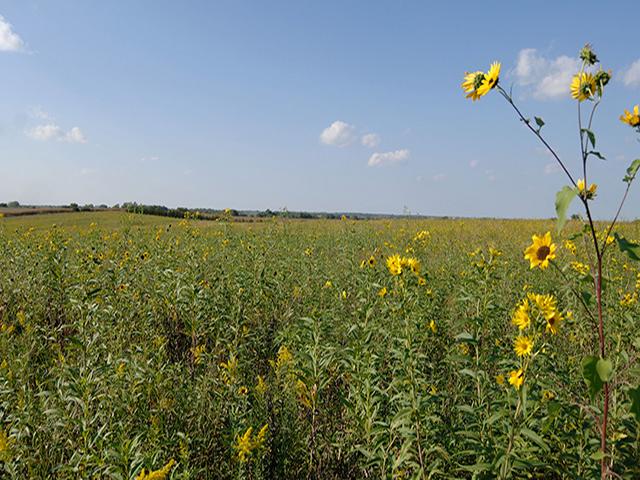
WASHINGTON (DTN) -- The U.S. Department of Agriculture accepted more than 2.2 million acres into the Conservation Reserve Program (CRP) for fiscal year 2026 following what the agency described as a highly competitive enrollment period.
This spring, producers submitted nearly 2.5 million acres for consideration under General, Grassland and Continuous CRP sign-ups.
Nearly 1.5 million acres of CRP are set to expire on Sept. 30. Producers submitted offers to re-enroll 982,000 of those acres, while another 1.5 million acres were offered for new enrollment.
"For more than 40 years, CRP has been a cornerstone of the farm safety net, helping producers manage risk while delivering unmatched benefits for wildlife habitat, soil health and water quality," said Andrew Schmidt, director of government affairs for Pheasants Forever and Quail Forever.
FSA Administrator Bill Beam said the strong interest demonstrated producers' continued commitment to conservation. "The success of the 2026 enrollment period reflects USDA's Farmers First commitment and the dedication of America's farmers and ranchers to protecting our natural resources," Beam said.
According to the Nebraska Center for Agriculture Profitability, CRP enrollment peaked at more than 36 million acres in 2007 before steadily declining through 2021 before Congress raised the acreage cap in recent years.
The program currently remains capped at 27 million acres, authorized in the stalled farm bill 2.0 debate. Lawmakers in both House and Senate proposals have generally sought to keep conservation spending budget neutral, making a significant acreage expansion unlikely.
P[L1] D[0x0] M[300x250] OOP[F] ADUNIT[] T[]
TOP CRP STATES
As of January 2026, Nebraska, Colorado and South Dakota ranked as the three largest CRP states by enrolled acreage.
-- Colorado: 3.11 million acres; average annual rental payment of $23.31 per acre.
-- South Dakota: 2.75 million acres; average annual rental payment of $53.41 per acre.
-- Nebraska: 2.50 million acres; average annual rental payment of $38.45 per acre.
General CRP enrollment is conducted through a competitive bidding process in which offers are ranked according to an Environmental Benefits Index that evaluates wildlife habitat, water quality, soil erosion reduction and other conservation outcomes.
Continuous CRP generally enrolls smaller, environmentally sensitive tracts, including wetlands, riparian buffers and wildlife habitat. Participants receive annual rental payments and cost-share assistance, with additional incentives available through initiatives such as Clean Lakes, Estuaries and Rivers (CLEAR) and State Acres for Wildlife Enhancement (SAFE).
Earlier this year, Jonathan Coppess, director of the Gardner Agriculture Policy Program at the University of Illinois, said a prolonged downturn in the farm economy could make CRP more attractive to producers.
"History teaches that farmers under economic and market stress tend toward overproduction, usually at the worst possible time," Coppess said in February. "It is here that CRP could be particularly useful and beneficial in these uncertain, chaotic times."
He added the program can provide producers with "an off-ramp from the downhill descent of overproduction."
See USDA's press release: https://www.fsa.usda.gov/….
See the Nebraska Center for Agriculture Profitability article on the "Future CRP Enrollments Dependent on Farm Bill Reauthorization," at https://cap.unl.edu/….
Jake Zajkowski can be reached at jake.zajkowski@dtn.com
Follow him on social platform X @jzajkow
(c) Copyright 2026 DTN, LLC. All rights reserved.
Comments
To comment, please Log In or Join our Community .