


Production Blog
Check Ears and Pods for Prospects
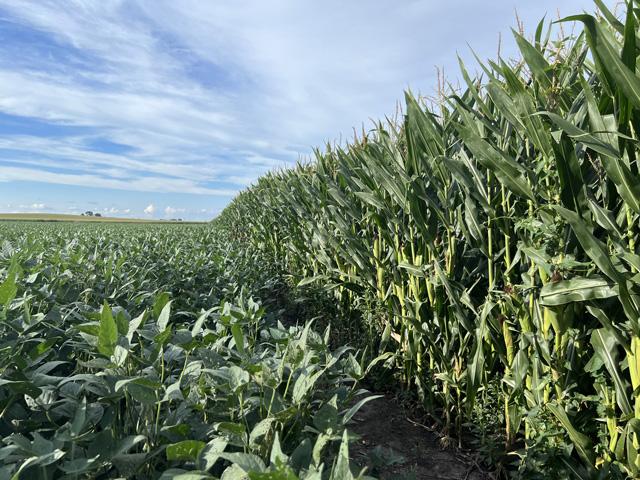
Walking fields this week in central Illinois, I could find corn fields nearing black layer and others still going through pollination. I found soybeans filling pods and others still in full flower. We've had just about every imaginable weather condition this season.
Harvest yield checks do more than estimate the size of the crop. They give you a boots-on-the-ground look at everything -- from how long it will be before we nose combines into fields to whether or not that date needs pushed forward to avoid stalk and standability issues.
AgriGold field agronomists provided the following observations from the season and what it means to crop prospects across the Corn Belt.
HEAT AND DRYNESS TEST NEBRASKA CROPS
It was very dry during the planting season across most of eastern Nebraska where Mark Grundmayer works as a field agronomist.
"There were farmers who had to irrigate their crop up, irrigate fertilizer in and irrigate herbicide in," said Grundmayer. The early heat and dryness turned the ground rock-hard, causing some issues with stand establishment. Grundmayer recalls three separate times when it was so dry that farmers were about to give up, and then, rain would come just in the nick of time.
Erratic emergence patterns showed up across the state as corn started to tassel. There was also plenty of late-July heat and questions about the toll that took, particularly on sandy dryland acres.
On the flip side, there's been very little disease or insect pressure to date. "Southern rust and tar spot are still fresh in farmers' minds after last year, and planes started flying mid-July," Grundmayer reported. Scouting remains important for these fast-moving diseases. Growers need to weigh disease pressure, corn growth stage and weather outlook before making additional fungicide decisions.
Grundmayer said corn in his territory appears to have the fertility it needs to finish strong, but the wild card will always be Mother Nature. "If we get favorable growing conditions until black layer, we'll be in good shape," he predicted. If hybrids have what they need to flex kernel depth, that could help offset some thinner stands.
Soybean crop prospects also look good if August weather cooperates, Grundmayer said. He encourages farmers with irrigation to stay ahead of soybeans' peak water demand this month.
P[L1] D[0x0] M[300x250] OOP[F] ADUNIT[] T[]
Soybean insects are starting to show up in the form of tent caterpillars and thistle caterpillars.
"Hopefully, the second generation of bean leaf beetles will be limited. We've also seen a few Japanese beetles in both corn and soybeans," he said.
OHIO AND INDIANA CORN SEARCHES FOR A STRONG FINISH
The growing season got off to a strong start in the far eastern Corn Belt states of Ohio and Indiana, but cool, wet weather moved in, slowing crop development and leading to replants in some areas, said AgriGold Field Agronomist Derrek Barnes.
"The crop looks pretty good given everything it's been through," he said, noting though that there are wet holes and unevenness that aren't readily apparent.
Much of the heavy rain preceded side dressing. Even so, Barnes is concerned the corn crop could run out of nitrogen.
"When you split the stalks, you can see some of the stress. It just doesn't have the reserves we'd hope for," Barnes said. "Corn has the opportunity to finish strong, but we'll need to protect the crop." Some gray leaf spot and tar spot have started to show up in corn.
Barnes noted that soybean fields are generally clean and look to have good potential, particularly if August delivers some rainfall. Watch for septoria brown spot and frogeye leaf spot.
"Some farmers are going to have some of the best yields they've ever had," Barnes said. "But there are also going to be a lot of farmers with average to poor crops."
VIEWS FROM MISSOURI AND ILLINOIS
"It's been the year of extremes," said Brett Leahr, AgriGold field agronomist covering eastern Missouri and western Illinois.
This has been a long, crazy season for Missouri farmers, according to Leahr. Conditions were ideal in Missouri during late March, and crops were planted fast. Then, rain and cool temperatures moved in.
"This led to replant after replant after replant for some farmers and slowed everything down," Leahr said. Southern Illinois experienced a similar pattern, with a strong start followed by a month of rain. Conditions have been better farther north in the state, he observed.
"Now, a lot of that early wet weather is showing its effects," Leahr said, pointing to signs of nutrient deficiencies such as leaf firing, along with diseases such as gray leaf spot, southern rust and a bit of tar spot. Given how wet it has been, many were surprised disease pressure didn't emerge sooner. Still, farmers have been proactive with fungicide applications.
Overall, the crops look good, despite the challenges, Leahr said. Early saturation limited root development, and he's also concerned crops could run out of nitrogen by the end of the season. Other problems he's watching for are increased crown rot and seedling disease in corn.
Soybeans look great now, but they also stagnated for a stretch amid wet weather and limited growing degree unit (GDU) accumulation early, he noted.
"Soybeans have a lot of potential, but they'll need August rains to finish strong," Leahr said. He also warned that early wetness could lead to red crown rot and sudden death syndrome (SDS) in soybeans. He also urged farmers to watch for stink bugs that can ding soybeans late season.
Learn more about black layer and dry matter in "Corn Black Layer Sends a Signal About Building Dry Matter," https://www.dtnpf.com/….
Find all the coverage from DTN's Digital Yield Tour here: https://www.dtnpf.com/….
Pamela Smith can be reached at pamela.smith@dtn.com
Follow her on social platform X @PamSmithDTN
(c) Copyright 2026 DTN, LLC. All rights reserved.
Comments
To comment, please Log In or Join our Community .