

MachineryLink
Severe G4 Geomagnetic Storm Watch Issued, Auroras May be Seen as Far South as Alabama
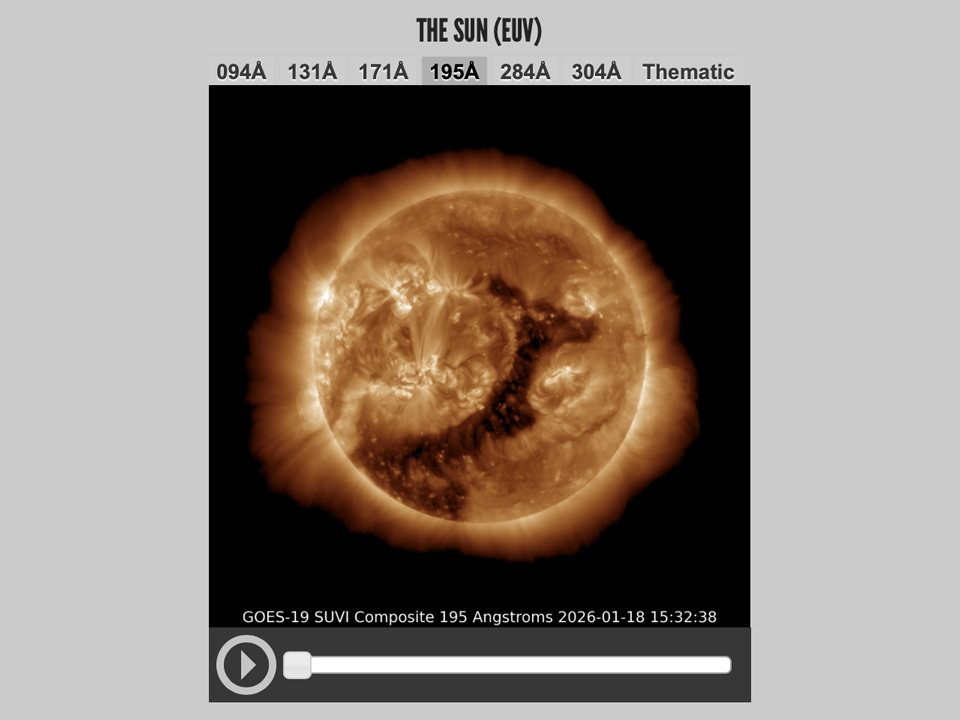
The Space Weather Prediction Center (SWPC) has issued a very rare G4 (severe) geomagnetic storm watch for Jan. 20 UTC, the result of a coronal mass ejection (CME) that left the sun on Jan. 18. This CME is associated with a X1.9 solar flare and is anticipated to arrive at Earth as early as late Jan. 19 (EST) to early Jan. 20.
Flares happen when the powerful magnetic fields in and around the sun reconnect. They're usually associated with active regions, often seen as sunspots, where the magnetic fields are strongest. Flares are classified according to their strength. The smallest ones are B-class, followed by C, M and X, the largest. Similar to the Richter scale for earthquakes, each letter represents a 10-fold increase in energy output. So, an X is 10 times an M and 100 times a C. The X1.9 reported by the SWPC is at the lower end of the X scale.
"Detrimental impacts to some of our critical infrastructure technology are possible, but mitigation is possible," the SWPC stated. The public can visit the SWPC webpage at: https://www.swpc.noaa.gov/… for up-to-date information.
A G4 geomagnetic storm may degrade satellite navigation for some hours and disrupt low-frequency radio navigation. But given this is January and not the middle of spring planting for example, this storm if it arrives will have negligible effect on U.S. farms.
Along with this storm, auroras may become visible over much of the northern half of the U.S., perhaps as far south as Alabama to northern California.
A look at recent history shows the impact of this storm could well be more significant during the crop season. On May 10, 2024, a powerful geomagnetic storm affected the U.S., at that point, smack in the middle of planting.
The Kansas State University Research and Extension News Service published a release about that event.
That storm came to be called the Gannon Storm. It caused "mass global navigation satellite system outages ... leading to an assumed $565 million in losses for Midwestern crop producers," the K-State release reported.
P[L1] D[0x0] M[300x250] OOP[F] ADUNIT[] T[]
The sun is the main source of space weather. Radio emissions, coronal mass ejections (CMEs), and solar flares are some of the causes of geomagnetic storms.
Radio frequency disrupting flares reach Earth at the speed of light. CMEs travel more slowly, taking one to five days to reach Earth. Both can disrupt communications, the power grid, navigation, radio and satellite operations for minutes, to hours or days at a time.
A complete loss of signal lock by the GPS receiver due to extreme noise from the upper atmosphere (primarily nighttime) can result in no location data for an interval of time. Noise introduced by the upper atmosphere also could have induced errors in the calculated position.
Storms are more common during solar maximums. The peak of sunspot activity is known as a solar maximum. The lull is known as solar minimum. Maximums and minimums occur on average in 11-year cycles.
NASA and NOAA officially announced that the sun entered the solar maximum period around 2024. Solar Cycle 25, as it is known, has shown elevated sunspot counts and activity. NASA said data suggest the peak likely occurred around late 2024 to mid-2025.
Like a thunderstorm, farmers can only manage their systems through GPS-battering geomagnetic storms. Newer positioning systems that lock onto multiple satellite constellations are little or not affected by solar storms.
With older navigation systems, farmers may bring a stop to fieldwork and wait for the storm to pass, often in hours. Or you could, like grandpa did, grab the steering wheel and just plow through, accepting crooked rows and any planting and data collection inaccuracies that follow.
But without GPS, the as-planted data (as-sprayed, as-fertilized) cannot be logged onto a map or georeferenced. This isn't just a negative result for farm operator. Seed suppliers and local agronomists rely upon these data for upstream use.
Here are specific actions you can take.
-- Understand what part of any equipment or data system relies on GPS or radio frequencies (RF), and how resilient that equipment is to RF/GPS noise. Are your GPS receivers single or dual frequency receivers? Single frequency receivers are more susceptible to space weather.
-- Have a short-term local data backup system. Similar to a commercial security system that records everything and then deletes it after a certain time period, data would go to both the cloud and a short-term, local backup system that could be recovered if the connection to the cloud is compromised.
-- Sign up for space weather alerts/watches/warnings at the NOAA Space Weather Prediction Center. https://www.swpc.noaa.gov/… or just to www.swpc.noaa.gov.
-- If an issue is noticed with the GPS systems, look at the NOAA alerts or the Navigation Centers civilian GPS outage reports (https://www.navcen.uscg.gov/…) to determine whether the source is environmental or a hardware problem.
-- If there is elevated space weather, and local hardware issues have been ruled out, report outage to the Navigation Center through the on-line reporting: https://www.navcen.uscg.gov/….
It is important that the nation has a good understanding of how space weather affects users.
Dan Miller can be reached at dan.miller@dtn.com
Follow him on social platform X @DMillerPF
(c) Copyright 2026 DTN, LLC. All rights reserved.
Comments
To comment, please Log In or Join our Community .