


Canada Markets
Energy Price Break in December May Present Opportunity
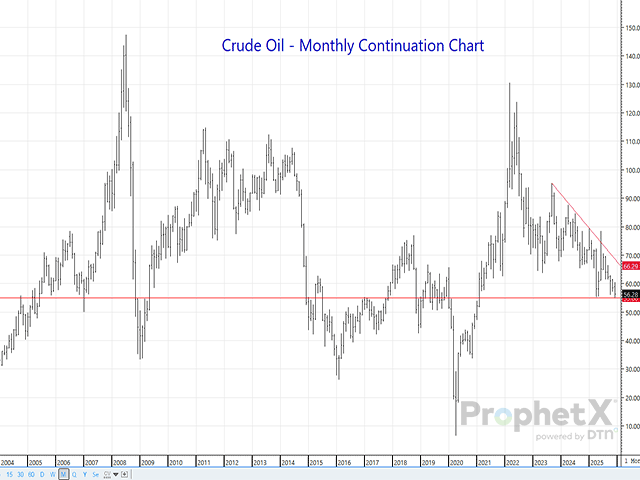
Weakness in energy markets in December may have been welcome news to President Trump based on his promise to lower fuel costs, but it has been anything but welcome for producers or grain and oilseed bulls. With the break showing signs of ending, it may be time to protect against higher fuel costs and look for a bounce in row-crop markets.
As you can see from the accompanying chart, crude oil prices fell to levels not seen since early 2021 with gasoline doing the same and ultra-low sulfur diesel not far off. With the price break based on what could be unrealistic optimism over an end to the war in Ukraine (and resulting return of Russian oil to the world market), there are plenty of reasons to suspect long-term support at $55/barrel for crude oil should hold with a bounce to follow.
The common explanation for the recent price break was expectations that the war in Ukraine was coming to an end thanks to the proposed peace plan. All the while ignoring the fact that 27 out of 28 points don't matter if Russia refuses to retreat from Ukraine territory it controls (and also wants to be granted territory Ukraine controls) and Ukraine refuses to give up any of its country. With the European Union firmly backing Ukraine as they consider Ukraine the front line in defense of Europe, that remaining obstacle seems insurmountable. Just Wednesday, Vladamir Putin reiterated that war would continue until they take the disputed territory, one way or another.
In the meantime, tensions are increasing between the U.S. and Russia over both Ukraine and Venezuela. With the U.S. realizing the EU and Ukraine have no intention of compromising on territory, they approached Russia with a counterproposal, suggesting they are preparing further sanctions against Russia should it not accept. That suggestion appeared to go nowhere with Putin responding by threatening the U.S. over its aggression against Venezuela.
P[L1] D[0x0] M[300x250] OOP[F] ADUNIT[] T[]
Up until Wednesday, energy markets chose to ignore increased risks associated with President Trump's threats and actions against Venezuela. With this week's announcement that the U.S. set up a blockade to check for sanctioned tankers entering and exiting Venezuela, the roughly 590,000 barrels per day (bpd) worth of exports could be at risk. With those primarily destined for China, tensions may only rise from here with prices responding to the developments.
All of which highlights the irony of the inconsistent objectives of the current administration. President Trump promised cheap fuel and is doing all he can to deliver on the promise. Yet cheap energy prices only discourage future development within the U.S. given breakeven prices for shale oil production are reportedly around $60-70/barrel for new wells. That said, September production did hit a record high of 13.844 million barrels per day (bpd), so the current break in prices won't be an issue if the market recovers in a reasonable amount of time.
Inventories also point to energy markets being undervalued. According to Wednesday's EIA's weekly inventory report for the week ended Dec. 12, crude oil inventories fell by 1.3 million barrels from the previous week. At 424.4 million barrels, supplies are about 4% below the five-year average. Gasoline inventories remain slightly below the five-year average while distillate fuel inventories (diesel) are 6% below their five-year average.
It's worth recalling the Strategic Petroleum Reserve (SPR) still needs to be replenished and prices in this area are attractive for such a thing. In mid-October, 1 million barrels of oil was purchased for the SPR when prices were around $57/barrel. As a refresher, the SPR was set up as an emergency reserve following the price spike in the 1970s with inventories hitting a high of 727 million barrels in February 2010. Following that, sales were made to help combat high pump prices with that accelerating sharply following Russia's invasion of Ukraine. It hit a low of 347 million barrels by July 2023 and has slowly been rebuilt since -- currently standing at 412 million barrels. Still, a relatively low reserve level considering the increasing geopolitical tensions.
And finally, OPEC+ has recently decided to refrain from any further production quota increases for the first quarter of 2026 in an effort to support prices. They also announced they will be reviewing member capacity levels with a report due out by fall 2026. The suggestion is some members are already unable to fulfill their production quotas so a reallocation to larger members may make more sense than general production quota increases.
With that, it should be reasonable to assume downside price risk should be somewhat limited from here, yet upside price movement could be substantial considering the high for 2025 was $78.40/barrel. One simple risk management strategy may be to keep farm tanks full anytime the price falls near $55/barrel. And look for a bounce to help the grain and oilseed prices do the same.
I welcome feedback along with any suggestions for future blogs. My daily comments can be found in Plains, Prairies Opening Comments and Plains, Prairies Quick Takes on DTN products.
Mitch Miller can be reached at mitchmiller.dtn@gmail.com
Follow him on social platform X @mgreymiller
(c) Copyright 2025 DTN, LLC. All rights reserved.
Comments
To comment, please Log In or Join our Community .