



CLAAS Invests in Apprenticeships to Close the Agricultural Technician Skills Gap
Wired for the Field
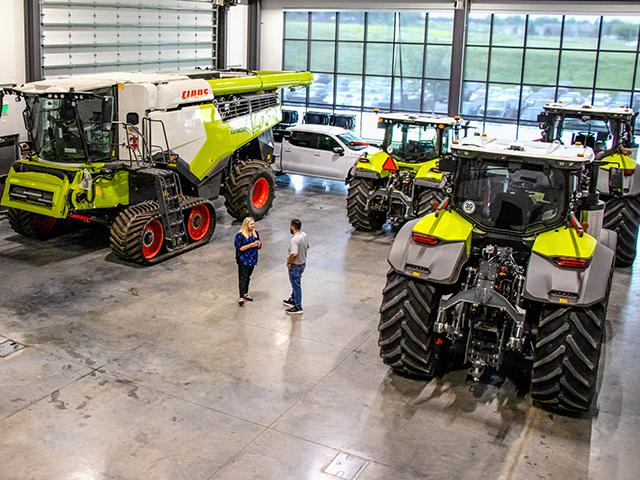
Matthew Dorner was fresh out of high school when he joined CLAAS as a full-time assembly technician. After more than a decade in the role, he made a critical pivot by applying to the CLAAS Apprenticeship program. It was a bet on a second career and on an industry scrambling to fill a skills gap.
As combines, tractors and forage harvesters have become rolling computers -- packed with GPS guidance, automated steering, telematics and sophisticated sensor networks -- the traditional diesel mechanic has given way to a new kind of specialist: the mechatronics technician, trained across mechanical systems, electronics and software. The industry is struggling to produce them fast enough.
The consequences for farmers are real and immediate: Every hour a machine sits idle during planting or harvest costs money. CLAAS -- a German, family-owned equipment manufacturer -- is betting that a German-style apprenticeship program can help close that gap one mechatronics technician at a time.
Launched in 2019 in partnership with Metropolitan Community College, in Omaha, Nebraska, the CLAAS apprenticeship uses the German-style ICATT (Industry Consortium for Advanced Technical Training) model to train mechatronics technicians in electrical, mechanical and computer engineering -- including GPS systems, telemetry, automated steering, hydraulics and pneumatics.
Without prior electrical or mechanical engineering experience, Dorner's interest in continual learning and yearslong experience in facility maintenance made him a strong candidate.
"I had general mechanical aptitude having worked at CLAAS for as long as I had -- that helped," Dorner says.
LIFE OF AN APPRENTICE
Now in his third year, Dorner is preparing for his next practical exam -- a six-hour test involving machining, wiring and rewriting a new program from scratch on exam day.
For practice, he built what he describes as a sorting system: a machine that moves a carriage and uses sensors to sort metal and plastic cubes.
"The explanation seems pretty simple, but there's a lot of wiring that goes into making something so simple happen," he says. "You need to have multiple sensors -- identify what the sensors do, what signals they send -- and then be able to interpret those signals into a program."
P[L1] D[0x0] M[300x250] OOP[F] ADUNIT[] T[]
Exam day is a wild card: The machine stays the same, but the program must be rewritten from scratch.
"He'll have to write a new program in six hours, and he has no clue what that will be," CLAAS Technical Trainer Supervisor Alex Pompa says.
For the written portion, Dorner has access to previous years' written exams and a book of mechatronics knowledge. The written tests cover any topic in electrical or mechanical engineering. The open-ended nature of the exams is deliberate. While he never knows exactly what will be on the exam, Dorner says that now he's in his third year, he's more confident that he'll be able to find the answer.
PATHWAYS TO APPRENTICESHIPS
CLAAS' apprenticeship model mirrors, on a smaller scale, the vocational pathways offered in Germany, where students are identified for technical tracks starting as early as middle school. But, in the U.S., the average age of apprentices is slightly older.
Like Dorner, second-year apprentice Alex Bruner spent years in another trade -- construction -- before finding his way to the program.
"My initial interview with Alex (Pompa) opened my eyes to everything I wanted to learn and the growth I saw for myself. I was ready to go back to school, I was at the age where I knew things were going to start clicking," he says, adding he was surprised at how quickly theory was applied in practice, for example, reading about filing materials and then doing it an hour later. "That's how you learn."
Pompa says the program currently enrolls four apprentices, but annually, the maximum number of students is six in varying stages of the program: first-, second- and third-year apprentices. Each apprentice is paid while dual-attending college to complete academic courses and motors, mechanical, welding and machining classes. Apprentices earn an associate's degree and the internationally recognized German American Chambers of Commerce Mechatronics certificate, benchmarked to Germany's rigorous standards. Following graduation, apprentices commit to two years with CLAAS. After that, equipped with transferable skills, they may choose to stay with the company or pursue other opportunities.
DIGITAL SKILLS GAPS
Because apprentices arrive from different fields and experience levels, identifying skills gaps is tough, Pompa says. The program's approach adapts accordingly.
First-year apprentices learn theory, hands-on fundamentals and metalworking followed by advanced theory and electrical systems in the second year. Third-year apprentices learn applied troubleshooting, open-ended projects, time management and real-world diagnostics.
"The biggest gaps are in troubleshooting, diagnostics and critical thinking -- it takes all three years to be able to master those skills," Pompa says. "From the very beginning, we're teaching both hard and soft skills focused on quality of work, documentation and presentation."
With apprentices working in proximity, first- and second-year apprentices often look toward third-year apprentices as mentors for help on reference materials, tests and executing.
CLAAS TRAINING ACADEMY
Beyond the apprenticeship, CLAAS hosts more than 630 service technicians from its dealer network for training each year between its Omaha facility and its Regina, Saskatchewan, location.
"Dealers are leaning on us to make sure we're providing the training that keeps the farmer up and running," says Felicia Nichelson, who serves as the head of CLAAS Academy. "We believe a strong training program is going to help team members feel engaged and confident, and in turn, that creates a better service output."
The availability of the sessions varies, ranging from weeklong in-person sessions, virtual instructor-led courses, hands-on labs, e-learning and on-the-job development support.
"By focusing on the execution of our training, we ensure that we have the right training at the right time to support the dealer network," she explains. The most effective technicians, she adds, share one defining trait: a commitment to learning.
**
-- Follow the latest from Susan on social platform X @jpusan
[PF_0826]
(c) Copyright 2026 DTN, LLC. All rights reserved.