

Winter Bale Grazing Offers Added Benefits to Cattle Producers' Pastures
Winter Bale-Grazing Believer
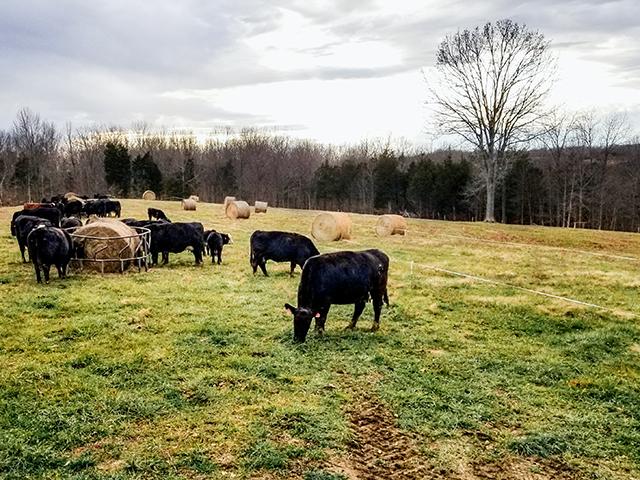
Though skeptical at first, Mike Wilson has readily adopted winter bale grazing for his 30-head commercial cow herd at Whispering Hills Farm, in northern Kentucky.
"I basically told them they were crazy when University of Kentucky (UK) educators began talking about using bale grazing around here," Wilson explains. "I told them it might work up north where the ground is frozen during the winter or out west where it's dry. However, with the rains we get, I figured concentrating cattle around bales in wet conditions would just tear up our pastures."
PASSIONATE ABOUT PASTURE RESTORATION
Wilson's pastures are dear to his heart, and the thought of damaging them after he'd worked years to restore them from nothing sent up plenty of red flags.
Wilson and his wife, Tammy, renovated a long-abandoned and overgrown 75-acre farm between Louisville and Lexington after purchasing the property in 1999. He spent hours with a bulldozer and track hoe clearing 45 acres of a jungle of hedge apples, cedars and thorn trees as a base for a small cow herd. He left 30 acres of forest intact along with 300-foot wooded buffers between pastures and creeks to prevent soil erosion and improve water quality.
After the land preparation, the Wilsons reestablished a mix of forages, including fescue, orchardgrass and red and white clover. Over the years, he also added Timothy and gamagrass to the mix.
To make efficient use of the newly established pastures, the couple began a rotational-grazing system to prevent overgrazing and to provide at least a monthlong rest period for the forage to regrow between visits from the cow herd.
Wilson uses adaptive-grazing techniques based on paddocks ranging from 2 to 8 acres each. Paddocks on his owned land are plumbed for city water. Three paddocks on leased ground have surface water available.
P[L1] D[0x0] M[300x250] OOP[F] ADUNIT[] T[]
The Wilsons have expanded the farm to 197 acres and lease another 60 acres to support an endophyte-free fescue hay operation and warm-season grazing. Their herd is now mainly Simmental-Angus that produces freezer beef, bred heifers and commercial cattle for the sale barn.
The couple's conservation ethic and efforts were recognized in 2024 with the state's Leopold Conservation Award for environmental improvement and inspiration to others to follow good land stewardship. In 2025, they received a Region 1 National Cattlemen's Beef Association Environmental Stewardship Award for long-term conservation management.
Thanks to their restoration and grazing efforts, the Wilsons have seen an explosion of deer and wild turkey numbers on their farm. It has also become a popular stop for numerous field days and workshops conducted by United Kingdom (UK) scientists and various conservation organizations.
BALE-GRAZING SKEPTIC
Naturally, when the mention of concentrating cattle around lines of big round bales of hay during wet winter months was discussed, Wilson pushed back -- hard. Little wonder since he had worked so diligently to protect his thin soils and 100-acres of productive paddocks and adjacent hay ground.
Bale grazing involves leaving big round bales in the field where they are harvested or hauling bales to a certain pasture to set out in rows for strip-grazing in the winter. Studies show the practice -- allowing cattle access to the bales in easy-to-move electrified Polywire "subpaddocks" -- can be more cost-effective than hauling hay to cattle daily in winter conditions. Since the cattle eagerly consume their spoon-fed forage, researchers say the practice keeps hay waste to a minimum.
"A couple of my friends also thought the concept was flawed for our geography and climate, but they tried it, and I saw how it worked for them," Wilson explains. "I started out eight years ago in a test with the UK scientists on a 10-acre strip and was really surprised. Sure enough, it looked like there was a lot of damage around the bales, but it recovered very quickly. Also, some of the gamagrass I'd sown and watched disappear was really coming back, apparently from severe hoof action."
In addition to fuel and time savings over daily hay hauling, North Dakota State University studies show a 50% increase in forage production the following growing season in the 15-foot radius of the bale's center. Also, forage quality in that 30-foot circle nearly doubled (9.5% to nearly 16%) in crude protein compared with control areas in the same field.
The second summer after bale grazing in the university studies saw an increase in forage production from 30 to 80% in the 30-foot circle surrounding the grazed bale. Scientists say the improvements are traced to manure and urine deposited in the circle, and the grass picking it up rather than it entering the soil profile and deposited downslope. The results also showed a four times increase in soil nitrogen in the bale-grazed circles.
While he doesn't have the actual soil test results from the ongoing UK study, Wilson says he sees ample evidence the practice is building the pastures' fertility and water-holding capacity.
"After that first year, it appeared as if I'd put down 100 pounds of nitrogen around those bales," he recalls. "Also, where cattle have concentrated in wet weather around feeding areas or water, it usually takes a couple of years to recover from all their tromping around in the mud.
"On the two fields we bale-grazed at first, that following year, they were some of the first to green up with lush growth," Wilson continues. "And, in areas where we'd been hit with drought several years ago, I noticed the areas where we'd bale-grazed were the last to dry out. It's like a compost with organic matter that holds moisture."
Now a believer, Wilson rotates the fields in which he uses the bale-grazing practice across his warm-season paddocks. In three or four years, he'll be back on the original field. To more evenly distribute the benefits of the concentrated feeding events, he consciously alters the position of bales from where the first set of bales sat.
"We don't bale-graze our hay meadows, which are across a county line and lack water and crossfencing, but elsewhere it's regularly used throughout cold weather," Wilson explains. "Sometimes, when the ground is frozen and snow covered, or if we've had a spell of dry weather, I like to roll out the bales to provide for some bedding as well as forage," he adds. "Otherwise, our bales are fed in rings to concentrate soil nutrients for the following season."
Initially, Wilson's trials began with bales set on quarter-acre enclosures, but he and the UK researchers quickly realized the paddocks were too small, and too much "hoof action" was taking place.
"We took that to one-half acre, and that is just about right," he explains. "I try to set enough bales out for three to four weeks' grazing, then restock the next line when I get a break in the weather. I don't want to stock all the bale-grazing strips and just have that quality hay sitting out in the rain and weather for months."
Wilson says the improvements he's seen in his pastures over eight years of bale-grazing have been impressive. He adds because the couple is the farm's only labor to manage 30 head of cows and their calves, the easy-to-manage Polywire paddocks for winter hay grazing conveniently complement his low-labor, warm-season adaptive grazing of growing pastures.
[PF_0526]
(c) Copyright 2026 DTN, LLC. All rights reserved.