


Ag Weather Forum
Snow Drought Brings Moisture Concerns to Western Plains
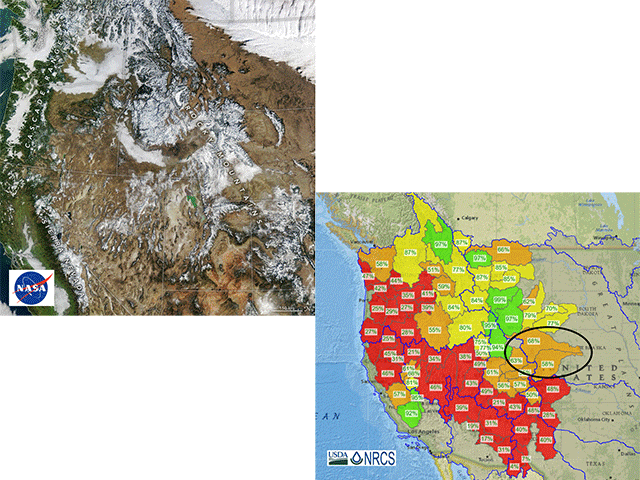
One of the primary features of the 2025-26 winter season is a pronounced snow drought in the western United States. According to the American Meteorological Society Glossary of Meteorology, "snow drought occurs when there is a period of abnormally low snowpack for the time of year in question." That abnormally low snowpack is certainly in evidence in the western U.S.
A mid-January National Aeronautics and Space Administration (NASA) report noted that "Although most regions saw average or above-average precipitation in fall and early winter, warmer temperatures meant that much of it fell as rain. The result has been an unusually low snowpack for this time of year, constituting a snow drought." On Jan. 15, snow cover was measured by satellite observation over 142,700 square miles (369,700 square kilometers) of the western U.S. That coverage was the lowest coverage for that date in the 25 years of satellite-based analysis and less than one-third of the median. Coverage did increase slightly by Jan. 26.
Much of the economic impact from this lack of snow has so far been noted in a lack of winter sports activity and revenue. However, the low snow cover also leads to subpar snowpack moisture in the river basins of the West. Moisture from snowpack, identified as snow water equivalent (SWE), is mostly 30% to less than 50% below average in the river basins of the western U.S., according to the USDA Natural Resources Conservation Service (NRCS). In the western High Plains crop and livestock areas, this below-average snow water leads to worries about the water supply for crop irrigation this year.
P[L1] D[0x0] M[300x250] OOP[F] ADUNIT[] T[]
University of Nebraska-Lincoln (UNL) extension crops educator Gary Stone, based in Scottsbluff, Nebraska, noted that the reservoirs in the North Platte River right now are below average in their water volume. Three main reservoirs are 32% to 53% full, and Stone said that average irrigation allocations from these reservoirs will depend on late winter and spring snowfall. "Average snowpack runoff is usually around 800,000 acre-feet from the mountains in south-central Wyoming and north-central Colorado, the headwaters of the North Platte River," Stone noted in an email. Average irrigation water demand for the irrigation system in the North Platte River valley would be around the same. So, (reduced) water allocations are a possibility for the 2026 growing season in eastern Wyoming and the North Platte River valley.
Stone placed a premium on how February, March and April play out on precipitation, particularly snowfall. "The next three months or so will be the telling story if we get snow on the mountains. Things are very dry in the Panhandle and nearly all of Wyoming," he noted.
UNL Extension beef educator Aaron Berger in Kimball, Nebraska, is also anxious about how the late winter and early spring treat the western Plains on moisture. Berger sees a strong resemblance between this winter's dryness and the year 2002. "That year was eerily similar to this winter. Then we had a very dry spring. It was terrible," Berger said in a phone interview. Recent history reminds Berger that moisture conditions in the western Plains can turn quickly. "In 2023 in late April and May, it rained over 10 inches," he said. "We're hoping that some wet storms could turn it around."
During the next three months, DTN forecasts for the western High Plains call for above-normal temperatures and above-normal precipitation in February; below-normal temperatures and above-normal precipitation in March; and below-normal temperatures and near-normal precipitation in April.
More details on the February weather outlook are available here: "Warmer Air Spreading Through US May Cause More Active Winter Storm Pattern for Mid-February," https://www.dtnpf.com/….
Bryce Anderson can be reached at bryce.anderson@dtn.com
(c) Copyright 2026 DTN, LLC. All rights reserved.
Comments
To comment, please Log In or Join our Community .