



Ag Weather Forum
Macro-Level Review Shows 2026 Brought Mostly Favorable Weather to US Corn Areas
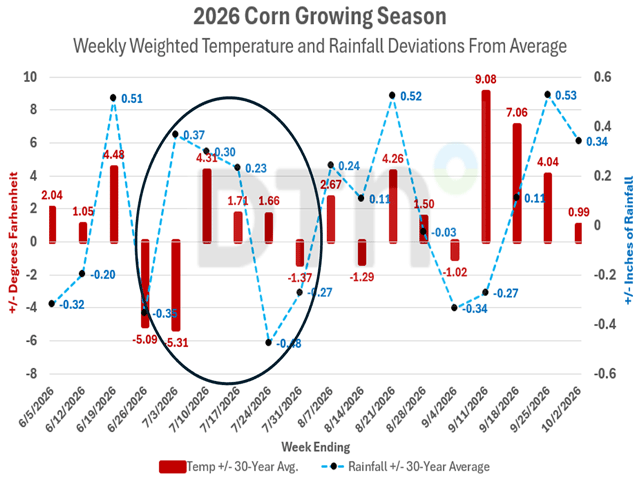
A large-scale view of 2026 weather for corn growing across the primary U.S. farming areas shows that this year's pattern was beneficial for production in many areas. This assessment offers some interesting details as U.S. corn harvest moves into its final stages. The driver for this assessment is a summary of weekly weighted temperature and rainfall deviations from average for the 2026 U.S. corn growing season, compiled by DTN Lead Analyst Rhett Montgomery. For 2026, the summaries begin at the week ending June 5, and the summaries conclude at the week ending October 2.
The weighted temperature and rainfall departures from average show notable variability along with short periods of extreme heat when it comes to total U.S. corn production areas. The month of July offers a useful illustration for pollination and the start of grain fill. Here is the breakdown:
P[L1] D[0x0] M[300x250] OOP[F] ADUNIT[] T[]
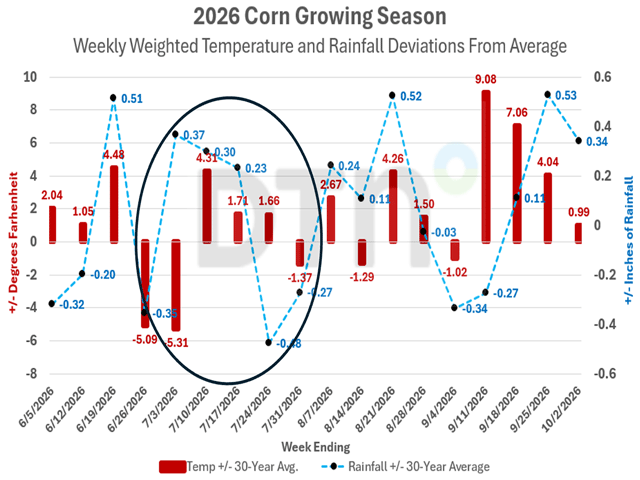
For the week ending July 3, weighted temperatures were 5.3 degrees Fahrenheit below average with rainfall .37 inches above average. For the week ending July 10, weighted temperatures and rainfall were 4.3 degrees F above average and .30 inches above average. For the week ending July 17, weighted temperatures were 1.7 degrees F above average with rainfall .23 inches above average. For the week ending July 24, weighted temperatures were 1.66 degrees F above average with rainfall .48 inches below average. And for the week ending July 31, weighted temperatures were 1.37 degrees F below average with rainfall .27 inches below average.
Continuing through the remainder of the growing season (through the week ending October 2), Montgomery's tracking shows that a hot and dry stretch for the weighted averages only occurred once -- in the middle two weeks of September, in the weeks ending September 11 and September 18. In the week ending September 11, temperatures were 9.08 degrees F above average and rainfall was .27 inches below average. The week ending September 18 also had its share of heat with weighted temperatures that were 7.06 degrees F above normal; however, rainfall offered at least some easing of crop stress, with .13 inches above average.
The result of this macro-scale combination was that, while the corn market had a few weeks with a higher price trend, the corn market did not develop the sustained concern about the eventual harvest outcome in Montgomery's view. "The market in 2026 clearly never grew concerned to the same degree as in late summer of 2020, and even in the summer of 2022 as examples -- where adverse weather and drought were certainly impactful to production," Montgomery noted.
USDA's November corn production estimate shows how this variable weather pattern for corn was generally beneficial in 2026, with total corn production estimated at 15.9 billion bushels, the second highest on record. The national yield at 179.6 bushels per acre is down almost 7 bushels from 2025; however, record yields are estimated for Iowa and Minnesota -- two of the top five corn-producing states. So, the season was not a perfect weather year, but it still is ending with some big numbers to finish the season out.
(c) Copyright 2026 DTN, LLC. All rights reserved.
Comments
To comment, please Log In or Join our Community .