

Ag Weather Forum
Oklahoma Drought Slows Wheat Planting and Fall Pasture Activity
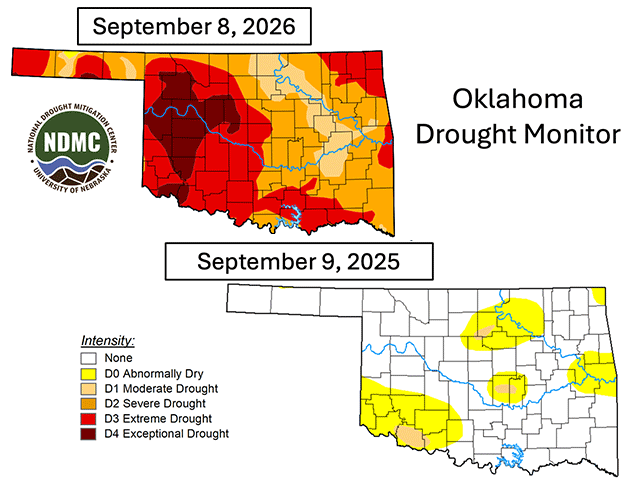
Autumn 2026 began on an extremely dry note in the Southern Plains, particularly in Oklahoma. The U.S. Drought Monitor from Sept. 8, 2026, assessed Oklahoma at 100% in dryness or drought, with almost 89% of the state in severe, extreme or exceptional drought.
The level of drought is far greater than a year ago, when just 25% of the state had some level of dryness or drought, but with 0% in severe drought or worse. The extent and severity of drought in Oklahoma now is the greatest since the bone-dry year 2012.
P[L1] D[0x0] M[300x250] OOP[F] ADUNIT[] T[]
Heat and a lack of rain have been notable. Much of central and western Oklahoma have had over 50 days this year with temperatures topping 100 degrees Fahrenheit, according to the Oklahoma Mesonet; and in the southwestern corner of the state, 70 days -- more than two months' worth -- have had temperatures above 100 degrees Fahrenheit. In addition, large portions of central, southern and southeastern Oklahoma have recorded more than 50 consecutive days with less than 0.25-inch of precipitation. Central and western Oklahoma had no more than 4 inches of precipitation during the meteorological summer months of June, July and August--mostly 25-75% of normal.
Drought Monitor commentary for the Sept. 8 week noted heat and dryness sprawling across the southern region of the contiguous U.S. "Mostly dry weather and hot temperatures (5-15 degrees above normal) covered a wide area from western and northern Texas through most of Oklahoma, Arkansas, northern Mississippi and Tennessee," the comment said. "Short-term rainfall deficits continued to grow across much of the region, along with dropping soil moisture and streamflow levels, leading to widespread agricultural drought impacts."
One significant agricultural effect caused by this drought is a slow start to winter wheat seeding in the state. The USDA-NASS crop progress report for the week ending Sept. 13, 2026, lists Oklahoma wheat seeding at 3% complete -- half the 5-year average pace of 7% complete. A lack of soil moisture for seed germination is cited as the main reason for this lag in seeding progress.
The slower start to seeding the 2026-27 winter wheat crop in Oklahoma is especially notable in terms of its impact on cattle grazing. Wheat grazing during the winter has an important role in Oklahoma's beef industry. However, the availability of winter wheat for grazing is based on seeding and early plant growth.
Forecast maps through the end of September suggest some beneficial moderate to heavy rainfall for the entire Southern Plains, including Oklahoma. If realized, soil moisture for winter wheat seeding may have some better conditions. From the standpoint of wheat pasture, this prospect is important. Already, at least one month of the wheat growing time frame has been lost to dryness, which, in turn, has delayed in getting the wheat pasture underway.
Bryce Anderson can be reached at bryce.anderson@dtn.com
(c) Copyright 2026 DTN, LLC. All rights reserved.
Comments
To comment, please Log In or Join our Community .