

Ag Weather Forum
June 2026 Weather Pattern Featured Areas of Heavy Rain, Flooding and Drought Reduction
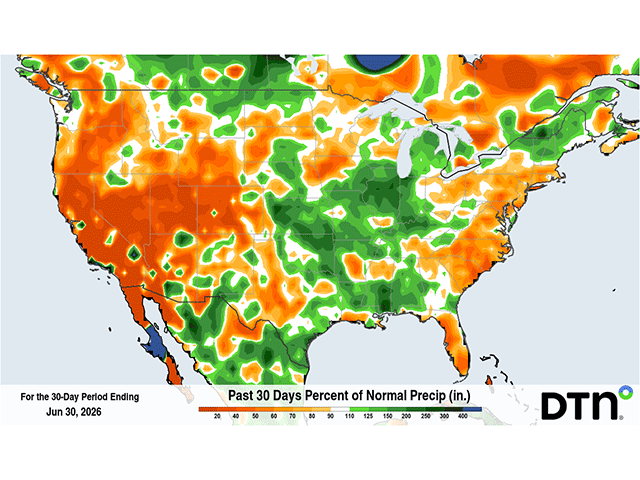
June was a very active month of weather across the U.S. Corn Belt. A western ridge contained the heat largely west of the Rockies outside of some heat during the first and last week in the month. The weather pattern featured multiple systems and disturbances that traversed the country, bringing a lot of precipitation to portions of the Plains, across most of the Corn Belt, and extensively across the Gulf Coast and Southeast.
That was enhanced by Tropical Storm Arthur, a very short-lived weak tropical storm. Despite its short life and limited winds as a weak tropical storm, it and its remnants brought areas of extremely heavy rain and flooding from the Texas coast through the Southeast from June 14-18.
Flooding was an extensive problem for large areas of the country throughout the month. While a lot of attention was paid to Arthur and its remnants, which produced some areas of more than 8 inches of rain, we saw streaks of heavy thunderstorms that also produced repeated heavy rain from Missouri through the Ohio Valley, down through the South and Southeast.
Near the end of the month, heavy rain spread westward to the Central and Southern Plains and a big system brought areas of heavy rain to the Northern Plains on the last weekend as the weather pattern began a major shift for the last few days of the month.
P[L1] D[0x0] M[300x250] OOP[F] ADUNIT[] T[]
When all is said and done, extensive heavy rain fell across large areas of the country outside of the West and Mid-Atlantic. Below is a list of select cities across the Plains, South, Midwest, and Southeast that saw very heavy rainfall for the month of June.
| City | June 2026 Rainfall | 2000-2025 June average | Percent of average rainfall |
| Great Falls, MT | 4.94 | 2.58 | 191 |
| Pueblo, CO | 2.73 | 1.23 | 222 |
| Valentine, NE | 6.89 | 3.97 | 174 |
| Dodge City, KS | 7.46 | 3.69 | 202 |
| Wichita, KS | 12.37 | 5.58 | 222 |
| Lawton, OK | 5.21 | 3.18 | 164 |
| Dallas-Fort Worth, TX | 8.07 | 3.81 | 212 |
| Corpus Christi, TX | 7.09 | 3.45 | 206 |
| Kansas City, MO | 8.63 | 5.45 | 158 |
| Springfield, MO | 9.04 | 4.57 | 198 |
| Columbia, MO | 8.51 | 4.73 | 180 |
| St. Louis, MO | 6.48 | 4.63 | 140 |
| Dubuque, IA | 9.76 | 5.20 | 188 |
| Quincy, IL | 10.89 | 4.86 | 224 |
| Peoria, IL | 8.74 | 4.21 | 208 |
| Springfield, IL | 8.54 | 4.83 | 177 |
| Evansville, IN | 10.34 | 4.29 | 241 |
| Paducah, KY | 7.67 | 4.18 | 183 |
| Lexington, KY | 10.61 | 4.62 | 230 |
| Louisville, KY | 9.72 | 4.54 | 214 |
| Jackson, MS | 9.52 | 4.69 | 203 |
| Gulfport, MS | 12.05 | 7.95 | 152 |
| New Orleans, LA | 13.31 | 7.56 | 176 |
| Birmingham, AL | 8.22 | 5.08 | 162 |
Some of these cities and the areas around them carried drought conditions into the month of June. Those conditions have either been eased or eliminated. Some areas between these official sites have seen extensive heavy rainfall as well. Radar estimates show streaks in Nebraska, Kansas, Oklahoma, Missouri, Iowa, Illinois, Indiana, Kentucky, and from Texas into Georgia with amounts that may have significantly eclipsed the above totals.
Soil moisture has been much improved during June, setting up U.S. agriculture in an overall good position heading into the most important month for corn.
The month wasn't a heavy rainfall month for all areas of the country though. Including the large portions of the West and Mid-Atlantic that saw below-normal rainfall, areas in western and central Texas and the Upper Midwest saw precipitation that wasn't nearly as heavy as elsewhere in the country. The below-normal amounts from southeast South Dakota into northwest Iowa and southern Minnesota have meant drought growth or maintenance throughout the month.
And the heavy rainfall was not all a good thing. In many areas, it was accompanied by flooding and severe weather, particularly with incredibly strong winds and numerous tornadoes. A derecho was declared in northern Illinois during a big event on June 10-11. Another severe weather event ripped through the eastern Midwest on June 17-18 that caused multiple injuries and a couple of fatalities. The Father's Day event produced almost 70 tornadoes in the Central Plains and Midwest, with most of those occurring from southern Illinois into southern Indiana. Multiple reports of hurricane-force wind gusts blew across the Plains both early and late in the month. Severe weather damage may have had more of an impact to infrastructure and crop development than usual this year.
To stay up to date with weather conditions and your local forecast for free from DTN, head over to https://www.dtnpf.com/…
John Baranick can be reached at john.baranick@dtn.com
(c) Copyright 2026 DTN, LLC. All rights reserved.
Comments
To comment, please Log In or Join our Community .