



Ag Weather Forum
Rainfall Deficits May Be Too Large to Overcome in Busy Early March Pattern
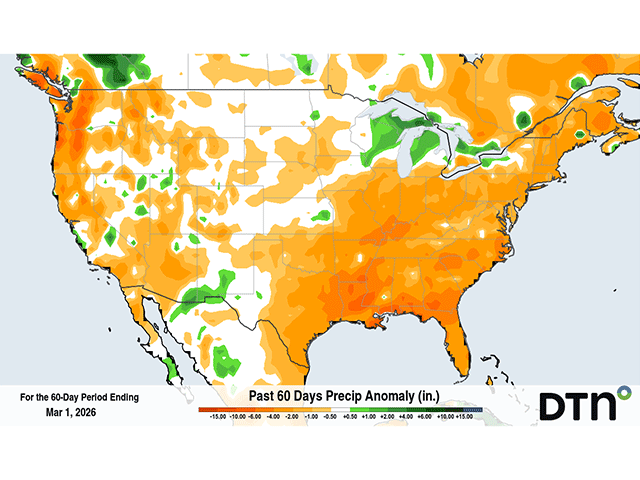
March is coming in like a lion, but its roar may not be enough to scare away drought for large portions of the country. Large areas of widespread D2-D4 drought exist across much of the southern United States from eastern Arizona through the Carolinas and Florida. Additional streaks exist from Utah to Nebraska and from Missouri through northwest Ohio. Yet more patches exist in the Pacific Northwest and into the Northeast U.S.
The weather pattern for the first two weeks of March is certainly looking quite busy, with almost continuous precipitation over the middle of the country this week, and a couple of larger storm systems possible next week. But the rainfall deficits to overcome are large, and this current pattern will not be able to erase it all.
As I mentioned last week in the Ag Weather Forum blog, (https://www.dtnpf.com/…) the pattern for the first half of March is off to a roaring start. Pockets of heavy rain have already fallen from eastern Kansas and northern Arkansas through Missouri into southern Illinois as of the morning of March 3. Northern Utah and southern Wyoming have also cashed in on some heavier precipitation as well. Amounts around or over an inch have been recorded in both regions.
The busy pattern is forecast to continue across the middle of the country all week, culminating in a larger system that will move through the U.S. on March 6-7 that will produce some fairly widespread precipitation. When put together, the heaviest precipitation looks to occur from eastern Texas and Oklahoma northeast into Missouri, then just north of the Ohio River from southern Illinois through Pennsylvania into southern New England. Forecasts generally agree on 2 to 4 inches of rain during this period.
P[L1] D[0x0] M[300x250] OOP[F] ADUNIT[] T[]
A second heavier band of near an inch or so of rain may be possible with the final system on Friday into Saturday from Wyoming through Nebraska and into southern Minnesota. Both of these zones are dealing with widespread drought and will gladly take the rainfall.
Next week, two storm systems are likely to move through the country, bringing some heavier precipitation for the middle of the country with a storm midweek, and with potential for more moderate precipitation later next week with a system moving across the north. The forecast for next week is a little more uncertain, however.
But significant deficits are running higher than the forecast precipitation. The 60-day deficits are between 3 to 6 inches below normal from the southeastern Plains through the Ohio Valley, and around an inch or a little more from southern Wyoming through southwestern Minnesota.
What's worse, those in the Southeast U.S. face similarly large deficits, but without much rain being forecast outside of the front finally moving through on March 7-8. Systems next week add something similar. Even then, amounts are looking to run around an inch or less for each event. They will also be spotty and are not forecast to produce much precipitation down to the Gulf or Florida, where some deficits are running more than 6 inches below normal.
We will see major reductions in drought for those areas hardest hit, and some flooding may result as well. But wholesale elimination of drought does not appear likely outside of a few lucky spots that have had better precipitation during the winter, like around western Kentucky and through Tennessee and northern Alabama. Southeastern Kansas and parts of Missouri could also see drought eliminated. But large-scale, lasting reductions in drought are going to take more than this week's worth of rain.
And for some areas, the deficits are larger over extended periods. Some areas in the south-central U.S., including much of Louisiana, Arkansas and the surrounding areas, are running 90-day deficits of 6 to 10 inches. Even adding both this week and next together will not overcome these deficits. Therefore, the pattern needs to continue to be active to feel good about soil moisture prior to planting season, which should start up this month across the far south. Those with heavy rain may need to wait to get into their fields, and they may be happy to do so, but this long-standing drought will not die out easily. In some areas, like western the southwestern Plains, or Florida, where the pattern does not favor much precipitation at all, drought may even grow or deepen.
To stay up to date with weather conditions and your local forecast for free from DTN, head over to https://www.dtnpf.com/….
John Baranick can be reached at john.baranick@dtn.com
(c) Copyright 2026 DTN, LLC. All rights reserved.
Comments
To comment, please Log In or Join our Community .