



Technically Speaking
New-Crop Corn Futures Show Technical and Fundamental Strength
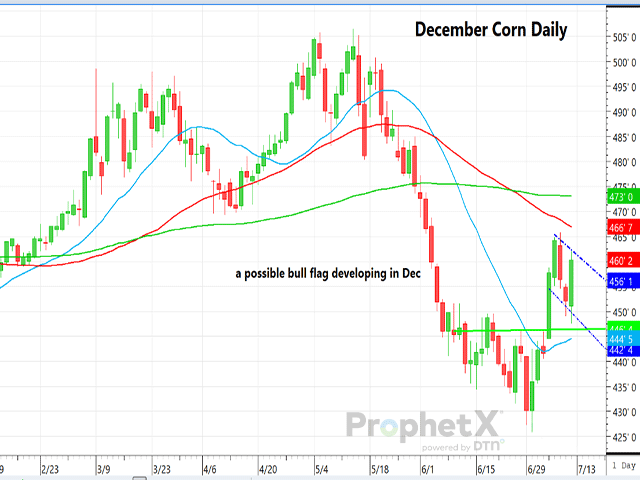
In addition to scorching weather in European corn areas, particularly France, the U.S. may have its own corn challenge in the critical pollination period as next week's forecast suggests a high-pressure ridge and the resulting heat and dryness setting up in the Corn Belt with some extreme temperatures. When you add that to the fact that U.S. corn export commitments are already 60 million bushels (mb) above the USDA projection with eight weeks left in the marketing year, and some of the potential bullish ramifications from the WASDE report, December corn may have more reasons to have an atypical rally extend in July.
USDA lowered old-crop corn stocks by 125 mb on higher exports and increased feed, while a modest drop in corn for ethanol use offset some of that. On the new-crop side, exports were raised by 50 mb and ending stocks fell by 170 mb. With the old-crop corn exports overachieving, USDA could still be light on that demand bucket as well. In the EU, French corn production is rated at the lowest level in 30 years and there is every indication it could get worse. For the next 10 days, the extreme weather is expected to stick around. The WASDE lowered EU corn production by 3.7 million metric tons (mmt) to 53.8 mmt, but there are plenty of predictions that EU production could fall below 50 mmt. Global ending corn stocks fell 6 mmt on Friday's report to 275.3 mmt.
P[L1] D[0x0] M[300x250] OOP[F] ADUNIT[] T[]
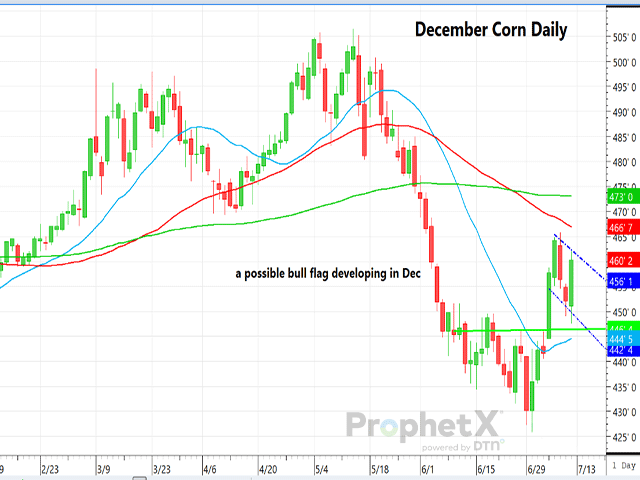
While the fundamental reasons above have the potential to send corn even higher, there are also a few technical signals that support corn. December was able to hold support on Tuesday's break toward the $4.45 support area, and the chart now appears to be forming a potential bull flag chart pattern.
While much of it is speculation, corn has enough reasons to hope for a rally from Friday's close. Next week's weather both here and in the EU will go a long way in determining that.
PARIS MILLING WHEAT SEPTEMBER DAILY:Both the U.S. wheat markets and the Paris milling wheat contracts closed with solid gains Friday, with the U.S. reacting to both lower production and stocks in both the old- and new-crop slots. Paris milling futures exploded to the upside. Part of the strength may have been related to Russia's closure of a key grain corridor on Friday. Global ending stocks of wheat fell 2% to 272.8 mmt. Both Chicago and Kansas City wheat futures rose back above the 50-day moving average for the first time since May after all-wheat planting was pegged at the lowest level in 150 years. Paris milling wheat finished less than $3 per ton from the recent high set back in March. All of this is occurring in the middle of harvest.
**
Comments above are for educational purposes only and are not meant as specific trade recommendations. The buying and selling of commodities, futures or options involve substantial risk and are not suitable for everyone.
Dana Mantini can be reached at Dana.Mantini@dtn.com
(c) Copyright 2026 DTN, LLC. All rights reserved.


Comments
To comment, please Log In or Join our Community .