

Production Blog
How to Size Up a Soggy Crop
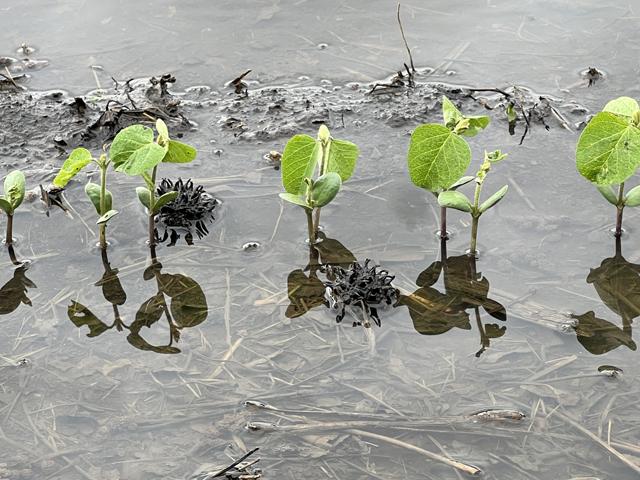
The grassy strip where I walk the dog splits two farm fields. This year, both acreages were planted in March to soybeans. Cool temps and crusted soils delayed their arrival.
A few weeks ago, digging uncovered some crooked necks. A rainy drizzle finally softened the soil enough to result in a so-so stand. But this week, the rain came hard and with it, ponding. Now, we wait to see how these baby beans look after the water recedes.
Farmers are no strangers to the whims of spring weather. But depending on soil types and tiling, fields can vary in forgiveness. The crop itself also varies in response.
University of Missouri Extension state soil science specialist Gurbir Singh pointed out in a recent news release that when soils stay saturated, air is pushed out and roots lose access to oxygen. This slows root growth and can lead to stunted or dead plants. Even after soils dry, damaged roots can struggle to take up water and nutrients, limiting recovery, Singh said.
Flooding happens when all or part of a plant is underwater and may involve complete submergence or saturated soils. Waterlogging occurs when soils are saturated without standing water. In both cases, oxygen is limited, stressing plant roots.
According to the Missouri release, corn is highly sensitive to waterlogging early in the season. Oxygen deprivation can occur within 24 to 48 hours, limiting root growth and nitrogen uptake. Prolonged flooding can reduce yield potential by 7% to 20%, depending on growth stage and duration.
Soybeans generally tolerate short periods of saturation better than corn, but they still suffer yield losses under prolonged flooding. As the release noted, research shows flooding can affect crops at all growth stages, but early growth stages are most vulnerable due to shallow root systems and limited energy reserves.
Corn is at most risk during VE to V6 (emergence to early vegetative) growth stages and soybeans from germination to V3. Read the entire Missouri release here: https://extension.missouri.edu/….
UNDERWATER WORRIES
How long crops can survive underwater is a question I quizzed University of Nebraska Extension educator Jennifer Brhel about several years ago after reading her blog on the topic: https://jenreesources.com/….
P[L1] D[0x0] M[300x250] OOP[F] ADUNIT[] T[]
This year, many Nebraska farmers are facing drought, and Brhel wishes regions with too much rain could funnel a few drops toward her state. However, her estimates about what farmers can expect in flooding situations based on crop stages still apply:
-- Corn, prior to V6: Plants can survive underwater for two to four days if temperatures do not exceed 77 degrees Fahrenheit.
-- Corn, V7-V10: Plants can survive seven to 10 days if temperatures do not exceed 86 F.
-- Corn, VT-R1: Reduced nutrient uptake and pollination if standing water is present longer than two to four days. Yield losses may occur.
-- Soybeans: Yield losses minimal if flooding lasts less than 48 hours. Flooded for four to five days, fewer nodes develop, and plants will be shorter; possible stand and yield loss beyond that.
-- Soybeans at flowering: Potential yield loss, especially on poorly drained soils.
You can find a more lengthy assessment in a University of Nebraska paper on the topic here: https://cropwatch.unl.edu/….
WATCH THE CROP
Bob Nielsen, Purdue University emeritus professor and retired Extension corn specialist, provides a look at the odds of young corn surviving "toad stranglers" here: https://www.agry.purdue.edu/….
Nielsen boils down the discussion to this: The consequences of flooding, ponding and saturated soils on young corn depend heavily on the duration of the stress and temperatures.
Wet conditions also favor diseases. Reduced stands mean more openings for weeds to thrive and to set seed.
With April in the rearview mirror, planting windows start to narrow. Using some of the guidelines provided here may help weigh options if you get too much of a good thing.
When I walk fields, the wet conditions we've experienced this week invariably transport me back in time to when a flooded field meant wading out to "ditch" the wet holes. That leads to a musical earworm of the same vintage -- "The Rain Song" by Led Zeppelin. Songwriters Jimmy Page and Robert Plant probably didn't have corn and soybeans in mind when they penned the ballad. But this time of year, the duplicitous meaning of the line "upon us all a little rain must fall" is there for us to see.
Bayer Crop Science offers some management considerations for flooded crops here: https://www.cropscience.bayer.us/….
Find an assessment of what happens with flooded crops from Pioneer here: https://www.pioneer.com/….
Kansas State evaluates what happens when soybeans are flooded here: https://eupdate.agronomy.ksu.edu/….
A paper from Arkansas on flooding influences on soybean yield and seed composition is available from the Soybean Research & Information Network (SRIN) here: https://soybeanresearchinfo.com/….
A SRIN paper discussing research in North Carolina aimed at using genetics to help soybeans withstand waterlogged soils is available here: https://soybeanresearchinfo.com/….
Previous writing from DTN regarding crops and flooding can be found here: https://www.dtnpf.com/…
Pamela Smith can be reached at pamela.smith@dtn.com
Follow her on social media platform X @PamSmithDTN
(c) Copyright 2026 DTN, LLC. All rights reserved.
Comments
To comment, please Log In or Join our Community .