


Ag Weather Forum
July Brought a 12-Year Low in US Corn Belt Precipitation
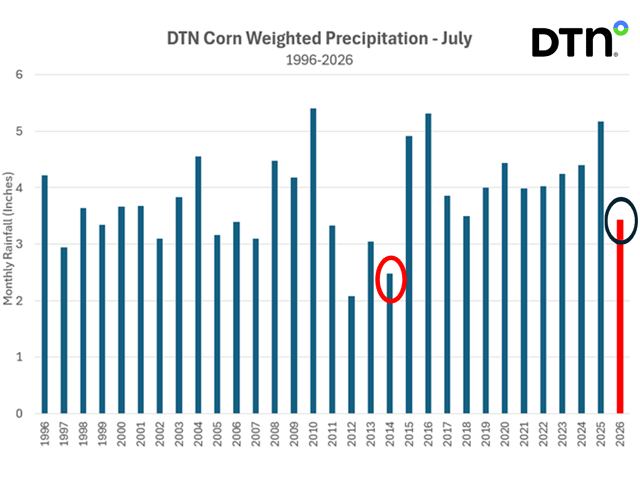
July 2026 is in the final days -- and it's been a notably dry and warm month. In fact, a study by DTN Lead Analyst Rhett Montgomery of July precipitation during the past 30 years finds that, for U.S. corn areas on a weighted basis, July 2026 has the least precipitation for the month since July 2014, 12 years ago. Montgomery's study uses weather observations gathered from DTN's collection of on-farm weather stations.
"(It) looks like July precipitation plus forecast for 2026 is 3.42 inches," Montgomery said in an email. "For last year, July precip was 5.17 inches ... 2014 precip in July was 2.48 inches."
In percentage terms, July 2026 had 38% more precipitation than July 2014. However, this year's July precipitation total is about one-third less than a year ago. And on the temperature side, July 2026 is warmer than both a year ago and 12 years ago in 2014.
P[L1] D[0x0] M[300x250] OOP[F] ADUNIT[] T[]
Montgomery's calculations, using both recorded and forecast data, place the average July temperature in weighted corn areas at 78.15 degrees Fahrenheit. A year ago, July Corn Belt temperatures averaged 77.79 degrees F. July 2014 temperatures were much lower, with an average of 72.37 degrees F in Montgomery's analysis.
Heat and non-substantial rainfall in many corn areas this July are due to interior U.S. high pressure -- known as a ridge -- influencing the weather pattern all month, according to DTN Ag Meteorologist John Baranick.
"In essence, the summer heat ridge developed and refused to let go," Baranick said. "It got pushed around a little bit but remained somewhere in the vicinity of the Corn Belt throughout the month." Baranick also noted that the summer heat ridge served to hinder precipitation despite its exact position changing during the month. "The bouncing around should have resulted in more opportunities for precipitation but just didn't. It was much more limited than it should have been," he said.
Conditions this July have been warm, with variability on precipitation, but they do not challenge the hot and dry growing season of 2012. Montgomery's analysis found that weighted U.S. corn areas in 2012 had just 2.07 inches precipitation in July, with an average temperature of 81.68 degrees F.
The corn crop stress implied by the 12-year low in July rainfall, along with sustained heat, places a premium on August conditions. Montgomery noted that August was key for corn yield performance back in 2014: "2014 rebounded to have a good August for rainfall and corn yield was a record that fall." There's an important feature, though. "July corn weighted temps that year (2014) were much lower than this year," Montgomery said.
The bottom line is uncertainty -- and concern -- ahead of the final full month of the corn growing season. "(There are) still more questions than answers but definitely looking concerning for hitting trend this year," Montgomery said.
More details on rapid drying of soil moisture due to the mid-July heat in the Corn Belt are available here: "Soil Moisture Used Up From Last Week's Heat Wave; Concerns Building on Expanding Drought," https://www.dtnpf.com/….
Bryce Anderson can be reached at bryce.anderson@dtn.com
(c) Copyright 2026 DTN, LLC. All rights reserved.
Comments
To comment, please Log In or Join our Community .