



Production Blog: Tar Spot
Tar Spot Reports Increase in Corn Country
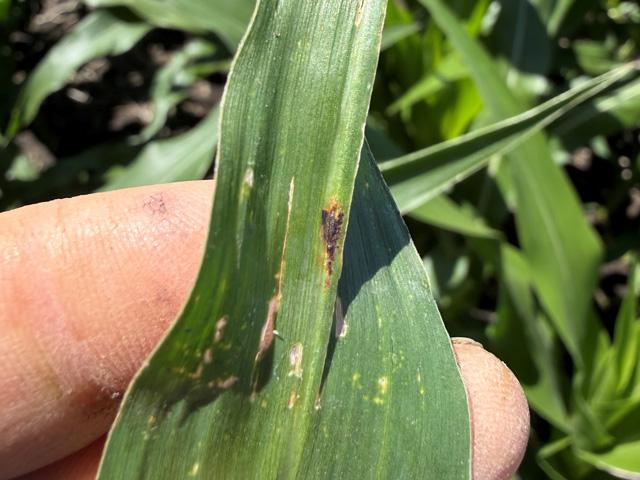
In recent years, tar spot has become a regular part of corn production in the Midwest. Each year brings a bit more knowledge about how to deal with the foliar disease. The message, "Don't panic, but be prepared," leads the current messaging. Fortunately, farmers have some online decision-making tools available from the Crop Protection Network (CPN) to help with those preparations.
As of July 14, the disease has been positively identified in Illinois, Indiana, Iowa, Kansas, Michigan, Minnesota, Missouri, Nebraska and Wisconsin. Together, these reports reflect continued tar spot activity across a broad portion of the central Corn Belt.
Damon Smith is an Extension field crops pathologist with the University of Wisconsin-Madison. This week, he posted a news report recommending that farmers not view every new detection as an emergency, but rather, he encouraged growers to focus on being ready to spray fungicides when economically warranted.
Other leaf diseases are also being reported this season. Southern rust caught many corn farmers unaware last year, and some positive detections have recently been recorded in the states of Georgia, Missouri, Mississippi and Texas.
CPN has a set of nifty interactive maps that highlight emerging field crop issues -- including tar spot and Southern rust. Called "Crop Lookout," the maps are powered by a network of university Extension specialists, researchers and agricultural professionals. Verified field observations and aggregated data from trusted sources help color in the maps throughout the season as problems are spotted. Find the complete list of maps (including tar spot) here: https://cropprotectionnetwork.org/….
Smith noted in a July 14 release that tar spot is present in Wisconsin, but the disease incidence and severity is currently low. While rainfall can contribute to disease development, tar spot thrives under a pattern of:
-- Alternating wet and dry periods.
-- Extended nighttime leaf wetness.
P[L1] D[0x0] M[300x250] OOP[F] ADUNIT[] T[]
-- High humidity and dew points.
-- Moderate temperatures.
Find Smith's recent assessment of the tar spot situation and tips on how to scout here: https://badgercropnetwork.com/….
Growers also have access to a CPN risk assessment tool to help evaluate recent weather conditions and estimate if the current situation is favorable for disease development. It does not tell you if tar spot is present in your field -- that requires scouting. Find the risk assessment tool here: https://cropprotectionnetwork.org/….
Successful tar spot management depends on both product selection and application timing. Smith noted that research continues to show that fungicides containing multiple modes of action provide the best protection. The CPN Fungicide Efficacy Guide offers product-specific performance ratings. Download it here: https://cropprotectionnetwork.org/….
Another decision-making tool from CPN helps determine fungicide return on investment when evaluating treatment decisions: https://cropprotectionnetwork.org/….
As the season progresses, Smith recommends these steps:
1. Monitor the CPN Tar Spot Risk Tool.
2. Scout fields regularly.
3. Prioritize fields with a history of tar spot or susceptible hybrids.
4. Have a fungicide plan in place.
5. Coordinate with your custom applicator if fungicide applications are likely.
Farmers who plan to make a single fungicide application should target the VT-R3 growth stages when disease pressure justifies treatment, Smith added. Those who spray between V8 and VT, should continue monitoring fields closely because a second application may be needed if favorable weather persists and disease pressure increases.
For recent DTN stories on tar spot, go to: https://www.dtnpf.com/… and https://www.dtnpf.com/….
For detailed information from DTN on the CPN Crop Risk Tool, go to: https://www.dtnpf.com/….
Pamela Smith can be reached at pamela.smith@dtn.com
Follow her on social media platform X @PamSmithDTN
(c) Copyright 2026 DTN, LLC. All rights reserved.

