

Production Blog
Asian Copperleaf Confirmed in Illinois and Iowa; What Corn and Soybean Farmers Need to Know
Crop weeds pop up every day, but the arrival of a new, and potentially problematic weed species, is well ... news.
Recent news releases announced the first confirmed population of Asian copperleaf (Acalypha australis) in Illinois. It was found in a field in Stephenson County in northern Illinois following corn harvest last fall. That makes the third U.S. state where the non-native weed species has been discovered.
First documented in New York in 1990, the weed was identified in Iowa in 2016 and has since been confirmed in 10 counties across central and western Iowa. DTN wrote about those reports here: https://www.dtnpf.com/… .
Asian copperleaf is an invasive species of the spurge family native to Russia, China, Japan and the Philippines. Currently, there are about 450 species within the genus that range from tropical to temperate climates.
University of Illinois weed scientist Aaron Hager told DTN one of the problems with this weed is there just isn't very much known about it. In a risk analysis released in 2012, USDA stated that Asian copperleaf did not show "any strong invasive or weediness" characteristics. However, the agency classified the plant as "high risk" due to a high level of uncertainty of its ability to establish in production agriculture fields.
But reports of herbicide resistance in Asian copperleaf populations in its native range raise concerns that it also could evolve herbicide resistance in U.S. populations.
"We know even less about effective herbicides for its control," Hager said. He has done field trials that looked at herbicide controls on hophornbeam copperleaf (also in this weed family).
"Most ALS inhibitors did not control hophornbeam copperleaf. So, in that instance, the species would not develop resistance since it is naturally tolerant," he said. "But we have no idea how that plays out in Asian copperleaf."
Iowa State University Extension Field Agronomist Meaghan Anderson noted that preliminary greenhouse screening data of some postemergence herbicide options suggests that the HG-14 PPO (protoporphyrinogen oxidase) inhibitors may be the most effective choice as long as populations are susceptible to them and the plants are treated while they are small.
P[L1] D[0x0] M[300x250] OOP[F] ADUNIT[] T[]
"We know of a report of resistance to fomesafen (a PPO herbicide) in China that gives me great concern of putting all our eggs in that one basket," said Anderson.
"We should have more information after this season regarding effective options for both preemergence application and post."
Anderson wishes there were more clues to how or why this weed is showing up -- and to whether there's a need for economic concern.
"All I can tell you is that we continue to find it in new fields every year. Locally, I'm certain it is moving on equipment between fields, and it is clear the seed moves with soil and water movement between fields as well," Anderson told DTN via email correspondence.
"We have no data showing yield loss, though some farmers have commented that they believe it caused maybe up to 10% yield loss in the soybean year," she added. "It is tricky to evaluate, and we hope to have some data from research plots this year." There is a paper from South Korea that soybean yield can be reduced 17-29% with high densities of Asian copperleaf (https://caws.org.nz/…)
KEEP EYES OPEN
Right now, the best thing farmers can do is scout and report anything that looks suspicious. Hager said it's important to remain in front of a new weed challenge rather than allow it to get ahead of researchers and producers.
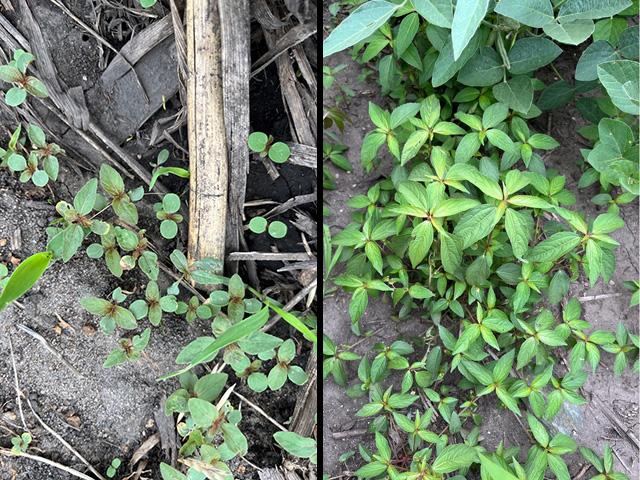
According to a University of Illinois release, identifying Asian copperleaf before reproductive structures are present can be difficult. Its leaves are alternately arranged on the stem and have serrated margins, pointed tips and slightly to very rounded bases. Stems are erect and flowers are not showy. Leafy tissues, called bracts, grow beneath the female flowers. These bracts are important for distinguishing Asian copperleaf from native Acalypha species such as Virginia copperleaf (Acalypha virginica), rhomboid mercury (Acalypha rhomboidea) and the more rare Deam's mercury (Acalypha deamii).
"Asian copperleaf's relatives are native to Illinois, growing in grassy areas, woods and sometimes as yard weeds," said David Zaya, associate research scientist and botanist with the Illinois Natural History Survey. "The best way to tell Asian copperleaf apart is the leafy tissue under the flowers."
According to Zaya, if it looks like a small hand or lopsided star with long "fingers," it is one of the native species. If it looks like a heart or egg with a pointed tip, it is probably Asian copperleaf.
The Asian copperleaf plants observed in Stephenson County ranged from 1 to 2 feet tall, though many were smaller. The bracts at the base of the female flowers and fruits are larger than in any other Acalypha species in Illinois, with some more than one-half inch long. The bracts in other Acalypha species known in Illinois are smaller at typically one-quarter inch long, and unlikely to exceed one-half inch long. The bracts in Asian copperleaf have a much different shape.
Asian copperleaf is a summer-annual species that reproduces exclusively by seed. In general, the weed is thought to be more easily identified after harvest, but farmers are encouraged to watch throughout the growing season. Preventing the spread of seed is crucial to limiting future infestations.
If Illinois growers suspect Asian copperleaf in a corn or soybean field, Illinois Extension staff can assist in verifying its identification. Contact Kathryn Seebruck, commercial agriculture educator at seebruck@illinois.edu.
Find Illinois Extension's Asian copperleaf fact sheet at: https://extension.illinois.edu/….
Find the original release from the University of Illinois here: https://emails.illinois.edu/….
For more information from Illinois about Asian Copperleaf go to: https://farmdoc.illinois.edu/….
For information from Iowa go to: https://crops.extension.iastate.edu/… and https://crops.extension.iastate.edu/….
Iowa farmers who suspect Asian copperleaf should reach out to their regional agronomist listed here: https://www.extension.iastate.edu/….
Pamela Smith can be reached at pamela.smith@dtn.com
Follow her on social media platform X @PamSmithDTN
(c) Copyright 2026 DTN, LLC. All rights reserved.

