



USDA Responsive to Prevent Plant Buy-Up
Fordyce Addresses Crop Insurance Updates, NRCS Challenges
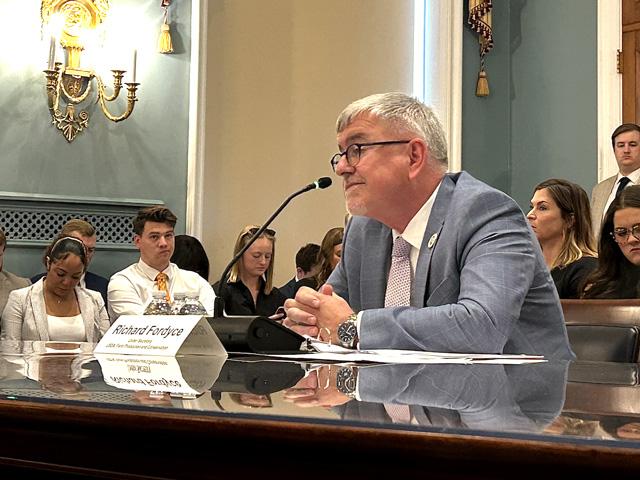
WASHINGTON (DTN) -- A day after the Senate farm bill package was released, the House Agriculture Committee met to discuss USDA's implementation of the One Big Beautiful Bill Act, which covers roughly 85% of dollars set aside for USDA, including important changes to commodity programs, crop insurance and conservation.
Richard Fordyce, USDA's undersecretary for Farm Production and Conservation, highlighted the agency's modernization efforts in his testimony, including the allocation of 30 million additional base acres nationwide, higher reference prices for Agricultural Risk Coverage and Price Loss Coverage (ARC and PLC) programs beginning with October payments and expanded crop insurance coverage options through the Risk Management Agency (RMA).
"We need to modernize our delivery systems," he said. One way he hopes to achieve that is through One Farmer, One File digitization of paperwork.
PREVENT PLANT BUY-UP
The Federal Crop Insurance Corporation in December removed the 5% buy-up coverage for prevent plant from federal crop insurance.
Rep. Angie Craig, D-Minn., questioned Fordyce over whether USDA is going to reinstate the buy-up coverage.
Fordyce acknowledged the public response to the rule change, noting USDA received approximately 350 comments. "Overwhelmingly, those comments were to reinstate PP 5%," he said. "That is under consideration currently ... I am positive personally that we'll have a positive resolution to that."
The timeline for its return would begin with notifying crop insurance companies that the option is again under consideration.
REEVALUATING PREMIUMS
Rep. Dusty Johnson, R-S.D., Eric Sorensen, D-Ill., and Nikki Budzinski, D-Ill., also raised concerns about crop insurance premiums in low-risk, low-loss-ratio states, arguing that farmers in those states often pay premiums that do not accurately reflect their level of risk.
P[L1] D[0x0] M[300x250] OOP[F] ADUNIT[] T[]
"In the Midwest, we have some of the lower loss ratios in the country, meaning farmers are paying in significantly more than they're getting out nationally," Budzinski told Fordyce.
In her district across central and southern Illinois, she said the average loss ratio is below 0.4.
Budzinski asked whether USDA would consider adjustments to the risk pool to provide relief for Midwestern states. Fordyce responded that provisions signed into law last summer should result in lower premiums and higher guarantees. "It's a better risk management product across the board," he explained.
Fordyce added that RMA recently completed a state rating study on loss ratios and committed to sharing the results with the committee. Budzinski also asked about a mandatory base-acre update. Fordyce expressed interest in obtaining a report from USDA's Chief Economist examining whether a base-acre update could lower the budget score for farm safety net programs.
CONSERVATION CONCERNS
Farmers, like their representatives in Congress, continue to point out that some conservation programs, such as the Environmental Quality Incentives Program (EQIP), are oversubscribed and hampered by staffing shortages. Lawmakers also noted that some controversial rulemaking proposals -- including an effort to eliminate prevent plant buy-up coverage -- may be reversed following public feedback.
The One Big Beautiful Bill Act (OBBBA) provided more than $34 billion dollars for conservation through fiscal year 2031, marking the largest long-term investment in Natural Resources Conservation Service (NRCS) in decades, Fordyce noted.
Rep. Derrick Van Orden, R-Wis., raised concerns of the basic functions of NRCS, application timelines and lengthy ones for conservation programs, noting EQIP applications can average three months while Conservation Stewardship Program (CSP) applications can take up to six months.
"We certainly have an opportunity to shorten," Fordyce responded. "There may be design work that has to happen as part of the EQIP project, so not an excuse, it needs to be faster."
Van Orden encouraged USDA to look at other federal agencies for examples of efficient program delivery and urged continued improvements as the remainder of the farm bill is implemented.
EQIP AND CSP FUNDING
Rep. Frank Lucas, R-Okla., described EQIP and CSP as consistently oversubscribed programs and questioned how USDA would manage increased funding demand on it most popular programs.
Last year, the number of farmers applying for EQIP and CSP contracts increased between 10% and 15%. However, the number of approved EQIP contracts fell by 38%, while CSP contracts declined by 21%, according to an Institute for Agriculture and Trade Policy report.
But demand continues to outpace available resources. "I would say that there probably are instances where we do have maybe potentially a staff shortage, which could impact that," Fordyce said.
Rep. Alma Adams, D-N.C., also questioned Fordyce about a new $700 million dollar regenerative agriculture pilot program funded through existing conservation programs. The initiative redirects $400 million dollars from EQIP and $300 million from CSP.
She argued the program was not explicitly authorized by Congress and could reduce funding available for traditional conservation projects. Fordyce responded that the initiative focuses on soil health and whole-farm conservation planning using existing conservation practices and does not displace farmers seeking standard conservation assistance.
Watch the committee hearing here: https://www.c-span.org/…
Institute for Agriculture and Trade Policy's analysis on EQIP participation: https://www.iatp.org/…
Read more at, "Farmers Lose PP Buy-Up Under New Rule," https://www.dtnpf.com/…
Jake Zajkowski can be reached at jake.zajkowski@dtn.com
Follow him on social platform X @jzajkow
(c) Copyright 2026 DTN, LLC. All rights reserved.