



Rural Communities Must Write Their Own Health Care Prescriptions
A Rural Prescription
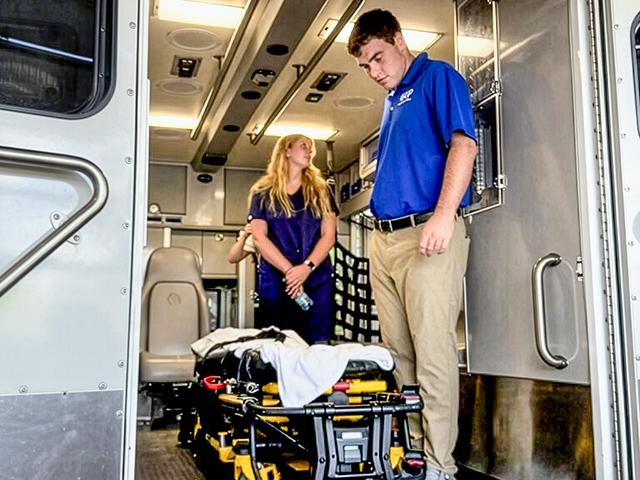
Benjamin VanDiest understands rural health care from both sides of the stethoscope. Born with a tracheoesophageal fistula and raised by medical professionals, he sees firsthand the value of maintaining rural health care. So, when the opportunity arose last year to participate in the Rural Immersion Project at Community Hospital, in McCook, Nebraska -- a partnership with the University of Nebraska at Kearney (UNK) -- the college sophomore jumped at the chance.
The experience reinforced his career plans to return to practice in rural Nebraska.
"My experience with the rural health initiative program was phenomenal," says VanDiest, who is studying exercise science with a nutrition minor on the pre-physician assistant track. "I was impressed with how the entire hospital staff worked together to provide quality care for all of their patients. Since the hospital is the hub of southwestern Nebraska, I was able to observe numerous different specialties, which I truly enjoyed."
CREATIVE SOLUTIONS TO CRITICAL SHORTAGES
The shortage of nurses, therapists and other clinicians has left communities such as McCook searching for creative solutions. Community Hospital is meeting this challenge through programs connecting education, housing and community engagement to grow the next generation of rural health-care professionals.
A model of community collaboration, the Rural Immersion Project engages the McCook Chamber of Commerce, McCook Economic Development Corp. and other organizations.
"The program was created to give health-science students real-world exposure to rural health care while introducing them to the lifestyle and opportunities a small town offers," says Troy Bruntz, Community Hospital president and CEO. "Each year, students in nursing, physical therapy, radiology and physician assistant programs spend one to two weeks in our hospital and community."
As participation grew, housing became a barrier. To solve this, Community Hospital developed the ROOTS (Rural Opportunities Offering Tomorrow's Success) housing initiative -- a 12-unit apartment complex planned, built and managed by the hospital in downtown McCook.
Students consistently describe their experience as meaningful and eye-opening. Several have expressed interest in returning to McCook or another rural community to begin their careers.
"The Rural Immersion Project both affirmed my commitment to rural health care and opened my eyes to the interdependence between providers at rural hospitals," explains Carson Radcliff, a UNK sophomore from Wilber, Nebraska. "Seeing providers work as a unified team to serve a community that they connect with and relate to is something really special. I enjoyed the community aspect of the project. By being able to immerse into the community for a week, we were able to explore landmarks, restaurants recommended by locals and other features around the town."
P[L1] D[0x0] M[300x250] OOP[F] ADUNIT[] T[]
The programs have strengthened relationships with academic partners across the state, creating new pathways for collaboration.
"Hands-on learning opportunities, strong community connections and accessible housing can make all the difference in turning a short-term student experience into a long-term career decision," says Lori Beeby, Community Hospital vice president of support services. "What began as a small pilot project in McCook has grown into a replicable framework that other communities can adapt to their own needs."
STATES TAKING ACTION
While more money -- particularly equality in Medicare and Medicaid reimbursement -- would help keep rural hospitals viable, facilities in several states have taken the initiative to "save themselves" before waiting for intervention.
"We can't wait for the government or anyone else to save our hospitals; we have to find ways to do it ourselves," says Jed R. Hansen, executive director of the Nebraska Rural Health Association. "It's the rural way -- take care of each other and find ways to make things work."
Rural health providers are increasingly forming networks -- sharing specialists, rotating providers and creating shared telehealth hubs. This collaborative spirit reduces isolation and spreads scarce resources more efficiently.
Some rural regions deploy paramedics not just for emergencies but for scheduled home visits, chronic care follow-ups and preventive checks. These programs reduce unnecessary emergency room visits and free up hospital capacity.
In Alabama, which has watched numerous hospitals close during the past decade, only 15 of 45 rural counties that had hospitals offering labor and delivery 46 years ago still provide obstetrical services. With some of the country's highest infant and maternal mortality rates, change is necessary.
The state and federal governments introduced new funding initiatives offering potential help, with Alabama corporations accessing tax credits to help rural hospitals serve their communities.
"We're very pleased by the support and the leaders who are coming together and recognizing that we can't stand by and watch more hospitals close," says Joseph Marchant, president and CEO at Bibb County Medical Center, in Centreville, Alabama.
Ten rural hospitals in Wisconsin are creating the Wisconsin High Value Network (WHVN), a clinically integrated network serving about 400,000 people. Members will collaborate on business initiatives and patient-care improvements, working together to get better prices on medical equipment and supplies.
The hospitals are teaming with Cibolo Health, which works with rural, independent hospitals to create networks. Cibolo has also formed similar networks of rural hospitals in Minnesota, Montana, Nebraska, North Dakota and Ohio.
The 10 hospitals in the network are Black River Health, Edgerton Hospital and Health Services, Grant Regional Health Services, Lafayette Hospital and Clinics, Reedsburg Area Medical Center, The Richland Hospital, Sauk Prairie Healthcare, Southwest Health, St. Croix Health and Vernon Health. Nine of the facilities are designated as critical access hospitals.
"By working together, we can deliver real benefits for patients, providers and hospitals in enhancing clinical outcomes, providing more care in our communities and controlling the costs of medical equipment, clinical software and other purchases," says David Hartberg, CEO of Vernon Health and board chairman of the network.
In Harlan, Kentucky, the local health system reinvented itself after losing inpatient services. Instead of competing with larger hospitals, Harlan shifted toward outpatient behavioral health, addiction treatment and chronic disease management, stabilizing finances and improving outcomes.
Across the country, Federally Qualified Health Centers (FQHCs) also deliver primary care in underserved areas, often regardless of a patient's ability to pay. These centers have become anchors in many rural counties, providing everything from maternity care to chronic disease management.
AI AND TELEHEALTH
Telemedicine has also emerged as a powerful tool to bridge distance gaps in rural areas. Federal and state programs subsidizing rural broadband have opened new communication pathways for health care. During the COVID-19 pandemic, remote consultations allowed specialists to reach and diagnose rural patients virtually.
Similarly, artificial intelligence (AI) is seen as a boon for rural health care as its use becomes more common. AI can enhance rural health care by analyzing health data to predict disease outbreaks or identify high-risk patients, allowing for timely interventions. It can create personalized treatment plans and provide wearable health-monitoring devices that watch patients' vital signs in real time, alerting health-care providers to potential issues promptly.
"These are just the tip of the iceberg for what AI could potentially mean for people living in rural communities with limited health-care options," says Mark T. Jones, executive director of the Minnesota Rural Health Association. "It's really encouraging and exciting to think what AI could do long term, but it obviously doesn't do much in dire or emergency situations."
While barriers persist -- spotty broadband access, reimbursement rules that vary by state and payer, and technology adoption that lags among older patients -- where telehealth works, it's a lifeline.
[PF_0426]
(c) Copyright 2026 DTN, LLC. All rights reserved.