

Small Towns, Big Resilience
Farm Belt Tightens, Main Street Adjusts
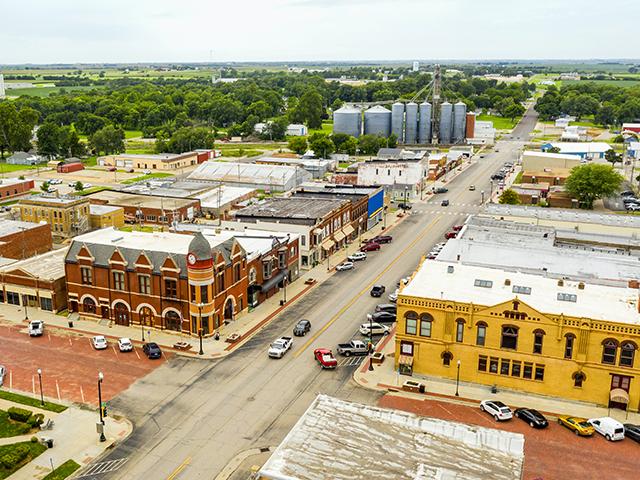
Rural America is dotted with hundreds of towns like Britton, South Dakota. Located in the far northeastern part of the state, the Marshall County seat boasts a population of a little over 1,200 in a county with a population of 4,306. Surrounding Britton are acres and acres of corn and soybeans, along with several dairies and livestock operations. It is a town smack in the middle of agriculture, where a four-way stop controls traffic on the two main highways, and where the local grocery store bagger still asks if you need help with your bags to the car.
Agriculture is an important part of the economy here, and its current downturn has created some discomfort on Main Street. "When the farm economy gets tight, farmers are going to start backing off purchases, and ultimately, that trickles down to businesses in Britton," Brian Beck says. Along with working for Full Circle Ag for 25 years, a cooperative located in Britton, Beck has served as city councilman for more than 16 years. "The bottom line is that fewer purchases mean there's less tax revenue for the city. So, that means we are adjusting our budgets to compensate. We've been conservative and watched our spending over the past few years, which has helped."
Agricultural economic health is largely determined by its location and type. "Some areas, like livestock, are faring better than others, like row crops," says Chrystol Thomas, assistant professor and Extension specialist in the department of agricultural economics at Texas A&M University. But, in areas that are suffering, the ripple effects can cascade from the farm gate to Main Street. "If you have a business that is heavily reliant on agriculture, most likely these are the only businesses of their type in a small community. So, when they suffer, they may reduce their workforce, which means these workers may reduce spending in the community. So, now other businesses are affected. Overall, these effects tend to be much larger than in more urban areas."
And, the pressure on the ag economy has been sustained in one form or another for several years. "The year 2022 was a high-water mark, and the overall ag economy has been down since then," explains Ernie Goss, Jack MacAllister Chair and professor of economics at Creighton University. He heads the university's Rural Mainstreet Index survey, a monthly survey of bank CEOs in a rural 10-state region dependent on agriculture. "We thought 2025 would be a better year, but that just didn't hold up. However, strong livestock prices supported farmers and ranchers with livestock operations. And, while bankruptcies and delinquencies have not increased significantly, the overall financial situation is not strong," Goss points out. "Market volatility and uncertainty have the potential for further belt-tightening in 2026."
The region's overall index reading for December 2025 increased to 50.1, its highest mark since July 2025, up from November's 44. The index ranges between 0 and 100, with a reading of 50 representing growth neutral. "Weak agriculture commodity prices, livestock aside, and high input costs for grain producers continue to restrain economic activity in the 10-state region," Goss says.
"You can segregate some areas of ag that have seen some positive gains, like livestock, but overall, the ag economy has been in contraction," says Matt Clark, senior rural economic analyst for Terrain, a team of economists and analysts who provide insights on economic factors, trends and agricultural markets. "When large parts of the agricultural economy are struggling, some of the rural economies are struggling. That could be businesses that work directly with ag, like co-ops or machinery dealerships. It also hits ag manufacturing located in rural communities. And, downturns there impact the entire community."
While the price of corn may have an indirect impact on the amount of money spent in town, there can be underlying factors that can impact the overall health of rural communities.
Agriculture has always faced economic ups and downs to varying degrees. "In general, when we look at the overall health of the ag economy, rural communities are often more impacted by periods of rapid transition," says Jase Wagner, president and CEO of Compeer Financial. "And, several rural communities have invested in areas outside of agriculture to strengthen their overall economy."
One example, he says, is how some rural communities have been actively investing in health-care facilities. "By keeping health care local, residents can stay close to home and spend money in their communities -- rather than traveling to metro areas -- supporting rural economic vitality."
Wagner says another bright spot he's seeing in Compeer's 144-county footprint is a renewed investment in these rural communities by industries outside of agriculture. "More industries are looking at bringing manufacturing to the U.S., whether driven by tariffs or avoiding a repeat of the supply chain disruptions we saw during COVID," he adds. This, in turn, is helping to shore up rural communities.
P[L1] D[0x0] M[300x250] OOP[F] ADUNIT[] T[]
THE POST-COVID-19 IMPACT
The supply-chain disruptions experienced during COVID-19 have shifted the manufacturing dynamics, and rural communities are taking advantage. "The supply chain dynamics are such that U.S.-based suppliers are more reliable, they can expand and allow those dollars to be invested in rural communities," Wagner explains.
The other impact is the flocking to the rural lifestyle experience. "We continue to see movement to rural communities from people seeking a rural lifestyle. They work remotely and make a local economic impact," he says. "We continue seeing accelerated interest and activity in new home construction in rural areas, even after significant growth in recent years."
And, the impact is more than just bringing jobs into rural communities. "The interest in living a rural lifestyle impacts the economic engine that goes with it," Wagner says. "And, that gives communities the ability to invest in essential community facilities, whether that's a rural hospital, clinic, assisted-living facility or even day care."
Erik Peterson, chief financial officer at Marshall County Healthcare Center, was drawn to Britton because of the more rural lifestyle. He relocated there after living in Sioux Falls with his family. "I had only lived in larger cities my whole life, so I really didn't know what to expect," Peterson says. "I visited during the interview process, and what struck my wife and I was that this was a town that was really good for families."
Despite its size, Britton boasts a new community event center built thanks to a large donation by a local manufacturer, a community pool, a robust emergency services department that's received extensive community financial support and a medical center that ensures most medical needs can be handled locally (the next medical center is nearly an hour's drive away).
WE'VE BEEN HERE BEFORE
The current economic downturn is nothing new to agriculture. In his book "The Farm Debt Crisis of the 1980s," published in 1990, renowned agricultural economist Neal E. Harl, wrote: "Without much doubt, the [agricultural] sector will once again experience trauma like that of the 1980s sometime in the 21st century. It is not known when a farm debt crisis or other cataclysm in U.S. agriculture will come about -- in 2035, 2040 or 2050. But, it is likely to occur when memories -- and warnings handed down to succeeding generations -- have faded, and the galaxy of economic conditions is positioned to create a sense of overconfidence among farm decision-makers."
In rural areas, ag suppliers are adjusting to a reduced demand for products and services. "But, these businesses have seen this situation before in agriculture, and they have a playbook of how to work in this environment," Compeer's Wagner says. "While any downturn is not good for business, they have past experiences to draw from."
What's also unique to many rural communities is that businesses that service rural areas aren't much different than the farms in the area. "These businesses are often multigenerational, so they've been through the ups and downs of the agricultural economy," Clark says. "They may be hurting financially, but that doesn't mean that they are insolvent."
WHAT LIES AHEAD
There is a bit of divergence on rural Main Street, with stories of success and survival versus decline or struggle. "Communities that are attracting different businesses are further ahead," Wagner says. "Agriculture needs rural communities more than rural communities need agriculture. Typically, a rural community can survive an ag economy downturn over time, but they have to be prepared."
Consolidation in certain businesses like cooperatives and equipment dealers can benefit some communities while hurting others. "Consolidation decisions are driven by both geography and the ability to recruit and retain a long-term workforce," he continues. "That's where we see a lot of differentiation."
Investment, and a willingness to work together, will be imperative. "Local development authorities need to understand the best fit for their community, because you can attract a manufacturing facility, but they may not be the right one, so they won't stay long term," Wagner says. "If these communities work together to attract one manufacturing facility, collectively, they have enough housing, access to health care and infrastructure to support a broader region. We are funding grants to help communities think differently about how to work together to create that economic vitality."
COMMUNITIES WORK TOGETHER
A common theme among many rural communities is resilience. Communities that have faced adversity before will face adversity in the future and have come together to ensure their survival.
"Relationships matter, and that's a hallmark of rural communities," Texas A&M's Thomas says. "Rural communities come together and rally to support each other, and not just the result of changes in the agricultural economy. We see this all the time, like when we see natural disasters. There are many instances where when a tornado comes through a rural community, people come together to rebuild."
She explains that these strong relationships and pride in their community have resulted in rural communities being as strong as they are. "That togetherness is something that you might not find in a more urban setting," she says.
Because of the location of many rural communities, their distance has meant that they've had to be more self-sufficient longer than their urban counterparts. "This inherently means that rural businesses have had to manage their business and resources far differently than someone in an urban area," Clark says.
Peterson, who currently serves on the Britton City Council, says, "You hear so much that small towns are slowly dying. But, when I came here, I saw a community that was in good shape. Sure, we have our struggles, but we come together as a community."
Beck, who has lived in Britton for more than 30 years, says the town has an advantage over a lot of small communities because of the manufacturing jobs available, the hospital and the cooperative. "Britton has always been very resilient and always will be," he says.
[PF_0426]
(c) Copyright 2026 DTN, LLC. All rights reserved.