


Canada Markets
Could 2026 Be the Year Spring Wheat Finally Delivers?
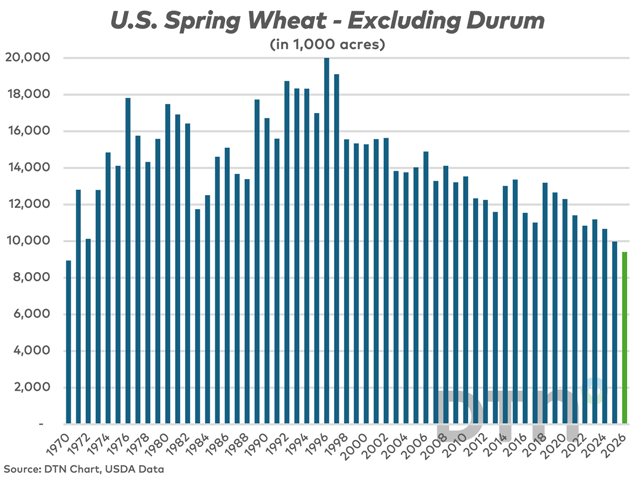
Even though wheat markets were sharply lower as I prepared this blog on Wednesday morning (on forecasts for the best rains of the spring to roll through the center of Oklahoma during the next three days), the big-picture outlook for wheat is arguably the most optimistic it has been for years.
Tuesday's Prospective Plantings report can take part of the credit with spring wheat (excluding durum) leading all-wheat to a lower-than-expected outcome. Other spring wheat (excluding durum) planting intentions came in at 9.415 million acres compared to an average pre-report estimate of 9.843 million and below last year's 9.990 million acres. If realized, that will be the lowest since 1970, as seen in green on the accompanying chart.
That contributed to a miss for all-wheat planting intentions with the total coming in at 43.775 million acres compared to pre-report estimates of 44.786 million and last year's 45.328 million acres. If realized, that will mark the lowest total wheat area in the U.S. since 1919. Nothing cures low prices like low prices.
But the low seeded area figure is not the only challenge to wheat production in the U.S. -- or globally. Drought still has a firm grasp on the U.S. Southern Plains with 55% of the winter wheat area in some level of drought (compared to just 24% last year). This will lead to tough decisions on top-dressing nitrogen, given the fertilizer situation thanks to the closure of the Strait of Hormuz. The rain forecast for this week will likely help in that decision-making process for some areas of the eastern Southern Plains.
The closure of the Strait of Hormuz to energy and fertilizer passage (as well as everything else) adds to much greater issues. Questions remain regarding the supply of nitrogen, the price, the resulting application rates, and finally the total impact on cereal grain production globally. But a much more consequential impact may be seen for Australia.
P[L1] D[0x0] M[300x250] OOP[F] ADUNIT[] T[]
With that country so heavily dependent on imports of both fuel and fertilizer from the Middle East region, the fact that Australian farmers' seeding of wheat, barley and canola normally occurs from now until June, their supplies already critically short going into seeding, and that experts suggest it will take three to four months to return to normal shipments once the Strait of Hormuz is finally open -- it's hard to imagine a scenario where a normal production level can be expected from Australia. The critical part is timing: Once the seeding window is missed, it is missed for the entire year. And, for reference, Australia produced 36 million metric tons (mmt) of wheat in 2025-26 compared to just 26 mmt as recently as 2023-24. That was with normal supplies, suggesting the production risk is significant.
In Canada, we are much more fortunate but are still feeling the pain on both fertilizer and fuel pricing, potentially curtailing use of the former. With drought still affecting Southern Alberta and Southwest Saskatchewan, producers may not be willing to take a chance on a repeat of the timely rains that saved the crop last year. Especially if grain prices don't respond to the bullish signals.
As far as our planting intensions go, the best we can do is consider the Statistics Canada report from March 5 that Agriculture and Agri-Food Canada (AAFC) is using that was based on a survey from late December through early January, so simply a starting point at best.
That said, Statistics Canada predicted other spring wheat area will remain relatively unchanged from last year at 18.781 million acres versus 18.809 million last year and 18.943 million acres in 2024. That was very close to pre-report estimates at the time and provided a good starting point for the debate as to whether the fertilizer issue and dry conditions will reduce area and production from there, or not.
It's worth noting that AAFC assumes a return to more normal yields based on those seeded acres will result in ending stocks contracting from 2025-26 levels to 4.6 mmt, a relatively tight level.
It's also worth a quick mention that the rally experienced in wheat markets during the past six weeks has drastically improved the technical outlook on the charts, potentially attracting buying interest from managed money traders. Not to mention the increased interest from commodity index traders as a hedge against inflation.
Despite all the above, wheat markets do have a habit of ignoring bullish news and focusing on bearish headlines instead. As such, a disciplined marketing strategy of rewarding rallies with small incremental sales while patiently watching how the situation unfolds may be wise.
**
I welcome feedback along with any suggestions for future blogs. My daily comments can be found in Plains, Prairies Opening Comments and Plains, Prairies Quick Takes on DTN products.
Mitch Miller can be reached at mitchmiller.dtn@gmail.com
Follow him on social platform X @mgreymiller
(c) Copyright 2026 DTN, LLC. All rights reserved.