

Son and Granddaughter Return to the Family Farm for Possibly the Last Wheat Harvest
Harvest Time Is Family Time
It was a four-letter word that transformed a simple admission into the cruelest thing I ever said to my dad. I was 11 years old, and he was trying to help me with my homework. As he leaned over my shoulder to explain something -- long division, probably -- I lashed out.
"I'll never need to know this," I snarled.
"You might. I use math in farming all the time," he replied.
"I don't want to be just a farmer," I shot back.
Words matter, and so does their order.
"I don't just want to be a farmer" says that maybe I'd like to mix a career as an astronaut in with growing crops.
"I just don't want to be a farmer" might also say, "I don't want to let you down, but alas, I must."
I didn't say it like either of those, though. I said it mean.
"I don't want to be just a farmer."
The note of irony did strike me when, about three decades later, all I wanted was to get my oldest daughter back to the family farm, though the world seemed to conspire against it.
We were nearly 1,100 miles away. The weather wouldn't cooperate, with heat and rain pushing our target -- the summer's wheat harvest -- forward and backward without a shred of concern about our plans. And, she was too busy, with dance practices and summer camps crowding the tiny window we had left available.
It wasn't easy, and that's why her words a week later meant so much.
"Dad," she said one night, teetering on the edge of sleep in the house where I grew up after a long day of wheat harvest, "I'm glad I came to Kansas."
AMBER WAVES
Wheat harvest was a way of life for my family in south-central Kansas on an 800-acre fourth-generation farm. It doesn't feel like long ago, but it was a different era: dryland corn and soybeans were nonexistent. There was some sorghum every fall, but wheat was king, and harvest monopolized our lives for the month of June. No other plans could be made -- vacation taken or camps attended -- until the wheat was cut.
Harvest meant long, hot days in the field. Lunch was just a few quick minutes under a shade tree or in a minivan. Dinner never came before 10 p.m., and we'd run past midnight if rain loomed.
My first real job on the farm -- when I was maybe 11 years old -- was pulling the unloading wagon, driving a John Deere 4020 with a radio that barely worked and no cab, let alone air-conditioning. The wagon was a teacup, just big enough to handle one load from Grandpa's Gleaner L2, with an auger so stubby you had to all but rub the outer tractor tire on the truck bed to unload.
P[L1] D[0x0] M[300x250] OOP[F] ADUNIT[] T[]
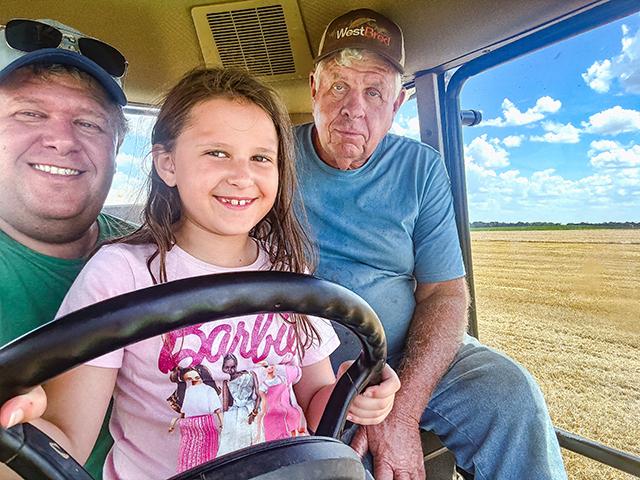
When I think back to those days, I don't remember being tired or hungry. I don't even remember being hot, though a 99°F day on the 4020 had to have been horrible. What I do remember is family. I remember riding in the combine with my grandpa and later my dad. I'm 43 years old and can't think of a seat more comfortable than the little one next to those men in the combine.
I remember aunts and uncles driving the grain trucks, and my mom with the lunch and snacks. I remember great-aunt Elsie would drive out from town with a cooler of cold beer in the evenings.
Wheat harvest was exhausting and stressful, even as a kid expecting to be paid regardless of yield or price. Yet, it felt like a celebration.
Memories of harvest are central to who I am and where I'm from in ways I never appreciated when I was 9. Going into last summer, my two daughters knew absolutely nothing of it.
A GENERATION REMOVED
There were plenty of reasons I never went back to farm. I bumped (some say "crashed") the 4020 into a barn during that first harvest I helped with. It was the start of an error-prone tractor-driving career. My proclivity to break things made it especially unfortunate that I wasn't fond of spending time in the shop fixing things. And, I had too little patience to wait for seeds to grow and too much willingness to let wayward weeds survive.
But, with age has come appreciation for what farming did give me. I now know that most things can be fixed with a little bit of effort and ingenuity. My ability to back up a trailer is wildly out of sync with the fact that I cut a quarterly check to an HOA. And, above all, I have a rooted understanding of a part of the world that's mysterious to so many.
Most students in my rural high school 25 years ago were at least one generation removed from farming, and that's felt more pronounced as I've gone on in life. I tell someone where I'm from or what I do for work, and some proudly explain they understand because their grandpa farms, or their uncle or their second cousin. But, I wonder, do they really understand?
What bothers me the most is that my children may not.
Lydia was 7 entering last summer and Eleanor 4, and they've existed a world away from the farm. They've known Grandpa Larry was a farmer, and they've been to the farm. But, they'd never been farming -- a fact not easy to change living 16 hours away.
There's always been a reason not to go back -- often a dozen -- with summer days full of camps and evenings filled with dance classes and soccer practices.
What changed last summer was that my dad, 73 years old, is on the verge of retirement. Wheat harvest has been a fixture on the Reichenberger family calendar for more than 130 years, but that likely will end when my dad and his brother, who farm together, hang up their tractor keys.
Because I didn't go back to farm, nor did my brother or any cousins, there will be a "final family harvest," and it will be soon. With that in mind, we decided to make the time to get our oldest back to the farm.
So, my wife and I left a week in mid-June open in Lydia's schedule, and as the date approached, we prepared with suitcases and car snacks.
THE RAINS CAME
But, while we packed, wheels turned in Kansas. Harvest started five days earlier than my dad expected. So, I rescheduled. Combines were rolling, and we needed to be.
The plans changed even more when humidity pushed the wheat's moisture too high and paused the party before a torrential downpour -- nearly 6 inches in three days -- which straight up stopped it. That pushed harvest not only back to the original timeline but straight through the week we'd set aside.
Lydia had commitments that next week, and life was set to resume. We had missed our chance.
We vowed to try again the next year, but I couldn't stop thinking: Harvest next year could be in May (it was once) or July (it almost was last year). I had no idea what our schedules would look like, but I did know if we skipped a summer camp we'd already paid for, the last two dance classes of the season and the associated ice cream party now, Lydia would see wheat harvest.
After some cajoling, she agreed, and we set off.
SIXTH GENERATION
All I could think about on that drive was what my children won't have that I did. They won't have summers helping on the farm. They won't see 10 harvests. They may not even see two.
But, after 32 hours in the car, all that stood out was what we did have, including three days of rides in the combine, tractor and trucks.
Uncle Jack gave Lydia a grand tour of the elevator in town. Months later, she still remembered the mechanics of the facility almost as well as the three Dum-Dum lollipops she got from the staff at the scale.
We had time with family. Great-aunt Elsie is more than a decade gone, but Aunt Paula showed up at happy hour with a cooler.
We had Lydia engaged, excitedly relaying what she'd learned to her mom over the phone as we prepared for bed.
"Fun fact, Mom," she said. "Did you know you can make 1,400 loaves of bread from the wheat in one load from Grandpa Larry's combine?"
We had lunches in the minivan, dinners after 10 p.m. and real hours in that most comfortable of seats, the one in the combine next to Grandpa.
We had three days of her being just a farm kid, riding equipment and spending time with family at harvest -- the sixth generation of Reichenbergers to be so lucky.
We had Lydia looking out the window all 1,068 interstate miles home explaining why farmers planted this in their field instead of that, insight she gleaned from conversations during the week.
And, thank God we skipped a week of summer camp, two dance classes and an ice cream party to drive across the country to give it to her.
We may not have it all, but we'll always have, "Dad, I'm glad I came to Kansas." And, that just might be enough.
**
-- Follow Joel on social platform X @JReichPF
[PF_0326]
(c) Copyright 2026 DTN, LLC. All rights reserved.