

Clayton's Favorite Story of 2025
When Talking About Farm Labor, a Picture is Worth 1,000 Words
As the year comes to a close, we've once again asked the DTN/Progressive Farmer reporting team to pick out the most significant, most fun, or otherwise their favorite, story of 2025. We hope you enjoy our writers' favorites, continuing the series with today's story by DTN Ag Policy Editor Chris Clayton.
**
OMAHA (DTN) -- Most of us are familiar with the old saying, a picture is worth a thousand words.
That's held true for me my entire career in journalism. But I was a writer long before digital cameras and modern phones turned me into a halfway decent photographer.
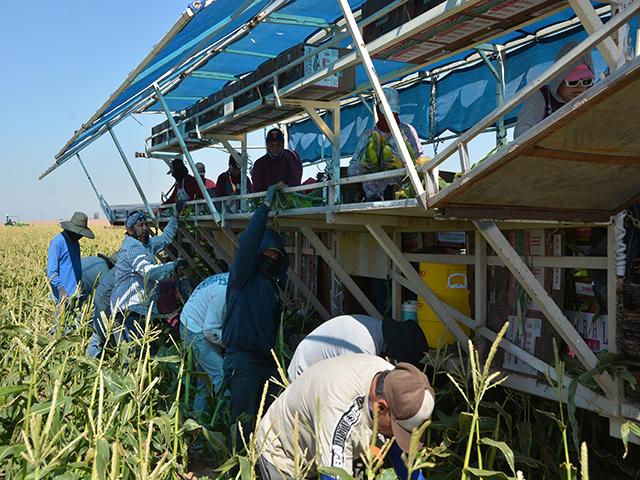
The photo above may look simple, but it tells a complex story about farm labor in America, one that I tried capture on a trip to Arizona and California back in April.
We were putting together a package of articles for Progressive Farmer magazine on farm labor at the time.
I traveled to Yuma, Arizona, to visit John Boelts, president of the Arizona Farm Bureau, who has become one of the stronger voices in agriculture on the farm-labor crisis in the country.
"American agriculture is withering on the vine due to a lack of workers," Boelts told me.
That's a great quote, but I was at Boelts' farm at the wrong time. He was between harvests, so Boelts didn't actually have anyone physically working on his farm at the time.
P[L1] D[0x0] M[300x250] OOP[F] ADUNIT[] T[]
I had gone out there to get some photos of people working in fields, so I kind of panicked a little.
Boelts suggested there might be some people still doing harvest work in Brawley, California, which is about 70 miles west of Yuma.
Brawley itself is something of a special place for me, even though I have only been there a handful of times, because my stepfather was born there. My grandpa was a farm manager in Brawley in the 1940s and '50s. When the 1950 Census was released to the public, I found their names in the data, which I thought was pretty cool at the time.
So I headed off to Brawley, and I drove up and down roads outside of town until I came up on a single crew setting up to harvest onions. I spent about an hour watching a handful of guys pulling up the irrigation lines while some other workers moved around large open containers that pickers would later fill by picking up the onions, cutting the green stems and dropping them in the containers that were so large it took a forklift to move them when they were full.
One worker caught my attention as he went back and forth setting up the empty containers. He wore a red ballcap with "MEXICALI" on it and told me everyone in the crew was from across the border in Mexicali, which is just south of Brawley. He was 57, same age as me, and told me he had been working as a farmhand most of his adult life. A nice guy, but he was cautious about giving his name to a journalist.
I was about to pack it in and head back to Arizona when I came across another group of farm workers picking and packing sweet corn. That's the photo you see accompanying this story.
There were three crews of about 20 people each in the field. They had a set of pickers, then another group of workers on a conveyor loading boxes of corn ears, which they then immediately stacked on a trailer to haul out of there for shipping.
Again, they continued working away while I furiously snapped photos watching guys stoop down picking ears as they go. I thought, "That would kill my back in about five minutes."
I was sweating just watching these men and women work. It was 10 a.m. when I walked out of the field, pleased as heck with the photos I had just shot. The temperature gauge in the car said it was 93 degrees Fahrenheit.
I cranked up the AC and headed back toward Phoenix.
My article focused heavily on the flawed H-2A program, but also touched on the Trump administration's increased focus on deportations. It wasn't long after the article ran that we saw more reports about ICE raids in California, dairies from New Mexico to New York, and even a small meat processing plant in Omaha.
As of today, there is no fix for the farm labor crisis, except the Trump administration cut wages for H-2A workers.
I think about that guy in the onion field and those workers picking sweet corn. All they were doing was putting food on people's tables.
When other editors picked a photo for the article to publish on the website, they chose a guy in a tractor. And to me, that didn't quite tell the story about what on-the-farm "labor" really looks like.
See, "Farms Find Value in Foreign Labor, But at What Costs?"
Chris Clayton can be reached at Chris.Clayton@dtn.com
Follow him on social platform X @ChrisClaytonDTN
(ES/cz )
(c) Copyright 2025 DTN, LLC. All rights reserved.