


UP-Norfolk Southern File With STB
Railroads Tout Transcontinental Benefits of Merger, But Ag Shippers Urge Scrutiny
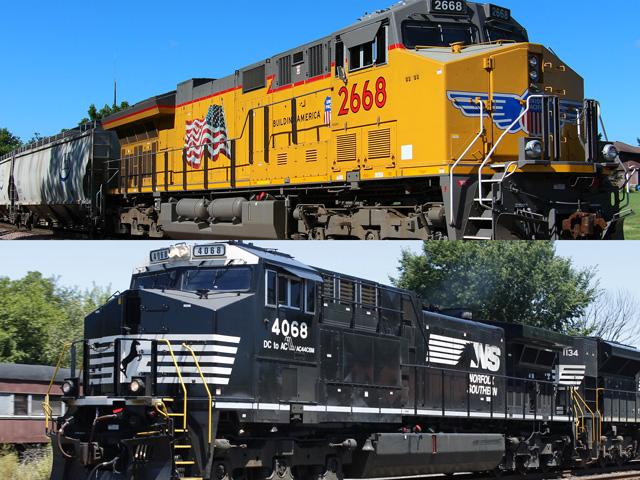
OMAHA (DTN) -- Lawmakers, businesses and unions are weighing in after Union Pacific and Norfolk Southern railroads filed their official merger application to combine the two railroads, a deal that would create the country's first transcontinental railroad.
The railroads filed a 7,000-page application with the Surface Transportation Board (STB) on the $85 billion deal, which would create a single railroad capable of moving freight from the Pacific to the Atlantic. The railroads cite that combining the companies would reduce or eliminate "time-consuming handoffs between railroads," improving the efficiency and speed of cargo moving across the country as a result.
The application includes 2,000 letters of support from various stakeholders. Shareholders from both companies voted 99% in favor of the merger last month.
The STB is now tasked with deciding whether to greenlight the merger -- a process that is expected to take as long as two years. Under the last major railroad merger between Canadian Pacific and Kansas City Southern (CPKC), it took the STB nearly two years to approve the deal, which was less than half the scale of the UP-Norfolk Southern deal.
BUSINESS GROUPS QUESTION VALUE
The Rail Customer Coalition -- a collection of industry trade associations -- "issued a stark warning" and called for a rigorous review.
"The proposed merger would mark the largest railroad consolidation in U.S. history and the most consequential case ever reviewed by the STB. It is an unprecedented test of the Board's updated merger standards that were adopted after previous mergers upended the rail network and crippled the national supply chain," the coalition stated in a news release.
P[L1] D[0x0] M[300x250] OOP[F] ADUNIT[] T[]
The Rail Customer Coalition release included statements from the head of the American Fuel & Petrochemical Manufacturers (AFPM), the American Chemistry Council, the American Cement Association, the Essential Elements Association, and the Agricultural Retailers Association.
"Farmers and ag retailers operate on razor-thin margins, so even a small, artificial cost increase can have a big impact," said Daren Coppock, president and CEO of the Agricultural Retailers Association. "When rail service is dominated by just a few players, they hold the power to set terms that work for them -- not for the shippers and customers who depend on rail to move agricultural commodities, fertilizer, ag chemicals, fuel, and other essential supplies. That imbalance drives up costs and threatens the reliability of our entire supply chain."
The Fertilizer Institute also raised concerns about limited railroad options and increased costs, questioning how a coast-to-coast merger would improve the imbalance between railroad companies and shippers.
"Today, railroads hold all the cards, and larger railroads only give carriers a bigger deck," The Fertilizer Institute stated. "Now that UP and NS have submitted their merger application, we urge the Board to make the merger's impact on carload shippers, including fertilizer and agriculture, a priority during the review process."
LAWMAKERS, OTHER OFFICIALS WEIGH IN
Lawmakers weighed in on Friday with a collection of mixed messages to the STB on how to handle the giant merger.
Union Pacific is based in Omaha, so it may come as no surprise that the five-member Nebraska congressional delegation urged the STB to approve the merger. In a letter led by Sen. Deb Fischer, R-Neb., the Nebraska lawmakers said they believe the merged rail line "will enhance competition and provide value to the public." The Nebraska lawmakers added that there was limited overlap between the existing UP and Norfolk Southern networks, resulting in "only a handful of shippers seeing service decreased from two freight rail carriers to one."
Sen. Tammy Baldwin, D-Wis., called on the STB to reject the merger, saying it would "worsen already poor service and high costs experienced by Wisconsin farmers and manufacturers while jacking up costs on consumers as businesses pay more to get their products to market." Along with Sen. Roger Marshall, R-Kan., Baldwin had written the STB back in July, questioning the impact the merger would have on areas that already face poor rail service. Baldwin also noted that railroad consolidation since the 1950s had reduced the number of Class I railroads from more than 100 freight railroads down to just six now.
In late October, a bipartisan group of 18 senators led by Sens. John Hoeven, R-N.D., and Amy Klobuchar, D-Minn., also sent a letter to STB members asking for "a rigorous and comprehensive evaluation" of the proposal to ensure competition remains among Class I railroads. The senators specifically said the STB "should take into account the long-term implications for the movement of agricultural products across the domestic rail network, including potential impacts on shipping costs and market access."
Last month, nine Republican attorneys general also sent the STB a letter challenging the merger from the states of Florida, Iowa, Kansas, Mississippi, Montana, North Dakota, South Dakota, Ohio and Tennessee.
UNIONS
Unions are split on the deal as well. The Sheet Metal, Air, Rail and Transportation Workers-Transportation Division (SMART-TD) union announced in September that the group backs the deal, as does the International Brotherhood of Railway Boilermakers. Two other unions, the Brotherhood of Locomotive Engineers and Trainmen (BLET) and the Brotherhood of Maintenance of Way Employees (BMWED), announced this week that they oppose the deal.
Also see "Union Pacific, Norfolk Southern Shareholders Vote Yes to Proposed Merger" here: https://www.dtnpf.com/….
Chris Clayton can be reached at Chris.Clayton@dtn.com
Follow him on social platform X @ChrisClaytonDTN
(c) Copyright 2025 DTN, LLC. All rights reserved.