



Kub's Den
Old-Crop Contracts Still Center of Attention
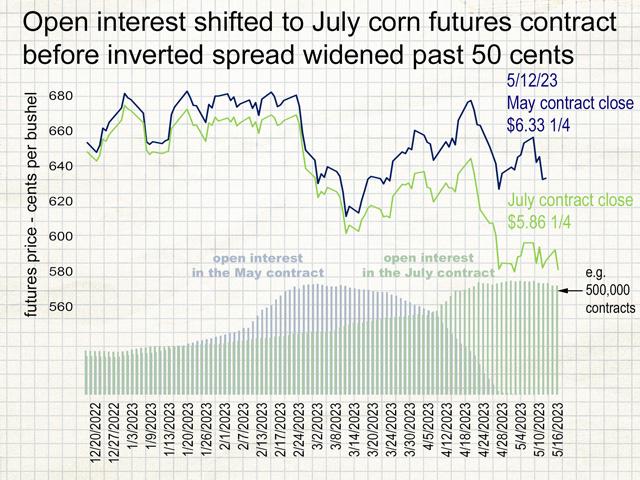
We've seen some wild behavior in grain prices again lately -- soybeans dropping 36 cents per bushel in a day, corn lurching 13 cents lower in a single session -- but at least some of this can be explained by the shift in "front-month" contracts. A continuous futures chart, which simply tracks the prices of each successive "front-month" futures contract after each previous contract expires and falls off the calendar, will always be vulnerable to artificial-looking jumps in price if the expiring contract's price looks much different than the new "front-month" contract's price.
For instance, when the May 2023 corn futures contract stopped trading last Friday, it was worth $6.33 1/4 per bushel. After that, the continuous chart picks up the July futures contract, which closed on Friday on $5.92 1/2, but it's a bit misleading to think the corn market overall suffered a sudden 41-cent change on that one day.
It may be alarming if all you see is the simple "soybeans" ticker saying $14.35 one day then suddenly $14.00 the next, or it may seem inviting if you're a computer algorithm trawling the front-month quotes for any sudden unexplained buying opportunities. But the real structural developments in these markets took place long before the May futures contracts' expiration last Friday.
The folks out in the countryside actually buying and selling grain already switched their bidding process to reference the upcoming July futures contract sometime last month. Open interest in the July corn futures contract (400,313 contracts) overtook the open interest in the May corn futures contract (373,931 contracts) on April 10, 2023. Yes, a lot of that open interest was the participation of "managed money" speculators, but by far the largest contingent of corn futures traders are the bona-fide commercial hedgers (producers, merchants, processors, users), so the overall movement of open interest from one contract month to the next is likely led by that bona-fide hedging activity.
P[L1] D[0x0] M[300x250] OOP[F] ADUNIT[] T[]
DTN's ProphetX trading platform has two ways to show continuous grain price charts: 1) the continuous front-month charts, which always track the price of the front-month contract, even when that contract is near expiration and has very little open interest; or 2) the "most-active" charts, which track the price of the contract with the most daily trading volume (versus a moving average of contract volume), giving a seamless look at the most heavily-traded price tag for each grain. The July corn futures contract has been the most actively traded contract since April 19 by these metrics, so on the DTN ProphetX continuous "most-active" chart, there is no sudden jump between last Friday's close ($5.86 1/4) and the following session's performance ($5.92 1/2).
However, even the continuous "most-active" chart's transition from one contract to the next hasn't been exactly seamless. In fact, its unrelenting downward trend is a demonstration of how badly an "inverted" market wants to motivate grain sales sooner rather than later. We know that, typically, the futures markets for grain, an annual crop meant to be stored from one month to the next, displays a positive "carry" structure, with later months being priced higher than nearby months to reimburse owners for the costs of storing the grain. When the opposite occurs -- when nearby contracts are priced higher in an "inverted" structure -- this is a sign of intense bullishness, showing that the market wants to incentivize owners to sell their grain now, urgently, rather than keeping it off the market. That's what we're seeing in the old-crop corn and soybeans (and hard red winter wheat) markets.
When the May corn contract expired, it was 47 cents higher than the July contract (instead of roughly 10 cents lower than the July contract, which would have been typical in a market with a normal supply scenario). The front-month July contract is presently 71 cents higher (inverted) over the new-crop December contract. These are wild times indeed.
So, while the new-crop fundamentals get all the headline-grabbing attention ("87.5 Million Acres of Soybeans!" "Record-Large Corn Crop!"), the old-crop market remains the one where the action is spiciest. It is certainly the trickier market to trade because, while there is some natural limit to how wide normal carry spreads will go (generally not past 100% of the full commercial costs of carrying the grain), there is no guidance for how far inverted spreads can widen once they become inverted. In June 2013, for instance, summer urgency brought the July 2013 corn futures contract $1.32 higher than the September 2013 contract. Similarly, in June 2021, the July-to-September spread hit $1.20 wide, and in June 2022 the July-to-September spread hit $1.15.
Therefore, anyone still holding old-crop grain should continue to beware of this inverted market, particularly if they are holding the grain in a futures-hedged position. Presumably, commercial grain elevators are going into this season with their eyes wide open and with full guidance from their futures brokerage about potential losses if they're forced to roll hedged positions from July to some later month. But even for individual farmers who might be holding unhedged grain with some hope for a hot summer basis market -- beware. The market is trying to communicate that today's prices are a limited-time opportunity and, at this point, the month-by-month price tags look like they're only going down from here.
**
Comments above are for educational purposes only and are not meant as specific trade recommendations. The buying and selling of grain or grain futures or options involve substantial risk and are not suitable for everyone.
Elaine Kub, CFA is the author of "Mastering the Grain Markets: How Profits Are Really Made" and can be reached at masteringthegrainmarkets@gmail.com or on Twitter @elainekub.
(c) Copyright 2023 DTN, LLC. All rights reserved.