



Fall Grazing Management
How Much Forage Is Grazed in Fall Affects Production Next Spring
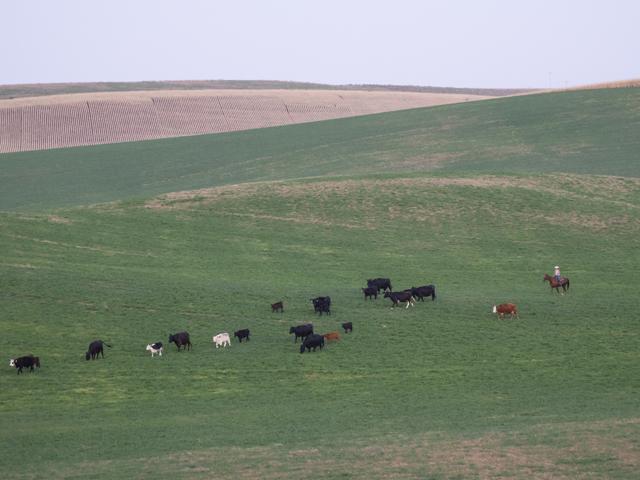
OMAHA (DTN) -- The grazing season is coming to end, and how much grass was grazed in the fall will have an effect several months down the road. Proper grazing management in the fall will lead to more grass available come spring.
Different forages need different grazing management strategies to go into dormancy in the proper condition. The fall is also a good time of year to control weeds, especially thistles, according to Extension specialists.
DROUGHT AFFECTS FALL MANAGEMENT
Ben Beckman, a University of Nebraska-Lincoln (UNL) beef systems assistant Extension educator based in Hartington, Nebraska, told DTN the severe drought this growing season that enveloped the entire state should have grazers operating slightly different this fall.
Grazing is stressful enough for plants, but adding drought and grazing is a recipe to damage plant health heading into dormancy. The more stress plants are put under, the less likely they can pull through winter unaffected, he said.
"With dry weather, the risk of overgrazing increases," Beckman said. "So, grazing a plant that is already stressed by drought can put it in a pretty bad place if we don't give it time to recover fully before winter."
One caveat to this is plants that are already fully dormant. If the stress from drought has been so bad that the plant is already dormant, then it can be treated as it normally would during the winter and dormant season grazing, he said.
Beckman said the above-ground portion of the plant is no longer photosynthesizing, so its removal by grazing is less impactful. Overgrazing, however, can still occur by allowing what is left to get too short and stress the plant's crown and roots going into winter.
This can also lead to the plants not being able to catch snow in the winter and thus reducing moisture levels, he said.
Some areas did see some grass growth this fall with the return of limited moisture, he said. While it may be tempting to put livestock on these acres, grazing this time of year puts more pressure on the plants as they head into winter.
Beckman said plants expend energy to grow, and if the plant has been unable to put down reserves due to dry weather, it's really pulling deep to put some growth out this fall. The plant is gambling it will be able to produce enough energy with this growth by photosynthesis to replace what it has used, he said.
P[L1] D[0x0] M[300x250] OOP[F] ADUNIT[] T[]
"When we remove that growth by grazing, we remove the ability for the plant to replenish reserves and in some cases can cause further depletion if the plant tries to regrow," he said.
Producers will sometimes overgraze because livestock need a place to get feed, and thus, pastures/rangeland get pushed harder than normal. Producers need to do their best to mitigate this stress and allow these areas to rest longer come the next growing season, Beckman said.
WATCH TILLER GROWTH
North Dakota State University (NDSU) Extension recently had a news release about fall grazing management
Pasture/rangeland in North Dakota is dominated by cool-season grasses, which can develop tillers in the fall, according to Miranda Meehan, NDSU Extension livestock environmental stewardship specialist. The development of these tillers has a direct impact on plant growth the next year.
If grazing is allowed below the bottom two leaves in the fall, the plants will likely not survive the harsh North Dakota winter, she said.
"If tillers do not establish or survive the fall, a delay in growth and development will occur the following season due to new tiller development in the spring," Meehan said in the news release.
Monitoring the degree of use is one way to prevent negative effects on developing tillers. The recommended utilization level for proper use of grasslands is 40% to 60%. At this level, rangeland utilization is fairly uniform, with 65% to 80% of the height of the desirable forage species being grazed.
A recent NDSU study found pasture with greater than 80% forage utilization had delayed forage growth and reduced forage production by as much as 57% the next growing season (https://www.ndsu.edu/…).
OTHER FORAGES FALL MANAGEMENT
The University of Kentucky has a guide for how fall management should be handled for the different forage species grown there (https://grazer.ca.uky.edu/…).
Cool-season perennial grasses such as orchardgrass and tall fescue should have an ending grazing height of 3 to 6 inches for orchardgrass and 3 inches for tall fescue. The basic recommendation is to leave 3 to 4 inches for these cool-season grasses, according to the guide.
For tap-rooted legumes such as red clover and alfalfa, the ending height should be about 2 to 4 inches. The reason that close grazing is OK is that energy reserves needed for regrowth are stored in the taproot below the ground.
Other forage such as spreading forages (Kentucky bluegrass, white clover) and warm-season annuals (pearl millet, sudangrass, sorghum/sudangrass) are not affected by the height of fall grazing. Native warm-season grasses (eastern gamagrass, big bluesteam, etc.) need a fall grazing end height of 8 to 10 inches.
CONTROL PASTURE WEEDS IN FALL
Beckman wrote a fall pasture management news release for UNL Extension (https://extension.unl.edu/…).
Fall -- specifically October and early November -- offers a good time to control thistles in pastures, he wrote. Most thistles that grow in the state are either biennials (grow over two years) or perennials (grow every year).
When trying to control biennial thistles, the destruction of rosettes prior to flowering is an effective means of preventing seed formation and spread. While in the rosette stage, thistles are more effectively controlled using herbicides.
"It is important to note that fall spraying of thistles is not a silver bullet, and effective control often needs repeated applications," Beckman wrote. "It will take several years of timely control before the soil seed bank is reduced to the point that new plants stop sprouting."
Beckman wrote that some herbicides available to producers to control thistles in pastures include GrazonNext, Milestone, Chaparral, Graslan L, Stinger, Overdrive and Tordon 22K. Graslan L and Tordon 22K are both restricted-use products, and producers should use extreme caution around other vegetation, especially trees, as both products will kill woody plants.
Russ Quinn can be reached at Russ.Quinn@dtn.com
Follow him on Twitter @RussQuinnDTN
(c) Copyright 2022 DTN, LLC. All rights reserved.