


Ranching Philosophy Produces Lush Pastures and Premium Beef
Built To Last
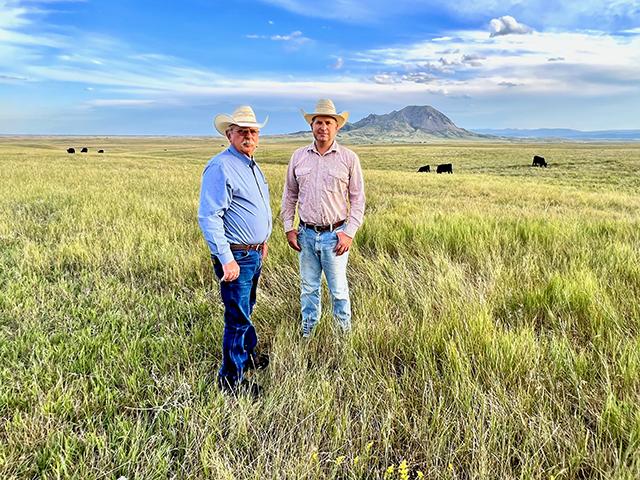
On a ridge overlooking a large portion of this 38,000-acre South Dakota ranch, you can see on the plain below the remains of what was a settler's cabin. The dwelling might be a mile away, but it's difficult to tell in this seemingly limitless horizon.
"The cabin was built about 1908 by members of the Kinghorn family, who established this ranch," says Chad Blair, who now owns and manages the property as part of Blair Bros. Angus Ranch. Blair, along with wife, Mary, and daughter, Clara, have been driving around the rolling grasslands and sometimes rocky hills in the northwest part of the state, north of Belle Fourche.
"I've been down on the flat at that cabin when it's been baking in 100°F heat," Mary says. "There's a rock cellar that's probably full of snakes and bugs, and I wondered what in the world in this remote location would make you want to stop and settle right here."
GRASS HAVEN
The sentiment is understandable, especially when you consider the hardships involved nearly 120 years ago. But, the short answer then is really the same answer now: lots of grass and plenty of space.
Blair Bros. Angus Ranch, a premiere cow/calf, stocker and feedlot operation, purchased more than 17,000 acres of what's known as Two Top Ranch from the Kinghorn family in 2014. Eventually, the 17,000 acres became 38,000 acres with a later purchase of 6,000 acres and multi-thousand-acre leases from the federal Bureau of Land Management (BLM) and the state.
Chad, Mary and their three children moved from Blair Bros. home ranch -- 7,000 acres located an hour southeast, near Vale -- to upgrade and manage the new purchase. The business is owned and managed by two brothers, Ed and Rich Blair, and their sons and wives, Chad and Mary, and Britton and Amanda, respectively.
Blair family members have been ranching in the region for 120 years, but the current iteration of their ranch was begun in 1954 near Vale. Today's two managing generations have expanded practices begun prior to them -- rotational grazing and water conservation -- while adding artificial insemination (AI) to refine the genetics and time the supply of their cattle going forward. They've also specifically planned their operation to optimize wildlife habitat.
For their work, the Blairs were presented the Leopold Conservation Award for South Dakota in 2020 given by the Sand County Foundation and the American Farmland Trust. They also won the 2021 Environmental Stewardship Award (established by the National Cattlemen's Beef Association) for their region.
The family has used Environmental Quality Incentives Program (EQIP) funding to put in place conservation practices designed to maximize grass production, including crossfencing, livestock watering wells, pumps, pipelines, tanks, shelterbelts and fabricated windbreaks.
ALL ABOUT WATER
The addition of 38,000 acres to Blair Bros. Angus a decade ago offered them a chance to put to work everything they'd learned for decades about pasture and water management with cattle. The average annual rainfall in the Belle Fourche region is 14 to 16 inches. The key word is "average." They can get more but have certainly gotten less.
The former Two Top Ranch already featured a dam and pond system that facilitated water distribution. However, that wasn't going to be enough to ensure a regular water supply distributed over numerous fenced rotational-grazing pastures.
P[L1] D[0x0] M[300x250] OOP[F] ADUNIT[] T[]
The Blairs sunk a 3,800-foot-deep well at a high point on the property -- not far from Chad and Mary's house -- and have run more than 25 miles of pipeline around the ranch to supply 80 water tanks. The distribution system, other than a pump halfway up the well, is gravity driven. More water pipeline and water supply tanks for the cattle are in the works.
Also near the well are underground water storage tanks capable of holding 30,000 gallons. They plan to eventually build more water storage.
"The system works really well," Chad explains. "The pipeline is designed with three big loops that interconnect. We can shut off water to one part of the ranch and still have water flowing to everywhere else we need it to be."
VALUABLE HABITAT
The Blairs are part of a multistate effort -- the Sage Grouse Initiative -- to protect the habitat of the once-endangered bird famous for its early-morning mating dance. Working with the Natural Resources Conservation Service (NRCS) and the nonprofit Working Lands for Wildlife, they've used funding from EQIP to plan and implement measures like prescribed grazing, removal of invasive conifers and restoration of wet meadows.
These voluntary efforts helped the U.S. Fish and Wildlife Service to determine 10 years ago that protections for the sage grouse under the Endangered Species Act were not warranted.
Among the things the Blairs and others have done is avoid putting fencing near sage grouse mating grounds -- they tend to perform in the same locations each year. Fencing features reflectors that warn away birds, and fence gates don't have high poles that would offer a higher vantage point for hawks to more easily hunt sage grouse.
The family also doesn't install any water pipes during the sage grouse mating and nesting season. The Blairs plan even more crossfencing to, among other things, better bunch cattle at times when they are going to receive AI.
THE HERD
At one time, Ed and Rich's grandfather, Enos, and his brothers had one of the largest registered Hereford herds in the U.S. Enos and brothers split up the ranch in the late 1940s to accommodate the return of several cousins from World War II, including Ed and Rich's father, Veldon. Veldon raised straight-bred Herefords until the 1970s.
To fill in an empty pasture one year, the Blairs purchased some Angus and Black Baldy calves. "We had 15 or 20 of them," Ed says. "Those animals outperformed everything else we had at the time." That was the beginning of the complete shift to Angus.
Around the same time, they began to use AI to keep their replacements out of their first-calf heifers. The Blairs haven't looked back.
The operation runs cows in herds of 300 to 400 head to better manage pastures. The herd size also helps them better identify animals that can compete in the harsh plains' environment. Their heifers are synchronized and bred via AI. Only heifers that conceive through AI are kept for replacements.
Cows are bred AI for two cycles then exposed to Blair Bros. bulls. The bulls are sold as yearlings via private treaty nearly year-round. Many are four to eight generations of AI sires stacked for calving ease, carcass weight, docility, marbling and rib eye. The operation began selling bulls in 1993.
In recent years, 98 to 100% of their steers and open heifers have graded Choice or higher. Prime and Certified Angus Beef designations have run 40 to 75% and 85 to 95%, respectively. Daily weight gains range from 4 to 5.7 pounds per day.
Between cow/calf pairs, yearlings, bulls and heifers, the entire 45,000-acre ranch might have up to 3,000 animals at a given time.
VALUE-ADDED EFFORTS
Britton Blair, who spends much of his day on herd health, feed procurement and the marketing of bred heifers they buy back from bull customers, says the idea of having their own beef brand has been discussed.
"I sell 20 to 25 head right now without really trying to family and friends mostly," he says. "But, we've found we really don't have the time to focus on that as a business. The beef industry is pretty efficient, and if you start doing small numbers -- say, driving three head 100 miles to a plant for processing -- that's pretty inefficient in terms of time, fuel, etc."
As it is, Blair Bros. works with customers around the country who buy their bulls and customers from as far away as Arkansas, Kansas and Texas who purchase bred heifers by private treaty.
The Blairs were among the founding members of U.S. Premium Beef (USPB), the vertically integrated, producer-owned cooperative-turned-LLC created to help ranchers better capture premiums for higher-quality beef.
"Before that, pretty much all cattle brought about the same price, and we were looking for a way to differentiate our herd," partner Rich Blair says. When they began with USPB (late 1990s), they weren't necessarily hitting the top end of quality when their carcasses were graded.
"This narrowed our focus," Rich explains. "We started to select for characteristics like marbling in our bulls and cattle, and it gave us a target to shoot for. It's been incredible."
The first steers they processed with USPB brought a $15-per-head premium. "That's nothing today," Rich says, "but at the time, we thought, 'This is kind of neat.'" Their cattle graded about 65% Choice then and now grade about 75% Prime. Back then, one lot of animals might grade out to a $200-per-head difference "top to bottom. Now, you have cattle with a $1,500-per-head difference top to bottom. The premiums have increased that much, not that the discounts have increased," he adds.
The attention paid to developing their herd, the marketing of it, along with the care of the land that includes benefits for wildlife signal an operation looking to the future. After all, there are five grandchildren coming up the ranks.
"You spend all your life putting together a business and hope that the next generation -- if they enjoy it -- will want to take it over," Ed explains.
"We want to be ranching for the next generations," Britton adds, "and that means leaving the land in a sustainable condition."
The Blairs are in a position to offer that opportunity, and that's required growth. "In the 1980s, you could make it with 100 cows," Rich says. "Then, it was 200 cows in the '90s, and by today, we have to have 600 to 1,000 cows to make it viable."
[PF_0126]
(c) Copyright 2026 DTN, LLC. All rights reserved.