

Ag Policy Blog
Trump Administration Rules Dairy Farmers Can Hire H-2A Workers
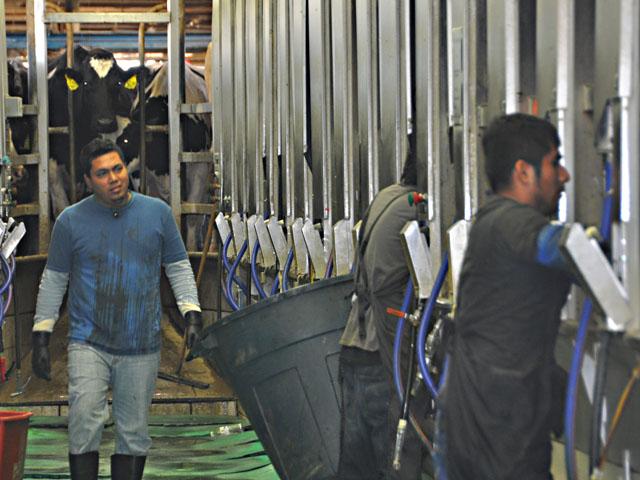
WASHINGTON (DTN) -- New guidance from the U.S. Department of Homeland Security (DHS) and the U.S. Department of Labor clarifies that U.S. Citizenship and Immigration Services (USCIS) will not reject H-2A petitions from dairy operations when they can demonstrate a qualifying temporary or seasonal labor need under existing law.
According to a Wednesday evening announcement, "dairying is an agricultural activity eligible for consideration under the H-2A program and recognizes that dairy operations may experience temporary or seasonal labor needs that qualify for H-2A employment."
USCIS will evaluate whether an employer's need for workers is temporary or seasonal, just as it does for any other H-2A employer and will evaluate requests individually. The policy does not create a new visa category or expand H-2A eligibility by statute. Instead, it changes how existing law is interpreted and applied for dairy operations, taking effect June 17.
"This guidance helps ensure that petitioners filing H-2A petitions on behalf of dairies are held to the same legal standards with respect to temporariness and seasonality as all other H-2A petitioners," the memorandum said.
Before this guidance, the H-2A program was only available for temporary or seasonal agricultural work.
USCIS often denied dairy H-2A petitions because dairy jobs appeared permanent. Some dairies were approved in limited circumstances, such as seasonal calving or temporary labor spikes, but little consistency existed in petitions for producers.
"This is a welcomed policy change for our dairy members and we are hopeful it is just the beginning of continued H-2A program expansion," said John Hollay, National Council of Agricultural Employers president and CEO, in a statement.
It comes at a time when guest farmworker certifications are up. The New York Times reported "in the first half of the 2026 fiscal year, the Labor Department certified 17 percent more (H-2A Temporary Agricultural Worker) jobs than in the same period the year before."
"NCAE looks forward to working with the administration and congressional leaders to ensure the H-2A program is reformed to meet the needs of all producers and that it receives the structural support required to protect our food supply chain," Hollay said.
The lack of access to H-2A labor has generally forced dairies to employ undocumented workers. Studies such as one by Texas A&M in 2020 cite that the dairy industry employs about 129,000 people, and roughly half of those workers are foreign born.
H-2A DATA
Despite the Trump administration's push to detain and deport immigrants in the country both illegally and legally, the H-2A program continues to grow in use. For FY 2025, the Labor Department approved 398,258 temporary farm workers, which was up by nearly 20,000 from two years earlier.
P[L1] D[0x0] M[300x250] OOP[F] ADUNIT[] T[]
This year, H-2A demand has spiked. DOL has already approved 254,688 foreign agricultural laborers in the first half of FY 2026, which is 36,721 more H-2A workers than in the first half of FY 2025.
Florida, Georgia, Washington, California and North Carolina are the top states for H-2A employment, making up roughly half of all H-2A jobs.
Last October, DOL also changed the Adverse Employment Wage Rate for H-2A workers, which rolled back the average wage for most jobs, which is projected to save farm employers roughly $2.4 billion per year.
PROPOSED WORKFORCE LEGISLATION IN CONGRESS
While this is a significant clarification, it does not make year-round dairy jobs eligible for H-2A or allow dairies to hire permanent foreign workers through the program.
The USDA H-2A dairy guidance seemingly preempts new House legislation on the foreign agricultural workforce that lawmakers intend to introduce soon, providing temporary relief while Congress considers statutory changes, the first in 40 years.
The text, obtained by DTN, is currently circulating around Congress for bipartisan co-sponsors before being introduced.
Another document indicates support from the Agriculture Workforce Coalition, a coalition that includes 35 national agricultural associations. It addresses many of the concerns shared by NCAE and H-2A labor advocates around the country, but most organizations are waiting for the formal release before endorsing it.
The Securing Agriculture's Workforce Act (SAWA) would amend the Immigration and Nationality Act and intends to expand access, control costs and streamline H-2A.
House Agriculture Committee Chairman Glenn "GT" Thompson, R-Pa, has been pressing for a foreign labor bill, but his committee doesn't have direct oversight. An agriculture-related bill would need to clear the House Judiciary Committee, which has not considered any foreign labor bills in this Congress.
The draft would remove the requirement that H-2A visas for agricultural labor be "seasonal," redefining eligibility around temporary work. Under the proposal, temporary would mean up to 350 days under a job contract.
Additionally, agency authority would shift on some aspects of H-2A approvals. Under the draft, the Secretary of Agriculture would control the definition of "agriculture labor and services," taking that authority out of the hands of the Labor Department. Expanding the definition would allow additional forms of production, including controlled environment agriculture, forestry, aquaculture and livestock harvesting, to qualify for the reformed work program.
The proposal also would codify the general wage rate methodology of the IFR while limiting year-over-year increases to no more than 3.5%. For employers, a new online platform would be mandated to streamline communication between employers and the approving government agencies.
The proposal would also establish alternative H-2A procedures for industries with unique labor needs and for existing unauthorized agricultural workers. However, it states, "A pathway to citizenship is not included in this draft legislation," which could be a potential turnoff for Republicans in immigration reform.
For decades, federal regulations have limited H-2A eligibility to jobs lasting no more than 10 months that are both temporary and seasonal, excluding industries like dairy from the program and leaving employers with few alternatives when they cannot find enough domestic workers to fill these physically demanding positions.
The last major workforce proposal, the Farm Workforce Modernization Act of 2025, was spearheaded by Rep. Zoe Lofgren, D-Calif., and Rep. Dan Newhouse, R-Wash., -- who both serve on the Judiciary Committee. It passed the House in the 116th and 117th Congresses but was only introduced with no action in the 118th and 119th Congresses.
In a message to its members, Western Growers Senior Vice President Jason Resnick said, "H-2A wage rates remain one of the most consequential compliance and cost issues for agricultural employers," also anticipating the full text soon.
See, "Trump Administration Welcomes Clarification on H-2A Eligibility for Dairy Operations," https://www.usda.gov/…
DHS Memorandum: https://www.uscis.gov/…
Jake Zajkowski can be reached at Jake.Zajkowski@dtn.com
Follow him on social platform X @jzajkow
(c) Copyright 2026 DTN, LLC. All rights reserved.
Comments
To comment, please Log In or Join our Community .