
A sharp rise in central Pacific Ocean barometer readings may be a sign of the expected fast change from El Nino to La Nina.
An active weather pattern has brought lots of rain to the U.S., but also resulted in a lot of severe weather, including long-tracked tornadoes and derechos. How does this year compare to other years?
A continued active weather pattern, even in the midst of change, is keeping much of the Canadian Prairies a bit too wet.
What is being called the worst drought in more than a decade is a big reason why U.S. corn exports to Mexico are up more than 40% so far in 2024.
When long dry stretches occur over a large portion of the U.S., it's usually due to a strong ridge blocking up the pattern. There is potential for one of these ridges to deflect incoming disturbances next week, but will it be strong enough? And how long can it last?
Both corn pollination and grain fill may now occur after the crop-adverse La Nina pattern begins this summer in the Pacific Ocean.
Two jet streams with multiple embedded disturbances will continue to charge through the U.S. and Canada for the next couple of weeks. Expect changes to your local forecast because of all the interaction and timing differences with each disturbance.
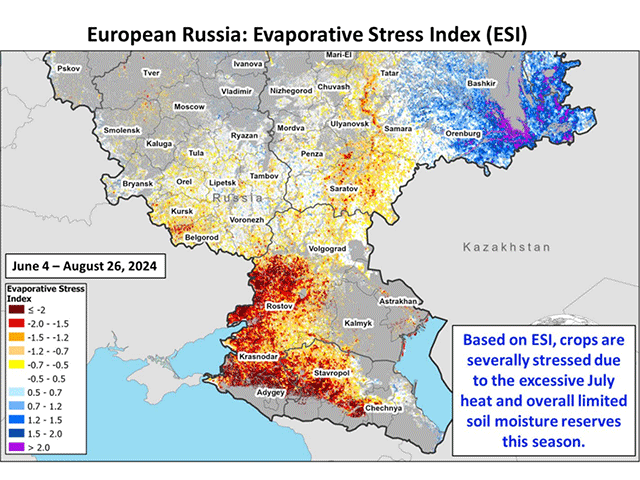
Mostly warm and dry weather over the last two months has robbed surface soil moisture from what was a really good winter precipitation pattern in the Black Sea region. With wheat heading in the south and getting close in the north, the region needs rain badly. Unfortunately...
The jet stream is going to split into two pieces this week, but both a northern jet and a southern one look to remain active across North America, pushing storm systems through that produce regular rainfall.
Wet conditions are leading to the prospect of a four-year low in France's wheat production.
A strong cold front will move through the Plains on Monday and bring a significant risk of severe weather, including long-track tornadoes, massive hail and a line of damaging winds.
A strong cold front will move through the Plains on Monday and bring a significant risk of severe weather including long-track tornadoes, massive hail, and a line of damaging winds.
Harsh springtime dryness in Kansas wheat areas shows the loss of El Nino winter moisture benefits.
Multiple rounds of severe weather and heavy rain ran through the middle of the U.S. late last week and weekend, bringing flooding rains and storm damage. They also delayed planting. But all was not bad as rain has helped increase soil moisture across a vast area.
An active storm track in and around the Canadian Prairies won't bring a lot of needed precipitation, but may keep producers out of their fields.
The forecast change from El Nino to La Nina increases concern about soil moisture reserves for corn and soybean crops.
Several storm systems will line up in a pattern that will promote widespread precipitation through much of the Plains and Midwest, including dry areas which missed recent storm systems. A very active pattern is set up to start April 25 that should last into early May.
Scattered showers turned into heavy snow this week as a system and low temperatures combined to bring back winter for a brief period. The snow will eventually help to moisten soils prior to spring planting and a more active pattern is likely to set up later next week.
The International Research Institute for Climate and Society's summer forecast suggests summertime dryness due to La Nina development.
A long and drawn-out system, or pair of systems, will move through the country this week and weekend. Areas of heavy rain will be welcomed in some places and not in others, causing some delays to early planting progress.
DIM[2x3] LBL[blogs-ag-weather-forum-list] SEL[[data-native-ad-target=articleList]] IDX[2] TMPL[news] T[]
DIM[2x3] LBL[blogs-ag-weather-forum-list-2] SEL[[data-native-ad-target=articleList]] IDX[5] TMPL[news] T[]