


Tick-Borne Disease Threatens US Cattle
US Cattle Industry Threatened by Disease From Invasive Tick as Range Expands
REDFIELD, Iowa (DTN) -- While relatively new to the United States, Theileria orientalis has begun spreading quickly, leaving infected cattle herds in several states. The disease is spread by the Asian longhorned tick, which is arriving in areas carrying the protozoa and infecting naive animals.
"There are several genotypes of Theileria orientalis, but the one we are most concerned with in the cattle industry is the Ikeda genotype," said Craig Payne, University of Missouri director of Veterinary Medical Extension and Continuing Education. "Sometimes this disease will be mistaken for anaplasmosis." A diagnostic test will reveal differently. Payne said a misdiagnosis could mean Theileria has been circulating in a herd longer than thought. The first diagnosis of Theileria was in a Virginia cow-calf herd in 2017.
DISEASE SYMPTOMS
Cattle with Theileria show lethargy, anemia and difficulty breathing. Payne explained that the protozoa infects red blood cells. "These infected cells are damaged and either break down in circulation or are removed by the body, leading to anemia," he added.
Additional symptoms include an elevated temperature, depression and pale mucous membranes. Severe cases will cause cattle to show signs of jaundice and extreme depression. Pregnant animals can abort.
Payne said many animals will become infected and show no signs. Death loss is usually less than 5%, but some herds have experienced much higher illness and death loss. Infection most noticeably leads to weight loss.
"The incubation period is one to eight weeks. By the time you see clinical signs, your herd could all be affected, some just won't have the clinical severity as others," Payne explained. "Infected animals are infected for life, although they may never show signs again."
HOW DISEASE SPREADS
The disease spreads when ticks acquire the protozoa while feeding on infected animals and later transmit it through their saliva. Other insect vectors include biting flies, mosquitoes and other tick species. Payne mentioned outbreaks in herds have also been associated with heavy sucking lice infestations.
Mechanical transmission can happen through blood-contaminated equipment -- including needles and dehorning, castration and tagging equipment. "This is a good reason to dispose of used needles, even after one use," he added.
Vertical transmission can occur from an infected cow to her calf. It's estimated this happens in about 10% of the animals. While not as common, testing of calves from infected cows can reveal their fate.
P[L1] D[0x0] M[300x250] OOP[F] ADUNIT[] T[]
INSECT SOURCE SPREADS DISEASE
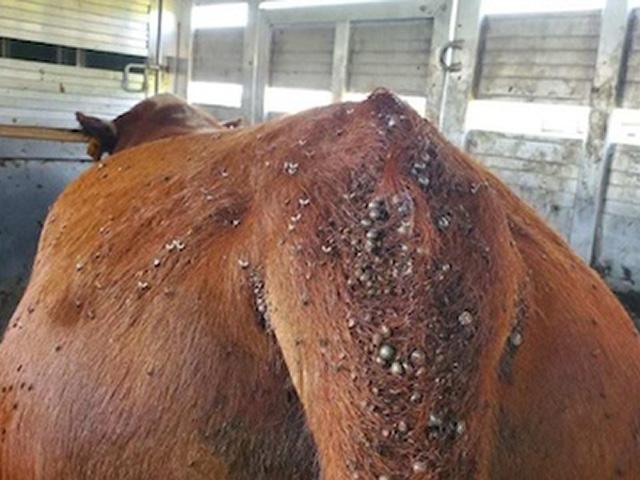
The Asian longhorned tick is particularly concerning with the spread of Theileria because it reproduces asexually, meaning a single female can establish an entire population without mating. This allows for rapid population growth, with animals sometimes becoming infested with hundreds or even thousands of ticks.
Teresa Steckler, University of Illinois Extension livestock specialist, said the Asian longhorned tick is native to southeast Asia and has gradually spread around the world. The tick can exist bisexually as well, but since no male field specimens have been collected, it is thought that the spread in the U.S. is due to the parthenogenic (asexual) reproduction.
"A second way the tick is spreading is because of the wide range of hosts, including cattle, horses, deer, raccoons, squirrels and numerous species of birds," she explained. "There are actually 11 genotypes of the Asian longhorned tick, but the Ikeda and Chitose cause the most problems for cattle producers, with Ikeda spreading Theileria."
ESTABLISHED TICK POPULATIONS CAUSE PROBLEM
"Although Theileria is not widespread in the U.S. to date, the presence of the Asian longhorned tick can be an indicator of its future presence," Steckler said.
Payne noted that Theileria was first detected in Missouri in June 2023 with a positive case in a southern tier county. By October 2023, a case was found in northern Missouri, and the disease was added to the Missouri animal reportable disease list in November 2023. By January 2024, Theileria was detected in four counties, and a year after that, in 22 counties. Most recently, in January 2026, the disease has spread to 59 of the 114 Missouri counties.
"We would consider this an endemic disease in Missouri. Since the Asian longhorned tick is a vector, Theilaria orentalis can likely become endemic in the areas the tick has established populations," Payne added.
TREATMENT AND PREVENTION
There isn't a cure or even a vaccine available for Theileria currently; once recovered, these animals will enter the chronic carrier state, at which they may require further management, Payne said.
"The key is to reduce the level of exposure to the source of the disease by using pour-ons and fly tags to keep insects off of the cattle," Payne said. "It's also important to be careful when bringing cattle into your herd from areas where the disease is present."
Supportive care to minimize stress and handling, providing access to water and feed, and the addition of anti-inflammatory medicines could help as well. There are currently no medicines approved for use in the U.S. to fight this, which is why Steckler said it is so important to look for ticks on animals on a daily and weekly basis. "Theileria is much faster moving than anaplasmosis," she added. And unlike anaplasmosis, Theileria doesn't seem to respond to antibiotics.
There are notable differences between Theileria and anaplasmosis. One is that animals with Theileria show clinical signs at any age, while anaplasmosis is more common in adult animals. With both diseases, animals show anemia, although it is more severe in anaplasmosis. Weakness and lethargy are common with both, as are abortions in pregnant cows. Anaplasmosis also has a high mortality in adult cattle, while mortality is low with Theileria. A blood test is required to be able to make an exact diagnosis.
Even with no exact treatments available, tick preventatives can help keep the disease from attacking cattle. Medgene, an animal health company located in Brookings, South Dakota, makes protein-based prescription-platform vaccines to target diseases affecting animal health. The technology uses advanced field monitoring, computer-assisted predictive algorithms for vaccine design, and both computer-assisted and bench assay methods to ensure the effective delivery of appropriate structure and amount for immunogenic proteins, according to the company.
Bob Gentry, veterinarian and technical adviser for Medgene, said the company started making tick vaccines in 1979, originally to be administered on the Texas-Mexico border to help prevent diseases crossing into the U.S. Gentry said the tick vaccine will reduce the tick burden on cattle, as vaccinated cattle produce antibodies that interfere with tick feeding. Over time, this will lead to fewer ticks on animals, fewer eggs being laid and lower tick pressure.
The vaccine should initially be given in two doses about three to four weeks apart and then as an annual booster, according to Gentry.
It is safe for any age animal and best to be timed before peak tick season. "This vaccine can help reduce the transmission risk of Theileria," he said.
Being aware of animal health situations and consulting a herd veterinarian for a health plan is recommended for all vaccination and treatment plans. Even though Theileria is not widespread in the U.S. yet, the Asian longhorned tick can be a good indicator of its future presence. Steckler said minimizing the movement of the tick is necessary to reduce Theileria infestations.
Payne suggested culling infected cows that are not thriving. It is also recommended to separate infected cows from non-infected cows to reduce the chance of infection spreading via insects. Proper biosecurity and reducing cross-contamination between animals can help prevent the spread as well.
"Assume there is a local establishment of the disease if there is an Asian longhorned tick population or Theileria is confirmed, and then get a long-term management plan," he concluded.
Jennifer Carrico can be reached at jennifer.carrico@dtn.com
Follow her on social platform X @JennCattleGal
(c) Copyright 2026 DTN, LLC. All rights reserved.

