


Ukraine Faces Black Sea Shipping Crisis
Black Sea Attacks Threaten Ukraine Grain Exports and 2027 Crops
OMAHA (DTN) -- Ukraine could leave as many as 15 million acres of farmland unplanted next spring if agricultural exports through the Black Sea are not restored by February, a Ukrainian agriculture official warned.
Vitalii Holovnia, Ukraine's deputy minister of agrarian policy and food, said in a webinar late last week that export disruptions through the Black Sea have created financial problems for farmers looking ahead to spring planting.
"We have problems with logistics and export, and because of the logistics, we have a problem with finance," Holovnia said. "So, in this case, if we (are) not open to February export through the Black Sea, this is a scenario where we will not plant."
If Black Sea exports are not restored by February, the deputy minister said Ukraine could see 5 million to 6 million hectares -- 12.4 million to 14.8 million acres -- go unplanted.
That represents roughly one-quarter of the agricultural land currently available to Ukrainian farmers, Holovnia said.
Nearly five years into Russia's full-scale invasion, Ukrainian farmers are increasingly struggling not with their ability to produce crops, but with their ability to harvest, store and sell them.
Despite the war, Ukrainian farmers largely maintained their winter crop planted hectares this fall. Winter rapeseed planting reached 102% of the five-year average, while winter wheat planting was at 92% of the five-year average.
Russian attacks on shipping, grain terminals and oilseed processing plants have cut agricultural exports roughly in half, depressed farm-gate commodity prices and raised questions about whether farmers will have enough money to plant their 2027 crops.
"Overall, Ukraine grew a good crop, but we cannot move it," said Roman Horobets, whose family farms about 5,400 acres in central Ukraine's Poltava region.
For Horobets, the most important step toward restoring profitability on his farm is reopening Ukraine's major Black Sea shipping routes.
"I don't see any ways for improvement other than opening the big ports," he said.
For now, both Russia and Ukraine continue targeting cargo ships. The United Nations on Monday briefed the Security Council members, warning that Russian attacks in the Black Sea region were "disrupting grain exports that many developing countries depend on." The report said Security Council members were concerned the fighting was "raising humanitarian, economic and food-security risks across the globe." The brief added that "UN officials are urging immediate action to protect civilians, shipping lanes and food supplies before winter conditions worsen."
In the press, officials from both Ukraine and Russia blamed the other side for increased attacks on shipping lanes and infrastructure.
CORN LEFT IN FIELDS
Ukrainian farmers had harvested roughly 16 million metric tons (mmt), or 630 million bushels (mb), of a potential 30-mmt (1.18-billion-bushel) corn crop, according to statistics presented by Roman Grynyshyn, founder of World to Rebuild Rural Ukraine.
Some farmers are questioning whether it makes economic sense to harvest the rest of their corn, given low commodity prices and the costs of drying, storing and transporting the grain.
P[L1] D[0x0] M[300x250] OOP[F] ADUNIT[] T[]
Grynyshyn said as much as 44% of Ukraine's corn crop remains unharvested and will likely remain standing in fields until spring to avoid drying costs. Winter conditions could significantly reduce the grain quality.
"So, huge amounts of Ukraine's corn is staying in the fields," he said.
USDA forecasts Ukraine's corn production at 31.8 mmt (1.25 billion bushels, or bb) with exports projected at 20 mmt (787 mb). USDA cut Ukraine's projected exports by 2 mmt earlier this month, increasing its ending stocks by the same volume.
Ukraine also faces an estimated grain storage capacity shortfall of at least 8 mmt due to damaged and destroyed grain elevators. Ukraine began its harvest with roughly 5 mmt of grain still in storage from the previous crop, mainly corn.
USDA pegged last year's corn carryover at 2.92 mmt.
While continued exports over the winter could alleviate some of that pressure, large carryover stocks would create additional storage problems when farmers begin harvesting winter crops next summer, Grynyshyn said.
EXPORTS CUT IN HALF
Holovnia said the country expects to produce roughly 82 mmt of grains and oilseeds this year, including about 61 mmt of grain and 21 mmt of oilseeds.
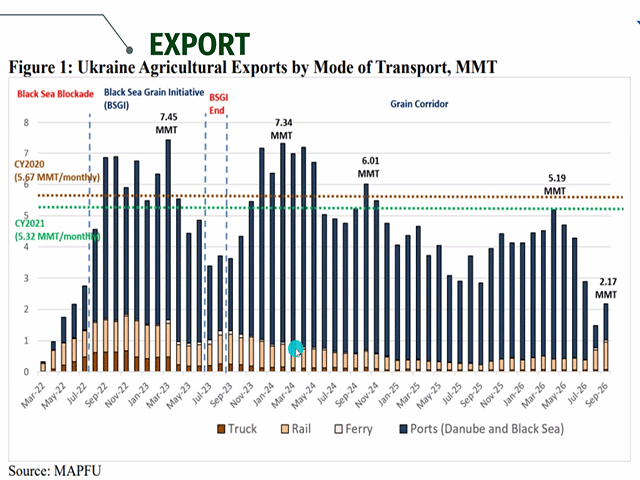
Ukraine normally needs to export 5 mmt to 6 mmt of agricultural commodities monthly since the war began. Exports fell to roughly 2.5 mmt each in September and October, with similar volumes expected in November.
Ukraine has relied heavily on its Black Sea ports to move the bulk its grain and oilseed exports. Although those ports technically remain open, attacks on commercial vessels have discouraged shipowners from entering the region.
Since the war began, Ukraine has sought to expand alternative export routes through the Danube River and shipments by rail and truck into the European Union. Those routes are more expensive and can only handle a fraction of the commodities Ukraine needs to export.
The deputy minister said some of Ukraine's traditional agricultural customers, including Egypt, Turkey and India, are increasingly looking to other suppliers, including South America and Australia.
Projections presented during the webinar showed exports of Ukraine's five major agricultural commodities could decline by 33% in the 2026-27 marketing year compared to the previous year.
ATTACKS ON OILSEED PROCESSORS
Ukraine had increased investments in domestic processing of oilseeds since the start of the war, allowing the country to export higher-value products rather than raw commodities.
Russia's attacks on oilseed processing plants are now undermining that strategy.
Earlier this month, Kernel, one of Ukraine's largest agricultural companies and sunflower oil processors, reportedly suspended operations at eight crop processing plants amid concerns about Russian attacks. Other agricultural companies also have suffered damage to processing facilities.
Sunflowers had been one of the few profitable crops for Ukrainian farmers, largely because of strong domestic demand from processors, Grynyshyn said.
Sunflower prices have fallen from roughly $800 per metric ton last season to between $350 and $400 per metric ton. The decline in domestic processing demand is forcing more farmers to look for buyers outside Ukraine, adding substantially to their transportation costs, Grynyshyn said.
THE WAR'S IMPACT ON FARMERS' BASIS
Horobets, a second-generation farmer, said his family is dealing with two consecutive years of drought as well as the escalating economic pressures of the war.
"We are far from the ports and far from the front line, but we are not far from the war," Horobets said.
A nearby soybean processing plant was attacked earlier this month as well, he said.
Corn on his farm yielded roughly 80 bushels per acre this year, compared to a typical yield of 127 bpa. Wheat yielded about 70 bpa, compared to typical yields of roughly 89 to 97 bpa.
Sunflowers were the bright spot on his farm, yielding about 3,000 pounds per acre.
The bigger problems for Ukrainian farmers begin after the combine leaves the field, Horobets said.
"For a farmer, the port is not a place on the map. The port is basically our price," he said.
The difference between the delivered price of sunflower seeds at processing plants in other European countries and the farm-gate price in Horobets' area is now roughly $180 to $200 per metric ton.
Before the recent export disruptions, Horobets said he could deliver sunflower seeds to a nearby Ukrainian processing plant for roughly $10 per metric ton. Shipping those seeds to a processor in Italy now costs about $200 per metric ton.
While farmers are receiving less for their crops, they are also paying substantially more for inputs. Diesel prices have nearly doubled since January, Horobets said, rising from the equivalent of $4.92 a gallon to $9.43 a gallon.
"In practice, we pay around $200 a ton to get our seeds to the buyers' crushing plant, and that money comes out from the farmers' pocket," Horobets said.
Chris Clayton can be reached at Chris.Clayton@dtn.com
Follow him on social platform X @ChrisClaytonDTN
(c) Copyright 2026 DTN, LLC. All rights reserved.

