


Call the Market
CME to Reduce Daily Trading Limits for the Live Cattle and Feeder Cattle Contracts in December
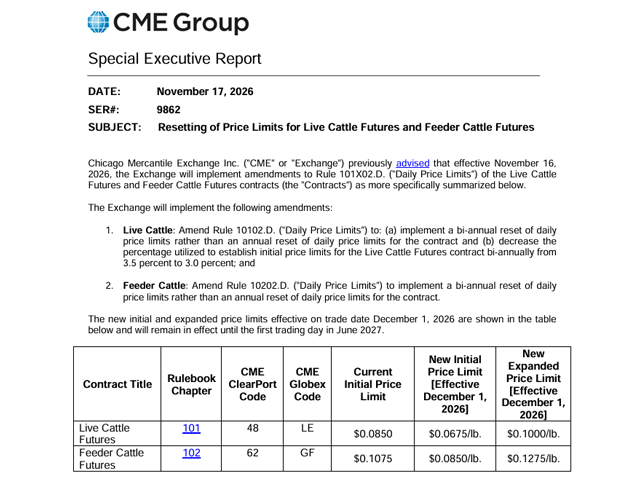
On Nov. 17, the CME announced that it intends to make several changes to the CME live cattle and feeder cattle contracts that will take effect starting on Dec. 1, 2026.
The first thing that the Special Executive Report highlighted is that the CME intends to implement biannual resets of the daily limits rather than just an annual reset. If you think back to the past years, we normally anticipate an announcement from the CME in June, which details what the year's daily price limits are going to be, but moving forward, that will now happen in June and December. Secondly, the live cattle futures contracts will be given a trading range of 3% as opposed to the current 3.5%.
P[L1] D[0x0] M[300x250] OOP[F] ADUNIT[] T[]
Personally, I was stunned to see that the CME was going to reduce the daily trading limits for both the live cattle and feeder cattle contracts from 3.5% to 3%. I personally believe that there is far too much technical risk in the marketplace, and this reduction to the daily trading limit was much needed to help reduce volatility in the marketplace and sheer loss of capital on assets for cattlemen.
Currently, the live cattle contracts have a daily limit of $8.50/hundredweight, but starting on Dec. 1, the daily limit will be reduced to $6.75/hundredweight, with an expanded limit of $10.00/hundredweight. Currently, the feeder cattle contracts have a daily limit of $10.75/hundredweight, but starting on Dec. 1, the new daily limit will be $8.50/hundredweight, and the expanded limit will be $12.75/hundredweight.
I know some people will think that this will limit traders' interest in participating in the contracts, as it slightly reduces how much the contracts can move higher or lower on any given day, but to that comment, I simply reply: Is that necessarily a bad thing? Given the past year that we've endured in the marketplace (seeing record-high prices, record-high risk and record-high volatility), wouldn't it be comforting to see the market influenced more greatly by things of its true nature as opposed to computerized trading and headline news? Unfortunately, neither of those two things are going away, but maybe this will partly lessen the sting of those days on which the contracts plummet and trade lower. While yes, the contracts have the same daily limits allowing them to trade higher and lower, you and I both know that the market is far more likely to trade its daily limit going lower than it is when it trades higher.
Click here to read the CME Special Executive Report: https://www.cmegroup.com/…
ShayLe Stewart can be reached at ShayLe.Stewart@dtn.com
(c) Copyright 2026 DTN, LLC. All rights reserved.