


Pesky Deer Devour Profits
Whitetail Woes
Travis Dixon isn't known for backing down from a challenge. The northeast Missouri producer has spent nearly 15 years building his row-crop operation from scratch, establishing his reputation by taking on ground some consider too marginal to farm profitably -- and then doing just that.
But, for the 2026 growing season, Dixon chose to stop leasing one 407-acre farm. It wasn't because the landowner raised the rent. It wasn't because of rising fuel and fertilizer costs. Instead, Dixon admitted defeat and reluctantly raised a white flag because of crop damage caused by white-tailed deer.
"If I tried to grow beans on it, it was just a fight to get them up and going before the deer wiped them out," he says. "It would look like somebody had a pair of scissors and just went right down the row snipping off every plant below the cotyledon, and you'd be left with nothing. It just wasn't profitable. I had to let it go."
Dixon isn't alone while navigating this deer dilemma. From the Midwest to the Southeast, whitetails are eating their way across fields of soybeans, corn, cotton and peanuts, costing farmers untold millions in lost yields. One 2023 survey by University of Georgia Extension found that deer damage cost cotton farmers in that state up to $152 million -- more than any other major pest, including pigweed, nematodes and stinkbugs.
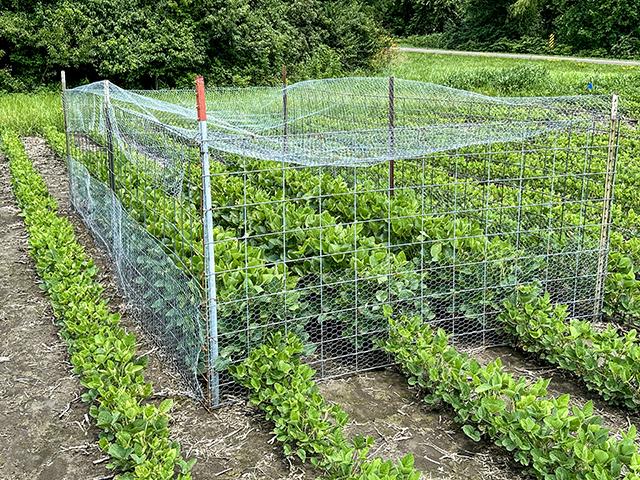
"Here in South Carolina, we estimate that 25% of our soybean yields are going to feed deer every year," says Cory Heaton, a wildlife specialist with Clemson University Cooperative Extension Service. "It's varied across the landscape. If you're farming 5- to 10-acre fields where we have these elevated densities, you're basically just a food plot. We're to the point on a lot of fields where your option is either put up a fence or stop farming."
The overall issue comes down to deer populations and density on the landscape, which in many regions far exceed what is considered healthy, Heaton says.
"If you look at what the National Deer Association says is the ideal deer density, that number is somewhere between 10 and 30 deer per square mile," he explains. "I believe the ideal density for a healthy deer herd is probably the ideal density for the farmer, too. The problem is that in some areas, we're 10 times higher than that. Deer are literally eating themselves out of house and home."
DETERRING DESTRUCTION
While preventing deer from feeding on crops may feel like trying to hold the ocean back with a broom, doing nothing isn't an option, either. The most common commercial deterrents available to farmers are repellents that can be sprayed on crops to decrease their palatability.
P[L1] D[0x0] M[300x250] OOP[F] ADUNIT[] T[]
"Repellents do a fabulous job when they're put in the right places, in the right ways at the right times," says Heaton, who had several repellents in trials during 2026. "The problem is none of them are a single application. There's also variability. What works really good at one location might not work at all at another site."
Heaton notes that while it's tempting to spray repellents when a farmer is already making a trip across a field to apply something else, such as a herbicide or a fungicide, it's important to avoid gaps in coverage. Like velociraptors testing the fences at Jurassic Park, deer will find a vulnerable field and eat it to the ground in just a handful of nights.
"You've got to scout the field and treat the deer like any other pest," he says. "You can't do it by the calendar. You've got to let them tell you when it's time for another application."
In areas with heavy deer pressure, Heaton recommends spraying a repellent as soon as the crop emerges from the ground and leafs out. Subsequent applications should be made when deer damage along field edges is 10% or greater.
"Sometimes, this works out to be two or three applications at relatively short intervals," he says. Once you encourage those deer to leave, "you might get 45 or more days out of that next application. You've got to think of it as a deer-repellent program. If you don't stay with it, it can fall apart fast."
Other deterrents attempt to scare deer away from fields. Propane cannons, flashing laser lights and dancing inflatable "tube men" have been employed -- all with decreasing effectiveness as deer realize there's no imminent threat of danger.
"They get habituated to these things fast," Heaton says. "I've seen deer feed right beside a propane cannon while it's going off and not even lift their heads."
FENDING OFF FUTURE FORAGING
Heaton says future efforts with autonomous drones and robotics to physically chase deer out of fields offer some promise. "But, the question is, how long until they aren't scared by a drone?" Heaton asks.
Biotechnology might also offer a means of preventing future deer damage. At The University of Tennessee, a group of researchers is attempting to make soybeans less palatable by incorporating overexpressed trypsin inhibitors to deter feeding.
"Trypsin is crucial to how mammals digest proteins. The idea is that by inhibiting its production, those deer get sick to their stomachs when they eat those beans and then choose to eat something else," Heaton says. "I talked with some other plant breeders about creating a similar scenario by elevating tannin levels. These solutions are still years away."
When it comes to solving this issue, there's an elephant in the room that no one wants to address.
"We're going to have to stop looking at managing white-tailed deer through recreational hunting because it's not effective anymore," he adds. "This isn't a problem we can't solve. Any biologist who's ever studied white-tailed deer can tell you exactly how to do this and make it work. The problem is the human component. People don't harvest deer the way we need them to harvest to control the population."
Dixon agrees.
"Everybody just wants to shoot a buck and then go home for the season, but the herd is not getting managed by just shooting bucks," he says. "I can go out in one night and fill all my nuisance permits, and it's still not enough to even maintain status quo. The herd is still growing."
**
-- Follow Jason on social platform X @JasonJenkinsDTN
[PF_1126]
(c) Copyright 2026 DTN, LLC. All rights reserved.