


Has the US Lost Food Aid Leadership?
World Food Prize Laureates Warn of Hunger Crisis, Eroding US Leadership
DES MOINES (DTN) -- As the World Food Prize celebrates its 40th anniversary, some of its most prominent laureates are warning that the U.S. is surrendering its leadership in the global fight against hunger while also opening the door for China to become the dominant force in agricultural research and development.
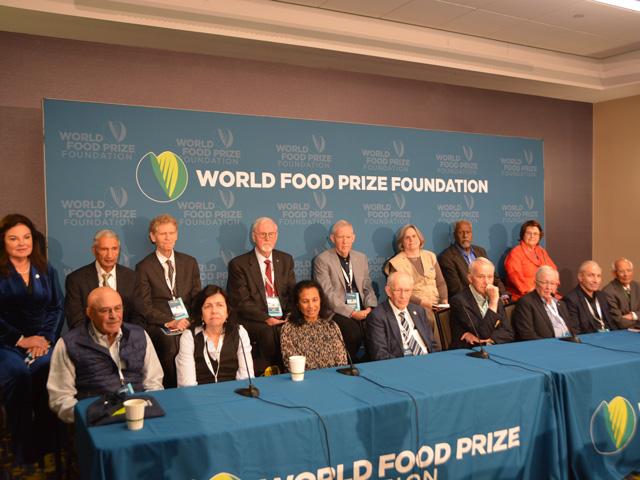
Gathering Wednesday at the World Food Prize's annual Borlaug Dialogue, 16 past laureates raised concerns about the dismantling of the U.S. Agency for International Development (USAID), reductions in international food assistance and uncertainty over how the Trump administration intends to rebuild programs that have helped feed millions of people around the world.
The discussion also raised questions about the future direction of the World Food Prize Foundation itself, and whether an organization dedicated to ending global hunger can remain politically neutral while confronting government policies that some laureates say are undermining decades of progress.
David Beckmann, the 2010 World Food Prize laureate and longtime anti-hunger advocate, described the atmosphere surrounding this year's gathering as unusually pessimistic.
"The Borlaug Forum this year is gloomier than it's ever been before," Beckmann said. "Progress against hunger is virtually stopped," which he attributed in large part to cuts in U.S. international and domestic assistance, along with policies involving climate change, tariffs and war.
The concerns come as the World Food Prize marks four decades of honoring scientists, researchers and humanitarian leaders whose work has improved agricultural productivity and helped combat hunger around the world.
While the Borlaug Dialogue often has been a forum for U.S. policymakers to tout their international policy agendas, there has also been a lack of U.S. officials in the past two years at the event. At the same time, the dialogue this year hosted leaders from multiple African and Asian countries as well as 2017 Nobel Peace Prize Laureate Malala Yousafzai.
GLOBAL FOOD SECURITY DISRUPTIONS
In a panel discussion on Tuesday, global food security advocates sounded the alarm about some of the crises facing agriculture and food distribution. Cary Fowler, a 2024 World Food Prize laureate and former USAID adviser, highlighted the risks to food security with the ongoing war in Ukraine and disruption of the Strait of Hormuz this year.
"I can't recall a time in my life there have been challenges of this magnitude or this variety," Fowler said.
Michael Wertz, senior counsel for the Council on Foreign Relations, pointed to the increasing weaponization of food going back to Russia's attack on Ukraine. He noted Ukraine has retaliated in kind with attacks on Russian supply chains.
"I call it the use of food as a long-range weapon that Russia perfected in that war," Wertz said.
The impacts of high fertilizer prices from the war in Iran have put pressure on countries that relied on fertilizer from the region, Wertz said. Another complication that could become a wild card is the Super El Nino that is anticipated this year.
Fowler asked if the international community is rallying to face potentially increasing global hunger that could worsen in 2027.
"We're paying attention, but we're not preparing," Wertz said. He added, "It is undermining our own national security and policy interests in a dramatic manner."
Henk van Duijn, president and CEO of the International Fertilizer Development Center, also said fertilizer is being used more as a "weapon tied to global logistics." That has been reflected by the closing of the Strait of Hormuz earlier this year, which disrupted 30% of the world's urea and an even greater percentage of the world's sulfur production.
"We are facing a much larger food security crisis in the coming years due to this disruption," Duijn said.
REBUILDING FOOD ASSISTANCE
The U.S. provided nearly $5.5 billion in combined international food aid in FY 2024, but then the State Department announced a "humanitarian reset" in 2025 before providing $1 billion in food aid and disaster assistance last December.
P[L1] D[0x0] M[300x250] OOP[F] ADUNIT[] T[]
USDA earlier this month also announced $825 million in "America First" international food assistance investments to buy more U.S. commodities to deliver as food aid. In four announcements since 2025, USDA has detailed $1.39 billion in funding or proposed aid commitments.
Pointing to cuts from major donor countries, the World Food Programme (WFP) earlier this week said the agency would now need to cut its monthly food aid in Gaza by roughly 500,000 people. The agency had been feeding about 1.6 million people, but stated it can no longer sustain food deliveries at that level. The agency also has been forced to cut rations as well.
Catherine Bertini, the 2003 World Food Prize laureate and former WFP executive director, said USDA's assumption of food assistance responsibilities may have prevented additional programs from disappearing.
USDA already administers the McGovern-Dole International Food for Education and Child Nutrition Program, giving the department experience in international school feeding initiatives.
"It's good that USDA took up the food assistance programs because otherwise they may have died, as other programs did," Bertini said.
However, she cautioned that USDA historically has operated those programs with limited personnel. Expanding the department's international responsibilities will require additional employees with expertise in administering humanitarian assistance.
"USDA really needs more staff that know what they can do and how to do it in order to effectively manage those programs," she said.
Bertini also argued that the U.S. must eventually restore the broader international development capabilities previously provided by USAID.
"USAID performed immensely important work around the world," she said, adding that the U.S. must find a way to reconstitute those functions to maintain its global leadership and continue fighting hunger.
Beckmann called the elimination of USAID a tragedy but said the immediate priority should be making the remaining programs effective rather than attempting another government reorganization.
"I'm in favor of restarting A-I-D, but for now, you can build some of the same program within the State Department and USDA," Beckmann said. "Rather than shifting things around again, I'd try to get something going with the institutions they've chosen."
CHINA FILLS THE LEADERSHIP VACUUM
Beyond the immediate consequences of reduced humanitarian assistance, several laureates warned the U.S. risks losing its longstanding leadership in international agricultural science.
Howarth Bouis, the 2016 World Food Prize laureate whose work helped develop nutrient-enriched staple crops, said China's sustained investment in agricultural research is positioning the country to become a global destination for scientists and students.
Bouis, who lives in the Philippines, recently attended the World Agri-Food Innovation Conference in Beijing. He described a gathering where Chinese universities, government agencies and private businesses demonstrated expanding commitments to agricultural innovation.
"There's a vacuum, and the Chinese are taking over that vacuum," Bouis said.
For decades, Chinese scientists traveled to American universities for advanced agricultural education. Bouis predicted that relationship could eventually reverse.
"Ten years from now, I predict that the best U.S. students will want to go to China to learn the best science in agriculture," he said.
Bouis said China's progress reflects years of consistent government investment rather than a sudden shift in research priorities.
He cited his own experience working with Chinese researchers on biofortification, which improves the vitamin and mineral content of staple food crops.
A program initially supported through international collaboration has since developed into a Chinese government-funded research effort, he said.
Bouis also expressed concern that the U.S. is becoming a less welcoming destination for international researchers.
Mariangela Hungria, a Brazilian scientist and 2025 World Food Prize laureate, echoed those concerns. For much of her four-decade research career, Hungria said, American leadership in agricultural science seemed unquestionable. Now she sees China making rapid advances backed by strong government support.
"I could never, ever imagine the U.S. not having leadership in research in agriculture," Hungria said.
She argued that the rapid changes also demonstrate how government policy can either strengthen or undermine a country's scientific capabilities.
WHAT ROLE FOR THE WORLD FOOD PRIZE?
The concerns about international assistance and American leadership eventually led to a pointed question about the future of the World Food Prize Foundation. After years of giving USAID leadership a voice at the Borlaug Dialogue, the foundation leadership remained silent when the agency was being dismantled.
Beckmann acknowledged the challenge of balancing political independence with advocacy.
"I think the World Food Prize Foundation needs to remain bipartisan," he said. "But we've also got to find ways, somehow, as a movement to not necessarily be partisan, but to be clear about the political changes that need to happen."
Beckmann said the coming U.S. elections could have significant consequences for anti-hunger efforts both domestically and internationally.
"I hope U.S. voters consider hungry people as they're deciding who to vote for," he said. "This election could make a big difference for a lot of people who can't feed their kids."
Rob Fraley, the 2013 World Food Prize laureate recognized for pioneering agricultural biotechnology, offered a more optimistic view of the foundation's future. Fraley pointed to advances in gene editing, crop genomics, artificial intelligence and other technologies that are expanding the ability of scientists to improve agricultural production.
He said genetic research tools once available only to major institutions are increasingly accessible to individual researchers around the world. A scientist working in Nairobi, for example, can now use technologies that would have been difficult to access just a few years ago.
Fraley suggested the World Food Prize could play a stronger role in removing barriers that prevent researchers and farmers from adopting those advances.
"One of the things that, looking in the future for the foundation, is to become an even stronger advocate for removing the barriers to further democratize that technology and make it increasingly accessible on a global basis," Fraley said.
Haddad also defended the foundation's role in providing a platform for scientists and researchers focusing on global hunger to raise concerns based on evidence.
"What the foundation has done is given us a platform," Haddad said. "It's elevated our voice to be able to speak more loudly to reach people we wouldn't be able to reach before."
Also see, "Hollywood Voices Challenge Food System: Sheen, Offerman Challenge America's Food Priorities at World Food Prize," https://www.dtnpf.com/…
Chris Clayton can be reached at Chris.Clayton@dtn.com
Follow him on social platform X @ChrisClaytonDTN
(c) Copyright 2026 DTN, LLC. All rights reserved.