

Hollywood Voices Challenge Food System
Sheen, Offerman Challenge America's Food Priorities at World Food Prize
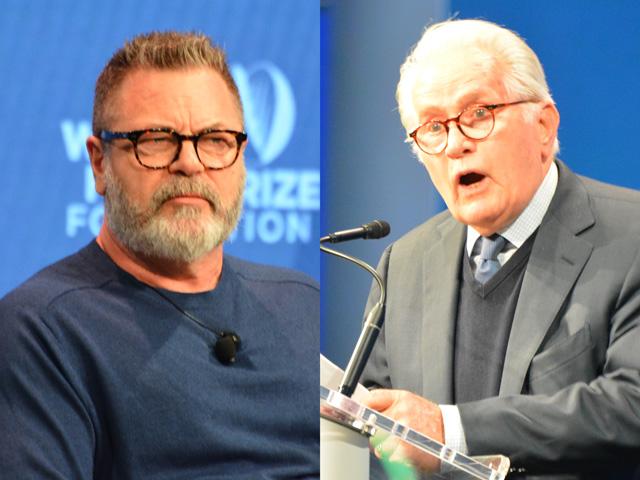
DES MOINES, Iowa (DTN) -- Two Hollywood actors brought distinctly different messages to the World Food Prize discussions on Tuesday, but both raised questions about America's responsibilities when it comes to producing food, sustaining farmers and feeding the hungry.
Martin Sheen recollected his role as U.S. president on "The West Wing," calling for restoring America's international humanitarian assistance programs. Sheen warned that the dismantling of the U.S. Agency for International Development (USAID) last year under the Trump administration has undermined decades of efforts to combat hunger and poverty around the world.
Nick Offerman, who grew up in an Illinois farming family, joined advocates for regenerative agriculture in questioning whether modern agriculture has left American farmers and rural communities worse off, even as the country has become one of the world's most productive agricultural powers.
The two actors spoke at the Norman Borlaug International Dialogue, which seeks to carry forward the work of the Iowa-raised wheat breeder and 1970 Nobel Peace Prize laureate to improve food production and reduce global hunger.
SHEEN CALLS FOR RESTORING INTERNATIONAL AID
International food aid from the United States has declined over the past two years. The Organization for Economic Co-operation and Development (OECD) cited earlier this year that U.S. food aid was cut more than 50% globally.
Sheen urged the World Food Prize Foundation to consider advocating for the restoration of U.S. foreign assistance or the creation of a new agency to replace USAID, which was dismantled last year as part of the Trump administration's Department of Government Efficiency (DOGE) agenda.
"Unfortunately, it was abruptly and permanently dismantled in an instant in January 2025, with the tragic humanitarian fallout that continues to climb rapidly on an unimaginable scale," Sheen said. "If my presence here today would create a spark, however small, that might motivate this foundation through the Borlaug Dialogue to consider adding to its agenda a serious exploration of how to repair, restore, and return U.S. aid to its rightful place in the world, or to consider creating a new agency that could take up the slack, then I would consider my time here well used and your investment well spent."
Sheen's comments on USAID drew applause from an audience of food and nutrition advocates at an event that drew an estimated 1,200 people from 65 countries.
OFFERMAN QUESTIONS THE COST OF CHEAP FOOD
P[L1] D[0x0] M[300x250] OOP[F] ADUNIT[] T[]
Offerman joined Mary Berry, daughter of the late Kentucky farmer and author Wendell Berry, who died in August, and British farmer and author James Rebanks in questioning an agricultural system that increasingly concentrates production among fewer farmers.
Offerman also read "Questionnaire," a poem by Wendell Berry, during the panel discussion. The poem challenges the moral decisions made in pursuit of economic growth, free markets and global trade. Offerman described the poem as a "gut punch" when he first read it.
"How much poison are you willing to eat for the success of the free market and global trade?" Offerman said, quoting from Questionnaire.
At a news conference following the panel, Offerman said he is passionate about regenerative agricultural practices, but he was also asked how the panel's criticism of industrial agriculture fit with the broader themes of the Borlaug Dialogue.
"I think the reason we've been invited here is part of a perhaps an erosion of resistance to this kind of ideology," Offerman said. "So, we're the regenerative kids who come in and say, 'Here are the things that we think are beautiful in ways that farming has always worked.'"
Offerman questioned who benefits financially from an agricultural system built around producing inexpensive food.
"The people making all the profits that the farmers aren't making are not eating the food that they're that they're feeding the world with, you know," he said.
Rebanks, who raises sheep and cattle on 500 acres in northern England, said he is trying to breed cattle on his operation that can perform well in a low-input system. Rebanks said a lot of his new grazing practices were inspired by what he learned from U.S. producers.
Still, Rebanks seemed to criticize what he perceived as the lack of attention to the environmental and social costs of American agriculture. Rebanks pointed to Iowa's enormous capacity to produce corn, soybeans and livestock while questioning whether agricultural policies adequately account for water quality, soil degradation and the economic well-being of rural communities.
"Nobody's asking the big question, which is, is this making rural America better?" Rebanks said.
Rebanks later acknowledged he didn't want to tell other farmers how to farm, either.
"I don't want us to sound like sort of hippie freaks with no answers," Rebanks said. "We genuinely want to be part of building real things that make it all better for our kids and our families."
BERRY WAS LEFT OUT OF POLICY CONVERSATIONS
Berry said her father believed his writings about the industrialization of agriculture would lead to a broader discussion about the future of farming. She recalled how a 1967 government report suggesting there were too many farmers in America helped spark her father's criticism of federal agricultural policies. Berry said that kind of mindset continued to influence government policy.
When Wendell Berry published "The Unsettling of America" in 1977, he hoped his criticism of agricultural policies and their impact on family farms and rural communities would become part of a national conversation. Instead, she said, his warnings were largely ignored by the agricultural establishment.
"My father, when he wrote 'The Unsettling of America', thought that he was joining in a conversation about the industrialization of agriculture," Berry said. "He was hoping to be invited into this conversation. Until the day he died, he actually never was invited in."
Mary Berry said she started the Berry Center in New Castle, Kentucky, in 2011 partially because her father's voice and message were not getting out to the broader world. The center is focusing more on government policies and looking for ways to change production agriculture to better profit farmers, she said.
"I recognized that we had given farmers two choices in this country," Berry said. "You could be large and industrial, or you could be small and entrepreneurial. There was almost nothing in the middle."
Chris Clayton can be reached at Chris.Clayton@dtn.com
Follow him on social platform X @ChrisClaytonDTN
(c) Copyright 2026 DTN, LLC. All rights reserved.