


Kansas Gov. Apologizes Over ICE Actions
Kansas Governor: ICE Action Costs Beef Industry Millions, Sows Lasting Fear
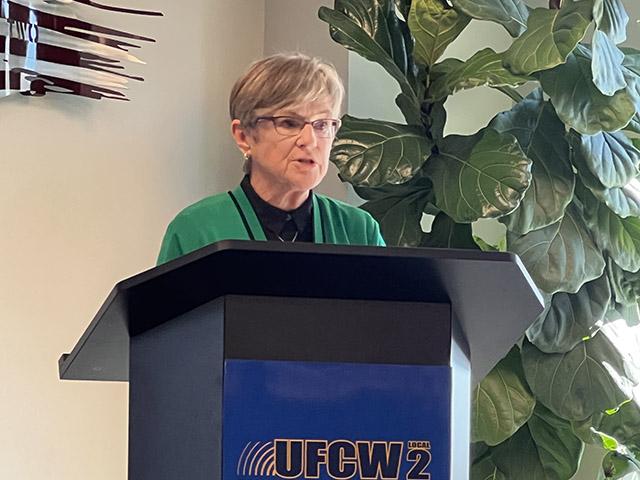
DODGE CITY, Kan. (DTN) -- Saying the Kansas economy is dependent on its immigrant population, Gov. Laura Kelly apologized to residents of southwest Kansas on Monday over last month's immigration enforcement actions that disrupted communities and meatpacking plants but acknowledged there is little she can do as governor to prevent federal agents from returning.
Speaking to union meatpacking employees and community leaders in Dodge City on Monday, Kelly, a Democrat who will leave office in January, said the Immigration and Customs Enforcement (ICE) operation the week of Sept. 22 took an economic toll on the state.
"The last conversation I had with one of the plant folks is that it was already up to $14 million, and I think that was on the second day of the raids," Kelly said.
The ICE operation hit the meatpacking cities of Dodge City, Garden City/Holcomb and Liberal, Kansas, an area dubbed the "Golden Triangle," accounting for more than 20% of daily fed-cattle slaughter. Because of disruptions to those packing operations, USDA data shows 45,000 fewer cattle were slaughtered that week than the previous week nationally, a drop of about 8.5%.
Cattlemen's groups in Kansas, Oklahoma and Texas criticized the sudden disruptions, saying it had a chilling effect on legal workers and disrupted the cattle supply chain, "resulting in millions of dollars in lost revenue and additional costs."
Martin Rosas, president of the United Food and Commercial Workers Union Local 2, said the impact of the ICE action will be felt not just by the communities but also by everyday consumers.
"If you imagine we're paying a lot for beef now, can you imagine what's going to be the consequences of disrupting the operation of all of these plants?" Rosas said.
Kelly said she was in regular contact with agricultural and meatpacking industry officials during the ICE operation as disruptions rippled through the region's beef industry.
Industry officials were concerned not only about immediate financial losses, Kelly said, but also about the longer-term effect the enforcement action could have on whether people are willing to live in southwest Kansas and work in the packing industry.
Speaking to reporters after the meeting, Kelly said frustration among agricultural organizations extends beyond immigration enforcement to tariffs and rising input costs.
"I think all of them are incredibly frustrated," Kelly said of crop and livestock groups.
Kelly suggested agricultural organizations have struggled with how to push back on the administration because of concerns about retaliation.
"They're still trying to figure out how they can make a difference without being targeted," Kelly said. "I think they've been intimidated into silence at this point."
The Department of Homeland Security reported ICE agents detained 104 people during the operation. DHS Secretary Markwayne Mullin posted on social media that ICE was not conducting worksite operations, but only targeting criminals and people in the country illegally with final removal orders.
At the same time, a representative from Catholic Charities said there are an unknown number of people in detention who were swept up, but did not have alien registration numbers before they were arrested. They are being held in detention somewhere, but their families have no way to reach them.
KELLY DIDN'T WANT TO 'POKE THE BEAR'
P[L1] D[0x0] M[300x250] OOP[F] ADUNIT[] T[]
When she first learned about the ICE enforcement, Kelly said her first instinct was to send in law enforcement officials to protect residents. But federal authority over immigration enforcement largely prevents the state from intervening.
"There is very little that I can do as governor of the state to ensure another operation does not occur," Kelly said. "It was my first instinct when I heard they were here. It was to send in my people to protect you. Yes, but I can't do that."
Kelly added, "I didn't want to sort of poke the bear and make them even angrier and more aggressive."
Kelly said she wanted to avoid the kind of conflicts that have occurred in places such as Minneapolis and Chicago when tensions escalated over ICE enforcement, leading to more violent confrontations between federal agents and residents.
ICE DISRUPTS COMMUNITIES
Kelly said federal agents entered several southwest Kansas communities without advance warning or coordination with state and local officials.
"Chaos and fear spread quickly across Dodge City, Liberal, Garden City, and beyond," Kelly said.
People were afraid to go out in public, children missed school and businesses closed, Kelly said. Meatpacking operations that account for a significant share of U.S. beef production also were disrupted.
Kelly said she supports enforcing immigration laws and deporting people who are in the country illegally and have committed serious crimes. But she sharply criticized the tactics used in southwest Kansas and called for an overhaul of the country's immigration system.
Kelly said the state historically has cooperated with federal law enforcement and would have been willing to assist ICE if federal officials had coordinated with Kansas authorities.
"We would be more than happy to cooperate with them now, but we need to know they're coming," Kelly told reporters after the meeting. "They need to work with us and plan this, and ... connect with our local officials."
If the goal is to deport serious criminals, Kelly said, "all for it. You know, let us help you do that, but don't just come in and create chaos and fear."
RESIDENT WITNESSES ICE ACTION
Jose Del Real, 38, a Dodge City resident and Army veteran who served during Operation Iraqi Freedom, said he encountered the agents while taking his children to school. After dropping them off, he returned and recorded the activity from a distance. The experience heightened his concerns about people who weren't the initial targets of the ICE operations becoming "non-criminal collateral."
Del Real said he witnessed ICE agents detain a woman near the Dodge City Police Department while her family tried to get prescription medication to her. A local clergy member also appealed to the agents, Del Real said. He did not know whether the medication ultimately reached the woman.
"The family was trying to give them their medication, prescription medication, and the ICE agents were just ignoring them," Del Real said.
Del Real said the enforcement action has left behind fear and mistrust even after the federal agents departed.
"People still kind of have that lingering fear and that kind of mistrust," Del Real said.
Another Hispanic woman who said she was 53 years old, born in Dodge City and lived there all her life said she has never experienced such fear, but now is worried she has to carry a document with her at all times to prove she's a U.S. citizen.
AG IMPACT EXTENDS BEYOND PLANTS
The economic effects spread quickly through Dodge City and the region's beef industry, Del Real said.
Restaurants closed when employees did not come to work, and meatpacking operations were affected. Any disruption at the packing plants, he said, quickly reaches other sectors of the cattle industry.
"If they're affected, every aspect of that industry is affected," Del Real said, pointing to truck drivers, feedyards and others who depend on the industry for income.
Residents responded with food drives, carpools and other efforts to help families affected by the enforcement action. Local volunteers said they have provided more than 600 meals to people who have essentially sheltered in.
IMMIGRATION CRITICAL TO KANSAS ECONOMY
Kelly also tied the southwest Kansas enforcement actions to the broader struggle over immigration policy and the state's dependence on immigrant labor. Kansas and other states with agriculture and food-processing industries cannot sustain their economies without immigrant workers, Kelly said.
"In this state, and quite honestly, some others, we are completely and totally dependent for our economy on our immigration population," Kelly said. "There's absolutely no doubt about it. The numbers are out there, and if we want to not only grow but just sustain, we have got to make sure that we solve that immigration issue."
STATE OPTIONS LIMITED
Kelly repeatedly emphasized that state officials are limited when it comes to helping residents who fear another federal operation. She told residents that immigration enforcement and immigration policy ultimately are federal responsibilities and argued that changes would have to come from Washington. She noted that the broken immigration system goes back decades, but Congress has remained gridlocked in trying to provide a solution.
The state can provide assistance to families affected by enforcement actions, Kelly said, but has little power to prevent ICE from carrying out another federal operation.
"I wish I could control this," Kelly said. "I wish I could make all the difference, but I can't."
Also see, "ICE Enforcement Hampers Beef Packing in Kansas, Delaying Thousands of Cattle," https://www.dtnpf.com/…
Chris Clayton can be reached at Chris.Clayton@dtn.com
Follow him on social platform X @ChrisClaytonDTN
(c) Copyright 2026 DTN, LLC. All rights reserved.