


Blueprint for Growth: Corporate Breakups
From Integration to Specialization
A decade ago, major seed and crop-protection companies argued that bigger was better. Megamergers promised an "integrated acre," where one company supplied the seed, traits and crop-protection products needed to maximize yields while simplifying farmers' decisions.
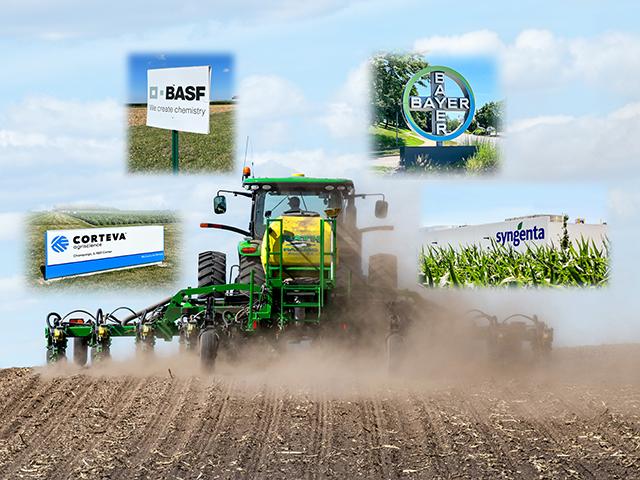
Today, many of those same companies are reversing course. Corteva is splitting its seed and crop-protection businesses. BASF plans to separate its agricultural division from its broader industrial portfolio. Bayer has carved out its glyphosate business into a stand-alone subsidiary. Syngenta is pursuing an IPO (initial public offering) that would separate ownership from operations.
The industry's biggest companies aren't just reorganizing. They're rethinking what kind of businesses they want to be. Rather than trying to own every part of the acre, companies increasingly are specializing in what they do best -- and partnering, licensing and competing in new ways. The shift could reshape everything from who develops the next seed trait to how farmers buy products.
"I think for farmers, it's fundamentally good, because you'll get more competition among these different companies," says Shane Thomas, an agronomist, business analyst and author of the "Upstream Ag Insights" newsletter, which covers ag tech and industry strategy for business professionals. He thinks the changes will foster greater collaboration, as well as create room for smaller, stand-alone businesses such as startups to compete.
BUSINESS PRESSURES
Jorge Fernandez Vidal, a global agribusiness strategist, professor and contributor to the "Purdue Agribusiness Review," says that as the business lines of major agricultural input companies become "more technologically, economically and organizationally distinct, the challenge of managing them through a common structure appears to be increasing."
Companies from General Electric to Honeywell have pursued similar breakups to create more focused businesses.
Vidal says in a recent article that companies across the ag sector are "responding to many of the same forces -- generic erosion, biological disruption, digital capabilities, regulatory tightening, challenged farming economics and investor scrutiny -- but in different ways." See the Purdue Agribusiness Review article at https://agribusiness.purdue.edu/…
A NEW CHEMISTRY PLAYBOOK
For the chemistry side of the business, Thomas says one of the biggest benefits of the breakups is focused capital allocation. When businesses have more direct control of their resources, they can plan, make better decisions and move with certainty.
BASF's planned IPO of its Agricultural Solutions division illustrates how specialization could change crop-protection businesses.
"All of a sudden, they don't have to fight with the chemicals business or the paint business" for capital every year, Thomas says, enabling leadership to get products to market faster.
He also sees collaboration and partnerships becoming a bigger part of the strategy for crop-protection companies. Without the seed business to use as a sales catalyst, Corteva needs to compete on its product portfolio alone. Thomas says it will either need to buy or partner with smaller companies to bring in novel products that are going to help differentiate them down the road.
Thomas says Bayer also could be writing a new playbook for the sector on how to handle commoditization of a once-innovative product. By segregating its entire glyphosate herbicide business into a subsidiary company, Ruveon LLC, it not only limits its litigation risks but also creates a business that can maneuver the narrower margins of a commodity business with expertise.
"Fundamentally, it's just better to have it operating away from the innovation segment," Thomas says. For example, a sales representative at the team or accounts level won't need to discuss saving a few cents on a generic product "when he could be talking about all the cool tech -- the Preceon corn and all the new fungicide tech coming to market."
Stand-alone crop-protection companies also face risks. Thomas points to FMC Corp. as an example. It restructured and took on a new minority owner after generic competition eroded sales of a key insecticide. But, the company also illustrates how collaborative partnerships can work.
To speed a new herbicide's path to market, FMC formed a strategic partnership with Corteva. FMC retains ownership rights and will supply the active ingredient, but both companies will develop it independently.
P[L1] D[0x0] M[300x250] OOP[F] ADUNIT[] T[]
NEW PLAYERS EMERGE
The restructuring isn't limited to the industry's traditional leaders. Other global companies are using the changing landscape to expand.
India-based UPL is separating its Advanta seed business while reorganizing its crop-protection operations under CEO Mike Frank, positioning the company for more focused growth in North America along with more collaborations.
Argentina-based GDM has made perhaps the biggest move. As one of the world's largest soybean genetics companies, GDM vaulted into the top tier of global seed companies with its acquisition of AgReliant Genetics in 2025, adding one of North America's largest corn-breeding programs and established U.S. seed brands, like AgriGold and Mustang Seeds, to its portfolio.
"We used to have what would be referred to as the big four, which was Bayer, BASF, Corteva and Syngenta, but now you've kind of got GDM vying for a position in that top tier of seed companies," says Dean Cavey, cofounder of Verdant Partners LLC, who tracks agricultural mergers and acquisitions. "They are a major force in the seed industry globally."
THE LICENSING RACE
Seed-industry competition increasingly centers on who controls genetics and traits -- not necessarily who sells the seed.
Corteva and Bayer settled a lawsuit earlier this year that clears the way for Corteva's seed company spin-off, Vylor, to expand licensing of its corn, cotton and canola traits.
Corteva CEO Chuck Magro, who will take the helm of Vylor after the split, estimated the annual licensing market at $4 billion at an investor conference in May.
"We have a very small part of that, and what we think our journey now is [is] to create about $1 billion in net licensing revenue over the decade," Magro says in the conference's transcripts.
The shift could create new opportunities for independent, regional and family-owned seed companies, which struggled in the integration era. Todd Martin, CEO of the Independent Professional Seed Association, says the number of independent seed suppliers has dropped from more than 300 a decade ago to less than 125 today.
"Farmers like to make an independent choice," Martin says, adding that independent seed companies' value proposition is a local focus on what genetics work in their geography.
Not every independent has been shrinking. Several of the largest regional seed companies have used the industry's upheaval to expand.
Beck's Hybrids has expanded westward through acquisitions and new infrastructure. Wyffels Hybrids has invested more than $100 million in production and research while expanding into Nebraska and Indiana. Stine continues emphasizing breeding, genetics and licensing.
"The center of all these independent companies is their ability and their desire to offer customer service," Cavey says. "They can do that as well or better than anybody else in the industry, and they can do it with a personal touch."
Martin sees patent challenges ahead for the seed industry. Bayer's NK603 glyphosate-tolerant trait, which is one of the most widely planted biotech traits in the U.S. and is often stacked with other proprietary traits, went off-patent in 2022 and is at the center of a lawsuit with Latham Hi-Tech Seeds.
"There's not a generic supplier in the marketplace," Martin says.
Together, these changes are shifting competition away from ownership and toward access -- access to genetics, traits and customer relationships.
BREAKING THE BUNDLE
The same forces reshaping corporate strategy are also reshaping how products reach farmers.
Bayer, Corteva and Syngenta have received varying levels of anticompetitive regulatory scrutiny for bundling practices and loyalty programs that used rebates to discourage retailers from selling competing products. Thomas says the resolution of those cases open the door for more competition from smaller companies and generic products, making it easier for farmers to assemble their own crop input programs instead of buying into a single company's ecosystem.
In Vidal's "Purdue Agribusiness Review" post, he argues that growers have already become more informed and comfortable combining products from different suppliers, especially if it gives them better results.
The integrated acre isn't disappearing, he explains. It may just be assembled by farmers themselves rather than delivered by a single company.
"No single season is likely to make this shift obvious," Vidal says. "But over time, changes in farmer purchasing behavior may provide one of the clearest indicators of whether integrated offerings continue to create sufficient value to hold together."
BUSINESS BEHIND THE BREAKUPS
Investor preferences change over time, agronomist and business analyst Shane Thomas says. In the 1970s and '80s, investors rewarded conglomerates -- companies that held many disparate businesses under one umbrella.
"Fast-forward to today, and everybody likes these streamlined, one-business-unit businesses," he says, adding that it's easier for investors to connect decisions to outcomes.
Agribusiness strategist Jorge Fernandez Vidal says the seed and trait businesses more closely resemble the business model of pharmaceutical industries with longer development cycles, licensing and royalty streams, and biological differentiation.
"Crop protection increasingly follows a different logic," Vidal writes. "Generic pressure, patent cliffs and tightening regulation are making many portfolios resemble mature industrial businesses more than differentiated innovation engines."
That reflects in companies' price-to-earnings ratio, which compares a company's stock price to earnings per share, Thomas says. Innovative companies with high growth potential usually have higher ratios, while mature businesses have lower ratios.
For example, he says seed and biotech companies trade around 18 times their earnings. Crop-protection businesses trade at eight to 10 times their earnings. A combined company, such as Corteva, might trade around 12 times earnings.
"But, when you split those out, now their earnings amplify the value of the seed business," Thomas explains. "So, you unlock a few billion dollars in shareholder value."
**
-- You may email Katie at katie.dehlinger@dtn.com, or follow Katie on social platform X @KatieD_DTN
-- Farm Business Editor Chris Clayton contributed to this article. Follow Chris Clayton on social platform X @ChrisClaytonDTN or on DTN at https://www.dtnpf.com/…
[PF_0926]
(c) Copyright 2026 DTN, LLC. All rights reserved.