


Ag Weather Forum
Low Runoff Forecast for the Upper Missouri River Illustrates Northwest Corn Belt Dryness
The latest runoff assessment for the Upper Missouri River Basin offers good perspective on how dry this year has been in the northwestern sector of the U.S. Corn Belt. The report, issued by the U.S. Army Corps of Engineers (USACE) on Aug. 10, noted continuing low runoff into the basin because of dry conditions going back almost a year.
The report stated that runoff in the Missouri River Basin above Sioux City, Iowa, was 2 million acre-feet (MAF) in July. That amount is just 61% of average. The farthest-north sector of the Upper Missouri -- the Fort Peck, Montana; Garrison, North Dakota; and Oahe, South Dakota reaches -- have below- to well-below-normal runoff "due to lack of precipitation, dry soils, and below-average mountain snowpack," the report said. The runoff was above normal in the Fort Randall and Gavins Point, South Dakota, reaches and near normal in the Sioux City, Iowa, reach.
Missouri Basin Management Chief Engineer John Remus cited the effect of July heat and dryness as adding to the low runoff. "July brought warmer and drier weather to the Missouri River Basin," said Remus. "The dry soil moisture, below-normal rainfall in the mountain regions, and below-normal mountain snowpack runoff have led to well-below-average inflows into the reservoir system this summer."
P[L1] D[0x0] M[300x250] OOP[F] ADUNIT[] T[]
July was indeed hot -- the hottest on record in the contiguous U.S., according to the NOAA National Centers for Environmental Information (NCEI). NOAA/NCEI statistics show that July 2026 averaged 76.89 degrees Fahrenheit (24.94 degrees Celsius) across the Lower 48 states, eclipsing the Dust Bowl's July 1936 by an eighth of a degree, according to the Associated Press.
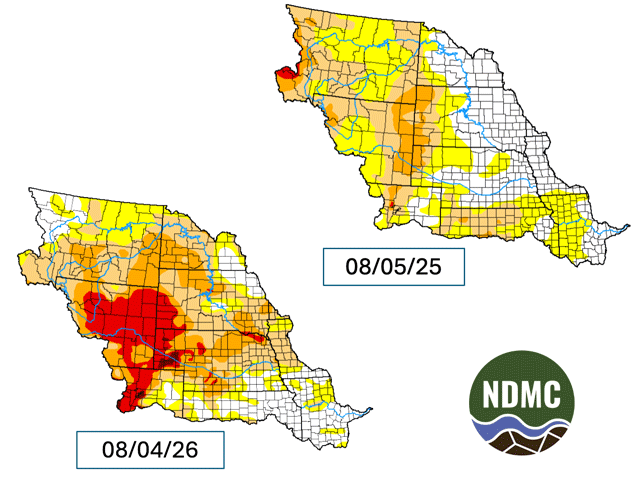
For the entire Missouri Basin, drought is a key feature this summer. The U.S. Drought Monitor for Aug. 4 showed 81.36% of the entire basin in drought. A year ago, 44.23% of the basin was in drought.
A brief look at summer precipitation in row-crop areas of the Upper Missouri shows dry conditions. Precipitation totals since June 1 are: (in South Dakota) Sioux Falls, 4.46 inches, 4.05 inches below normal; Mitchell, 3.62 inches, 3.17 inches below normal; and in Sioux City, Iowa, 4.83 inches, 3.90 inches below normal. Outside the Missouri Basin, but still in the northwestern Corn Belt, the Fargo, North Dakota, precipitation total since June 1 is 3.36 inches, 4.70 inches below normal. (All amounts are as of Aug. 9.)
Prospects for drought easing through the end of the year are variable. The report notes that drought is expected to improve in Montana, Wyoming and Colorado by late October, but that drought is likely to either persist or expand in the Dakotas, Nebraska and Iowa.
For the 2026 calendar year, the Upper Missouri Basin runoff volume is pegged at 15.4 million acre-feet. That amount is 60% of average and is almost identical to the runoff forecast a month ago. "If realized, this forecast would be the 11th lowest runoff in the period of record," the USACE report noted.
Bryce Anderson can be reached at bryce.anderson@dtn.com
(c) Copyright 2026 DTN, LLC. All rights reserved.