

H-2A Drivers Caught in CDL Freeze
FMCSA Rule Leaves Some H-2A Workers Unable to Get Commercial Driver's Licenses
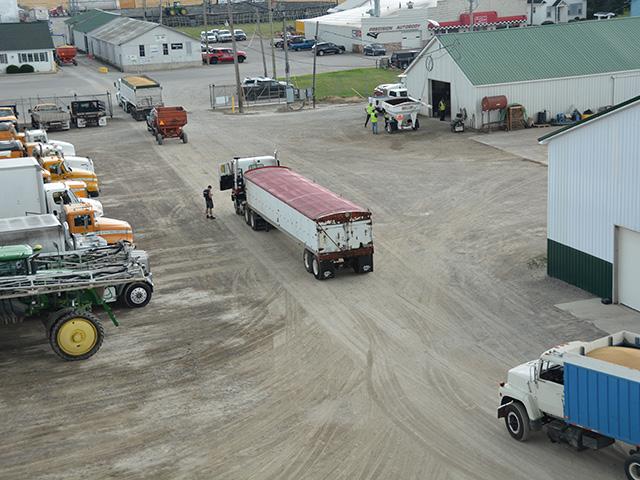
ELBA, New York (DTN) -- Christian Yunker has relied on H-2A workers on his western New York vegetable, grain and turfgrass farm for 15 years.
Many of his workers come from South Africa, where experienced operators travel to the U.S. for seasonal farm work and obtain commercial driver's licenses (CDLs) in the country.
On any given day at CY Farms, Yunker is directing traffic from his phone -- coordinating workers digging rocks from fields, hauling onions or chopping silage -- while watching equipment crisscross the county roads between his fields.
Since a March 16 rule from the Federal Motor Carrier Safety Administration, however, some of those workers have been unable to obtain commercial driver's licenses after the agency halted the issuance of non-domiciled CDLs in states that were not complying with updated licensing requirements.
FMCSA placed 25 states on a noncompliance list after determining some non-domiciled CDLs had been improperly issued. A 2025 audit of 200 New York licensing files found 53% were issued improperly, often for eight years even though the worker's visa was valid for only one year.
New York, California, Pennsylvania and Texas initially declined to revoke licenses identified as noncompliant, prompting the U.S. Department of Transportation to withhold highway funding. New York sued the federal government after about $73 million was withheld, and the case remains pending.
"We brought this guy here specifically as a driver, and he can't drive for us," Yunker told DTN.
The handful of workers Yunker relies on come from South Africa. Other skilled drivers in the industry arrive from Ireland, Australia and Scotland, earning wages six times higher than they would in their home countries, he said.
Those workers are spread out around corn states, too, though most of the states have complied with FMCSA rules.
According to U.S. Department of Labor data, employers received certification for almost 32,000 workers to operate agricultural equipment in fiscal 2024; about 5,600 H-2A workers were certified for heavy and tractor-trailer truck driver positions.
South Africa is the second-largest source of H-2A workers after Mexico.
The licensing changes were intended to strengthen CDL oversight and safety -- sought out by many rural communities entwined in highways and grain transportation.
But Gregory Reed, a transportation attorney with Hanson Bridgett, said it's also about reducing driver capacity because it could improve freight rates.
"I think in part, the reason for the consensus (among trucking associations) is because the transportation industry has been so challenging over the last several years -- rates (have been) below sort of sustainable economics for motor carriers and for owner-operators," he said.
For agriculture, however, thousands of H-2A truck driver certifications underscore continued demand for seasonal drivers and farm laborers who often do both, not a need for a reduction.
A decision in Rivera Lujan v. FMCSA is expected in September and will determine whether an estimated 200,000 non-domiciled drivers remain eligible to hold CDLs.
As of February, 11,500 drivers had been removed from the road, USDOT said.
Yunker has urged members of Congress to resolve the issue with one goal: "Let these guys get CDLs issued that are properly licensed."
Legal firms, including Hanson Bridgett, advise employers to review CDL-required positions and verify employee visa statuses under the DOT's updated framework. Employers should identify affected non-domiciled CDL holders, confirm foreign CDL reciprocity for Mexican and Canadian drivers, then prepare for added verification steps for other H-2A drivers.
P[L1] D[0x0] M[300x250] OOP[F] ADUNIT[] T[]
WHO'S EXEMPT
Many affected CDL holders worked on New York specialty crop farms or traveled with harvest crews nationwide, helping supply food and fill agricultural labor gaps.
"What I would normally do is be like, OK, well, you had your CDL so come to New York, it's less than a year old, and you can just get a Class A CDL here and get it renewed," Yunker said.
FMCSA narrowed eligibility to individuals with certain lawful immigration statuses, including H-2A, H-2B and E-2 visas, with specific documentation requirements. The rule eliminated J-1 visas from eligibility.
Today, only New York and California have not completed implementation of FMCSA's new rule, limiting their ability to issue CDLs to non-domicile workers.
For employers, the issue extends beyond new applicants. Those drivers also may be unable to renew, transfer, upgrade, replace or reinstate their credentials when their next licensing transaction comes due.
Lucas Smith, regulatory extension associate with Cornell Agricultural Workforce Development, said not all workers are affected.
"An increasing number of farms have been hiring South African H-2A employees. They are impacted more directly because there's no way for them to hold any CDL in NYS at present," he said.
While more farms have been bringing in H-2A employees to drive Class A and Class B trucks, many H-2A employees from Mexico hired for those positions already hold a federal Mexican CDL that can be relied upon in certain circumstances without retesting.
The issue centers on the practice of obtaining a CDL in one jurisdiction and using it in another. Current proposals are taking steps to prevent that practice and sanction states that do not comply with federal CDL requirements through potential program decertification, a petition introduced to court in July.
The rule change also affects custom harvesters in the Midwest, whose foreign workers make up 75% of their workforce who operate combines, trucks and other agricultural equipment.
ACCEPT THE RULES OR WAIT
U.S. Custom Harvesters, Inc. faced the biggest disruptions from February through June following the elimination of J-1 workers, the expiration of some I-94 documents and the time it took for states such as Texas -- which became compliant May 1 -- to resume non-domiciled CDL testing.
"The crops don't wait for anyone! But we support the idea, the timeline and announcement came at the worst possible time," said Mandi Sieren, executive director of U.S. Custom Harvesters, Inc.
The testing process takes around five weeks, and the difficulties began in February, she said. Employment opportunities were missed because CDL testing typically starts in March for forage harvest in the Deep South and in mid-May for grain harvest in Texas.
Despite the challenges, the organization supports the FMCSA changes.
"We want our roads to be safe for us, you and our families," Sieren said. While roadway safety remains the priority, Sieren said labor shortages continue to be a major concern for the industry.
"Labor is definitely the number one issue in the custom harvesting industry. Workers leave in the middle of the night, you can be forced to hire extremely inexperienced employees, etc. Trucks sit. Machinery sits."
New York is awaiting a preliminary injunction hearing in State of New York v. United States Department of Transportation, which seeks to restore highway funding tied to CDL compliance. Reed said withholding federal funds is a powerful tool for encouraging states to comply with federal requirements.
"Even states like California, New York -- wealthy states by many measures -- still critically rely on federal funding for their highways and transportation infrastructure," he said.
In Lujan v. FMCSA, the case directly challenging the pause on non-domiciled CDLs, Reed said he does not expect the plaintiffs to prevail.
"I don't think that the plaintiffs are likely to succeed. The final rule that the FMCSA promulgated was far more complete than the emergency temporary rule," he said.
While immigration advocates have pushed back against restrictions affecting foreign workers, and groups such as the New York Farm Bureau have collected data from hundreds of potentially affected farms, farm organizations have not publicly taken a formal position on the litigation yet.
DECERTIFICATION OF CDL PROGRAMS
The latest threat is the potential revocation of a state's authority to issue CDLs -- a proposal included in a petition from the Small Business in Transportation Coalition in the U.S. Court of Appeals for the D.C. Circuit.
The petition seeks decertification of CDL programs in New York and California, alleging the states are not complying with federal requirements.
"Decertification has never been done before. It really hasn't been seriously threatened before," until now, Reed said. "The transportation providers and the transportation consumers aren't going to wait around until some forthcoming deadline to take action and adjust the way they operate their business."
SBTC argues federal law and FMCSA regulations require decertification after the agency determines a state's CDL program is in "substantial noncompliance."
Reed said decertification of even one state could disrupt commerce, affect markets and discourage people from entering the transportation industry.
The H-2A program has entered another period of uncertainty as farmers navigate shifting immigration pathways, changes to wage requirements following the Adverse Effect Wage Rate system and the absence of major legislative reforms to the program in more than four decades.
The evolving rules add another layer of complexity to agricultural labor decisions, Yunker explained.
"In one sense, fortunately, New York State stood up for those drivers, but of course the Trump administration had to retaliate. There was probably a few that shouldn't have been issued, but it should not have been revoked across the board," he said.
To see more:
-- FMCSA March ruling: https://www.fmcsa.dot.gov/…
-- Decertification of state CDLs petition filed: https://www.overdriveonline.com/…
-- Law firm advises commercial drivers on new federal rules: https://btlaw.com/…
Jake Zajkowski can be reached at jake.zajkowski@dtn.com
Follow him on social platform X @jzajkow
(c) Copyright 2026 DTN, LLC. All rights reserved.