


Canada Markets
Corn Likely to See Greatest Impact From European Drought
Temperature records being broken in France are making the news headlines but the prolonged drought and its impact on grain and oilseed production could be the more important story going forward (to ag markets at least). And certainly, worth a closer look.
To begin with -- wheat, barley and canola are likely past the point of being impacted by this latest record-setting heat wave. They are seeded in the fall and are typically harvested from mid-June through August. That said, the drought has been impacting France (in particular) for long enough it is still expected to take the top off yields. And small crops tend to get smaller so future production adjustments will likely be lower, but more on that later.
The crop that should see the greatest impact on production, and therefore on imports, is corn. It follows the production cycle more closely to that of North America with seeding taking place in April and May, silking normally seen between early June and mid-July (so right in the worst of the heat and drought), and harvest taking place from mid-September to the end of November. With none of that looking good from a production point of view considering the current conditions.
As mentioned, France is at the heart of the problem with much of the country receiving less than 20% of normal precipitation over the past 60 days, so basically since the crop was seeded. The heat over that same period has been extreme with most of the country reporting a 5-7 degrees Fahrenheit anomaly over the timeframe. In fact, France endured its hottest day since records began on Tuesday with Paris reaching 105 degrees Fahrenheit. Although neighboring countries are not as hot, they are also setting records throughout. Not the best silking weather to say the least.
P[L1] D[0x0] M[300x250] OOP[F] ADUNIT[] T[]
The extreme heat is supposed to subside by the end of the month but is forecast to remain well above normal. Rainfall is not expected to amount to much either with most of the area expected to receive less than 60% of normal over the next few weeks.
That certainly puts the June estimates from USDA in doubt when it comes to corn production and the resulting import requirements. In the June update, USDA expected the EU would produce 57.5 million metric tons (mmt) of corn in 2026-27, up slightly from last year's 56.8 mmt crop but below the 25-year average of 61.5 mmt. That estimate will almost certainly decline in future updates given the conditions facing the crop.
The impact should not be taken lightly considering how EU production compares to total Canadian corn production of a paltry 14.5 mmt. Other notable comparisons are Ukraine that is expected to produce 30 mmt this year and Argentina that is just wrapping up a bumper harvest of 61 mmt (compared to 49 mmt last year). So, European Union corn production is not insignificant on a world scale, and a sizeable hit will result in increased imports that have to come from somewhere. Eastern Canada already has a track record of exporting to Europe, so Canadian producers need to keep this discussion on the radar.
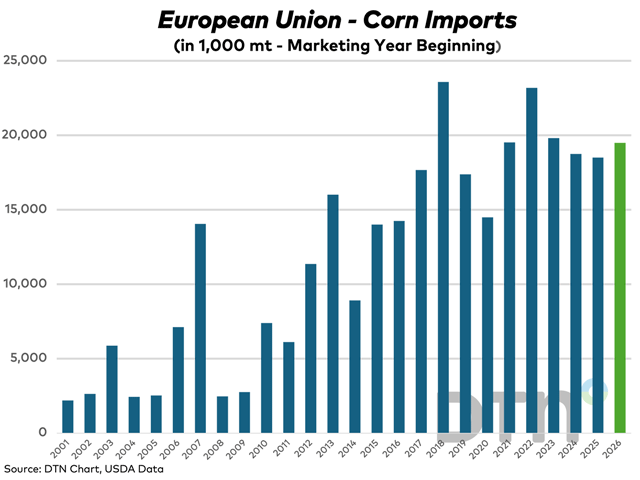
As far as imports go, as you can see from the accompanying chart, the European Union has been feeding its growing appetite for corn through increased imports. In the June update, USDA suggested EU corn imports for 2026-27 would increase to 19.5 mmt (in green) from 18.5 mmt last year. It would make sense depending upon the impact that the drought has on production, that the record high set in 2018 could be challenged instead. That happened to be 23.6 mmt, which would result in imports being at least 4 mmt above the current USDA estimate.
It's worth noting that the corn market in Europe has responded with contract highs being set on Wednesday (while Chicago corn set new contract lows), up 9.4% in the last 10 days.
Looking briefly at the other crops at risk, canola production is currently forecast (by USDA) to basically match last year's level with 20.5 mmt expected to be produced in 2026-27. That is expected to result in import requirements of 5.75 mmt, up slightly from 5.5 mmt last year. Given the growing demand for renewable diesel, it would not be surprising to see the record high import level of 2024-25 be challenged (should the crop estimates decline) with that being 7.964 mmt. Assuming supplies could be sourced, of course, which may be difficult given Australia's challenges from El Nino and input shortages and Canada's cool, wet spring.
Barley production is expected to be off slightly from last year's strong crop (due to spring dryness) with a 53.15 mmt production estimate by USDA for 2026-27 compared to 56.39 mmt last year (and a 25-year average of 56.16 mmt). Wheat production is supposed to be similar, coming in slightly above average but below last year's strong crop. 2026-27 wheat production is currently forecast by USDA to be 136 mmt compared to 145 mmt last year and a 25-year average of 135 mmt.
I welcome feedback along with any suggestions for future blogs. My daily comments can be found in Plains, Prairies Opening Comments and Plains, Prairies Quick Takes on DTN products.
Mitch Miller can be reached at mitchmiller.dtn@gmail.com
Follow him on social platform X @mgreymiller
(c) Copyright 2026 DTN, LLC. All rights reserved.