



Ag Weather Forum
Multiday Significant Severe Weather Event for US
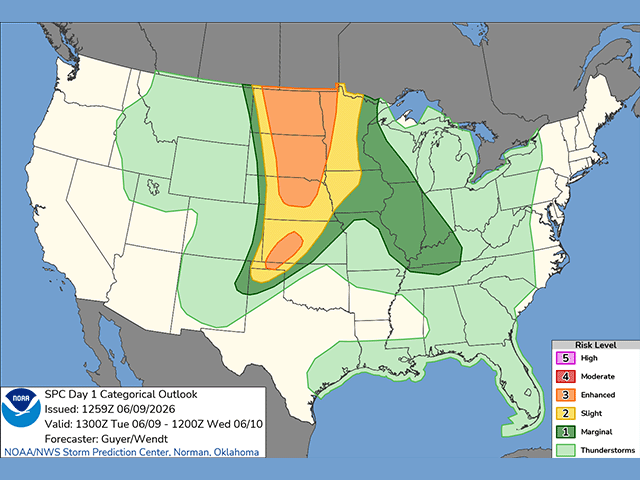
A combination of intense heat, high humidity, and multiple weather systems will combine to produce a significant run of severe weather across the country daily through at least June 13 and possibly longer. Massive hail, hurricane-force wind gusts, and several strong, long-track tornadoes are looking likely each day. The area under threat will change each day, but the chances for more widespread severe thunderstorms are looking likely during this stretch of very active weather.
The summer heat has certainly arrived across much of the United States that began last week. Temperatures well into the 80s Fahrenheit with large areas rising into the 90s have been met with increasing humidity with flow northward from the Gulf of America. This fuel is pretty typical during the summer, but it has come in during a time when the weather pattern is becoming increasingly active.
Upper-level low-pressure systems and disturbances have been crossing over the U.S. and leading to areas of thunderstorms. But a particular upper-level low will be more active in the days to come. It will move into the middle of North America during the next few days and largely stall out. Disturbances and reinforcing energy into the trough will set off a multiday severe weather event where strong thunderstorms will develop as cells or small clusters, form into lines, and push eastward during overnight hours, only to redevelop in another place the next day and start the process going again.
With multiple disturbances rotating around the trough, this will occur daily through at least Saturday, and could extend well into next week depending on how much fuel remains as these disturbances rotate through the U.S.
P[L1] D[0x0] M[300x250] OOP[F] ADUNIT[] T[]
The first is already moving into the Northern Plains on June 9. This little disturbance will quickly deepen across the Dakotas late this afternoon and evening, causing cells to quickly form lines of severe thunderstorms from southern Manitoba through the Dakotas and down into Nebraska. All hazards are on the table, but multiple tornadoes and massive hail should be the early threats, followed by significant severe winds that could reach hurricane force (greater than 75 mph).
Additional, more sporadic severe thunderstorms look possible farther south across Kansas down into the Texas Panhandle with wind and especially hail being the most likely hazards. This threat will shift eastward into the Midwest for June 10 where much of the same issues will be repeated. The greatest threats look to occur from eastern Minnesota and Iowa into Wisconsin and northern Illinois. Again, an earlier tornado and hail threat should transition to more of a severe wind threat, and hurricane-force gusts will be possible if the storms merge into larger line clusters and segments.
At the same time on Wednesday, another system will move into the Central Plains. Though this system will be behind the fuel on Wednesday, it will set up a bigger severe weather event as it moves east into the Midwest on June 11. It will then meet the hot and humid conditions where more rounds of significant severe weather are being forecast. There will likely be severe storms from Missouri northeast into Michigan with all the same hazards that have been forecast before. Early tornadoes and large hail could merge into lines that produce hurricane-force wind gusts in the afternoon and evening. That threat will shift east into the eastern Midwest to the Northeast and Mid-Atlantic for June 12. Though the risks of large hail and especially damaging winds remain, the risks for tornadoes will be lower.
On June 13, the process will tend to repeat itself. We will see another system moving into the Central Plains with strong-to-severe thunderstorm potential continuing northeast into the Great Lakes as well. That system will push a front down into the Southern Plains and across the eastern Midwest where showers and thunderstorms will continue for June 14. The risk of severe weather is more uncertain as the period continues, but a pool of hot and moist air will reside east of the front, providing enough fuel for severe thunderstorms should there be enough energy to trigger it.
Models are more uncertain with additional pieces of energy rotating around the upper-level low-pressure center next week, placing thunderstorms in various areas of the country. The pool of warmer and humid air will not be as great as it is this week either, providing less certainty. But the risk of severe weather will continue as long as there is enough energy to produce thunderstorms.
The Storm Prediction Center (SPC) is a great resource for understanding the risks of severe weather with their outlooks and discussions. Visit their website each day to see an updated outlook here: https://www.spc.noaa.gov/…. The SPC outlines the severe storm risk on a scale of 1-5 with 1 being marginal, 2 being slight, 3 being enhanced, 4 being moderate, and 5 being high. Visit the Center's page for the definitions of each rating.
But during the next three days, through Thursday, there are large areas of an enhanced risk (3 out of 5) of severe weather. The SPC also labels severe weather chances through day 5, which is June 13. And while they currently do not have a designation for days 6-8, Sunday through Tuesday, June 14-16, their discussion mentions likely chances for additional severe weather as models come more into alignment on the setup and risks.
To be fair, June 9 is not the first day of significant severe weather in this run of active weather. This run started with a cold front that moved across the Midwest on June 6, which saw multiple strong wind reports across the eastern Midwest into the Mid-Atlantic. That was followed by a system that moved into the Northern Plains on June 7, that made for a string of severe storms that produced large hail and damaging winds from Wyoming into Manitoba and included a line of storms that may have technically met the definition of a derecho as it moved through western and central North Dakota. And then another round of significant severe weather moved across Colorado, Nebraska and especially in Kansas where there were more reports of hurricane-force wind gusts on June 8.
To stay up to date with weather conditions and your local forecast for free from DTN, head over to https://www.dtnpf.com/…
John Baranick can be reached at john.baranick@dtn.com
(c) Copyright 2026 DTN, LLC. All rights reserved.