


Family Focuses on Diversification To Sustain Farm for Generations
Beef, Bourbon and Brews
John Evans' young son, Oliver, is running down the corn row ahead of his dad while Evans shows us around a good portion of the family's roughly 2,000-acre operation on rolling land near Little River Academy, in central Texas, south of Temple. "I certainly hope this is sustainable for generations," he says, nodding toward Oliver.
Evans' ancestors came to what is known as Wilson Valley 150 years ago. His family is tied to the six Wilson brothers who first came to the region in 1866. Evans is the fifth-generation farmer-rancher in his family.
"I hope we end up with sixth, seventh and eighth generations that can carry this on," he says.
DIVERSIFY TO THRIVE
Evans and wife, Erica, have not relied solely on hope to this end. They've boldly pushed to try new business ventures to diversify. The most high-profile of their efforts is Wilson Valley Mercantile, the on-farm distillery they opened in the fall of 2022.
A bourbon connoisseur, Evans wanted to make spirits using crops they grew. Among their offerings is Texas Bloody Butcher, a bourbon made with heritage corn of the same name, and Texas Three Way Bourbon, made from corn, wheat and oats.
Three years into Wilson Valley Mercantile, they've added gin to the whiskey and vodka offerings. Distilled spirits meant having a cocktail bar, which begat the need to offer beer. They now brew four beers.
"In January [2025], we more than doubled our production, going from running one day a week from September to May to running two days a week year-round," Evans explains. Right now, the distillery produces about 60 gallons of spirits per week and a smaller quantity of beer. These products are only sold on-site. They sell beer growlers to-go at the shop.
"Generally, our goal is to grow the hospitality business," he says. "At some point, we will need to take some leaps forward; but right now, that doesn't make sense."
The drinks led to a commercial kitchen to provide food -- and a value-added market for up to 35 head of their cattle annually through menu items like hamburger and thinly sliced steak fingers.
The family also sells Evans Ranch-branded frozen beef on-site, but they don't ship frozen beef at this time.
"I've done some initial research on doing so but haven't gotten past that point," Evans says.
"I think this is the only farm in America where you can get whiskey, beer and beef, with everything raised here," he adds.
STOREFRONT REPRESENTS LEGACY
P[L1] D[0x0] M[300x250] OOP[F] ADUNIT[] T[]
Wilson Valley Mercantile tells the story of the Evans family history, John and Erica explain. It is dotted with furniture and fixtures from their family histories. Numerous friends and relatives have helped start the Mercantile and occasionally work there for special events. There are musical performers every evening at no charge to customers, but occasionally, there are ticket sales for acts with higher name recognition.
No doubt, though, the Mercantile adds value to the farm and ranch. "This is also a venue to sell our commodities at higher, value-added prices," Erica says. "It's another way to keep farming and ranching."
The original J.E. Evans General Merchandise (an actual general store) opened in the county in 1911, and the Evans' distillery today is furnished with fixtures from that past, including the original safe and cash register.
CASH IN ON CROPS
The Evanses aren't strangers to diversification. Erica teaches middle school full time while still working at the Mercantile Thursday through Saturday evenings. "Just don't ask me to do anything come Sunday," she says with a laugh.
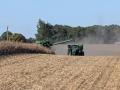
The bulk of the operation's corn harvest (1,000 acres plus) is sold as deer corn for wildlife. Most is sold to companies that do their own packaging. This is a business begun by John's father, W.C. Evans, too long ago for John to remember exactly when. He's continued growing corn and selling it to some of the same companies.
Deer corn is No. 2 yellow commodity corn that Evans -- by use of combine settings -- tries to get as clean as possible at harvest. Additionally, they test each load on the farm for aflatoxin.
"That's an added value for our customers who bag the corn," Evans says of the testing. "Buyers don't then have to test each load they receive. We also eliminate the risk of our corn being rejected after we've shipped it four hours away.
"We grind some of this corn ourselves for cattle feed and sack some of it as deer corn and sell locally," he continues. "The price is better than commodity corn, and anytime you can do that, it's a win.
"A lot of the premium comes from things we do for our customers, such as keeping the corn clean and providing aflatoxin testing," Evans explains. "We also make freight on delivery. I figure we make 10 to 15% above commodity prices, up to 25% in the right situations."
Evans Ranch's main crops are corn, wheat and oats, with some occasional cotton. The distillery has prompted them to grow 5 to 10 acres annually of specialty crops such as barley, rye and various specialty corns.
In addition, Evans runs a precision-farming business. He worked full time in information technology for a decade after attending Texas A&M University prior to returning to the ranch after his father died in 2011. He's been a licensed dealer for Ag Leader for years and consults on and services precision equipment.
"We get a discount in terms of what technology we buy for ourselves," Evans explains. "But, it really depends on Mother Nature what folks have to spend on precision farming. So, it fluctuates a lot what we can manage to sell."
In 2024, Evans also became a Pioneer seed dealer. They plan to build a 40- x 50-foot warehouse to store seed at the ranch in 2026.
"I'm happy with the amount of seed sales we had for the first year," he says. "Everything we do is adjacent to farming in some way."
CATTLE BUSINESS
At any given time, Evans Ranch has 250 to 300 cow/calf pairs in addition to registered Charolais and purebred Brahman cattle.
"My grandfather always maintained a herd of Brahman," Evans says. "You can put a Hereford bull on them, and the cross makes really good mamas [Braford cattle]. The replacement heifers command a premium when you sell." What those premiums are Evans can't say precisely in today's beef market. "Everything is high right now," he says. "Fancy heifers or pairs are particularly in demand."
Evans Ranch raises cattle in locations in three counties.
"We do run some stockers and feed them out on the ranch," he says. "I could feed out all our cattle every year, but that doesn't always make sense -- sometimes due to the market or whether we have the labor for it."
The ranch employs one part-time and three full-time workers. Chris Southerland has been Evans' right-hand man for years, and Southerland's wife, Amanda, is the operation's office manager. Evans and Southerland built a lot of the Mercantile themselves.
The Evanses are familiar with frugality -- not just in terms of what they can do themselves. The farm and ranch still use a 50-year-old John Deere 4430 and a nearly 45-year-old 4440 in regular rotation. When Evans speaks of his "new" equipment, he's referring to a 2012 tractor and a 2011 combine.
"I do like a deal," he admits. This penchant isn't confined to just farming equipment. When a San Antonio-based bakery went out of business, the Evanses bought its grain-milling equipment. Their beer brewing setup was purchased from a defunct Temple-based brewery. Part of that deal was that the brewer had to teach Evans how to make beer. (Spoiler alert: He's learned very well.)
A FAMILY AFFAIR
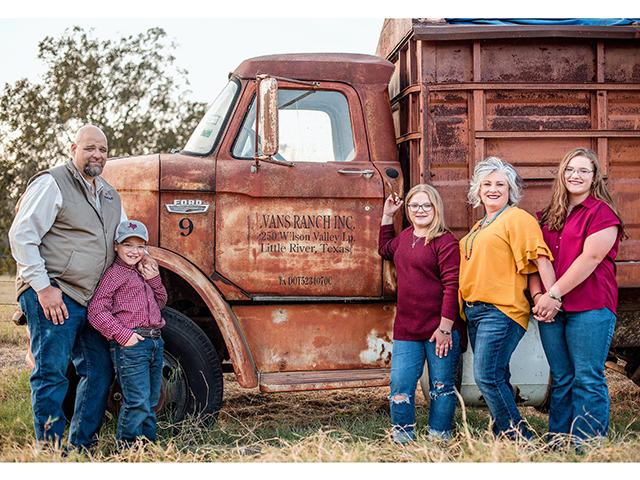
Evans isn't the only member of the family taking on new roles. Their children -- Darby, 15; Isabel, 12; and Oliver, 9 -- are all involved in the operation.
In third grade, Oliver, during show-and-tell at school, told classmates about helping his father make beer. He had to clarify for the class that he doesn't drink the finished product.
Darby and Isabel have become licensed food handlers and work at the restaurant. It helped inspire Isabel to take up baking. She now sells her pies and other sweets at Wilson Valley Mercantile.
"She's learning the business of owning and creating," mom, Erica, says. "Isabel's learned pricing by taking into account expenses like the ingredients." The practical experience all the children are getting with the family's various businesses resonates now with their FFA and 4-H activities.
This is a far cry from 20 years ago when Evans was pretty certain he wasn't going to farm and ranch for a living.
"I was actually encouraged by my father, W.C., not to come back because of the economics of the operation back then," Evans explains. "But, when Dad passed away in 2011, the ranch wasn't something I was willing to let end.
"I'm still trying to get the hang of farming," he admits. "It's like medicine -- you practice it."
[PF_0526]
(c) Copyright 2026 DTN, LLC. All rights reserved.