



Health Care Code Blue
Code Blue
When the nearest hospital is 35 miles away, a heart attack becomes a lottery. For 60 million Americans living in rural communities, that's not a hypothetical -- it's daily life. With Medicaid cuts poised to shutter facilities from Texas to Pennsylvania, experts warn the odds are about to get much worse.
In his 30 years in health care, Mark T. Jones has never seen things this difficult.
"Nothing is easy these days when it comes to rural health care," says Jones, executive director of the Minnesota Rural Health Association. "Funding, attracting physicians and nurses, medical transport, you name it. The solution is to make things easier and more balanced, but where do you start? I'm not sure any of us really know."
Compared to other states, Minnesota's rural hospitals are managing to stay open and provide essential services like emergency care and childbirth. Still, most small-town health-care providers -- especially those in remote areas -- face significant challenges that threaten their survival.
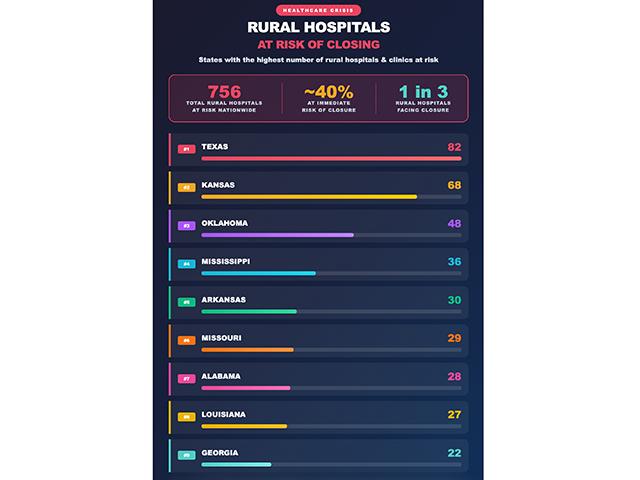
According to Becker's Hospital Review, a leading medical industry trade publication, the states with the most rural hospitals and clinics at risk of closing in the next couple of years include Texas (82 at risk), Kansas (68), Oklahoma (48), Mississippi (36), Arkansas (30), Missouri (29), Alabama (28), Louisiana (27) and Georgia (22).
Every state has rural health-care facilities that teeter on the edge of shutting down or losing vital services, leaving populations without reliable, nearby care.
So, why are some states struggling while others remain status quo or even thrive?
Several factors contribute, but the biggest comes down to money -- Medicare and Medicaid reimbursement, in particular -- as not all states are paid back for medical services at the same rate.
THE STAKES ARE HIGH
Since 2010, more than 140 rural hospitals have closed nationwide, with hundreds more cutting inpatient services or eliminating maternity wards as cost savings. Nearly one in five Americans lives in a rural community, yet almost half of rural hospitals now operate at a loss, with 432 facilities vulnerable to closure. Roughly 60 million people rely on rural hospitals for their health care.
Health care gives life to its community -- literally. Hospitals are economic anchors, community stabilizers and essential lifelines for populations that often face geographic isolation, workforce shortages and higher health risks.
"A community loses health care, and it loses much more than access to doctors and nurses," says Lisa Davis, director and outreach associate professor of health policy and administration, Pennsylvania Office of Rural Health. "In rural communities, they are often the largest employer and one of the best-paying employers. Without a reliable hospital or clinic in town or close by, it's difficult to attract business."
Rural residents tend to be older and experience higher rates of chronic disease, unintentional injury and mortality than urban counterparts, partly because they live farther from specialized medical services and emergency care. When a rural hospital closes, the nearest alternative may be 30, 60 or even 100 miles away -- distances that can turn treatable emergencies into fatal ones, creating "health-care deserts."
A LANDSCAPE OF STRAIN
For decades, rural communities have struggled with fewer doctors, limited infrastructure and financial stress. In recent years, these challenges have been compounded by sweeping federal policy changes, financial pressures on Medicaid and Medicare, workforce shortages and COVID-19-era aftershocks that continue to reverberate.
Today, rural clinics, critical access hospitals and community health centers serve vulnerable communities on razor-thin margins. As policymakers debate sweeping legislation like the One Big Beautiful Bill Act and ongoing Medicaid reforms, rural health-care leaders warn that decisions made in Washington may decide the fate of entire towns.
P[L1] D[0x0] M[300x250] OOP[F] ADUNIT[] T[]
Residents in rural counties commonly travel 30 minutes or more for emergency care or specialist appointments. Rural Americans live an average of 10.5 miles, or about 17 minutes, from the nearest hospital -- nearly twice as far as people in urban areas, according to national health analysts.
"In Nebraska, the general rule is that rural hospitals are 35 miles on average from people who need their services, and that leads to some precarious situations," says Jed Hansen, executive director of the Nebraska Rural Health Association. "The most rural areas in northwest Nebraska are the most isolated when it comes to health care. But, with the way things currently are, what we have are the best options to provide them with health-care services."
STAFFING SHORTAGES
Another challenge that plagues rural areas is a chronic shortage of health-care workers. Doctors, nurses and specialists are often drawn to urban centers where pay is higher and professional support more readily available. Recruitment incentives and loan repayment programs exist, but many rural clinics still can't attract the staff they need.
"We can advertise all we want, but when housing and schools are limited -- and pay is tight -- people go where life is easier," Davis says.
In rural areas, the hospital or clinic is often one of the largest employers. Attracting medical practitioners is vital but complicated.
In 2023, the average operating margin for rural hospitals was just 3.1% compared with 5.4% for urban systems, according to the National Rural Health Association. Many rural facilities operate at a loss.
Medicaid accounts for a significant share of rural hospital income. Many rural residents rely on Medicaid rather than private insurance, which typically pays better -- yet federal Medicaid reimbursement rates are often lower than actual service costs.
"If rural hospitals lose Medicaid revenue, many will have no choice but to cut staff, reduce services or close entirely," says health economist Dr. Adam Gaffney.
This dependency has profound ripple effects. When Medicaid cuts occur or eligibility tightens, hospitals see reduced revenue and increased uncompensated care -- treating uninsured patients with no reimbursement -- driving a community's health care system closer to collapse.
POLICY PRESSURES: THE ONE BIG BEAUTIFUL BILL ACT
No single policy captures the attention of rural health leaders like the One Big Beautiful Bill Act (OBBBA), passed last Fourth of July by Congress. The law has become one of the most politically controversial federal pieces of health and budget legislation in recent history.
The OBBBA implements extensive Medicaid funding cuts over the next decade -- the largest reduction in the program's history. It adds work requirements for most able-bodied Medicaid recipients, tightens eligibility rules and verification, and creates a Rural Health Transformation Program with $50 billion over five years to support rural providers.
On its face, the legislation attempts to balance budget priorities, incentivize work and invest in rural infrastructure. In reality, experts and opponents see a volatile mix of potential help and probable harm, warning that the cuts pose an existential threat to rural health care.
"The Medicaid cuts in the One Big Beautiful Bill Act would devastate rural hospitals across the country," says Rick Pollack, president and CEO of the American Hospital Association (AHA). "Many would be forced to choose between maintaining services, keeping staff and possibly closing their doors. That is something no health care provider should have to do."
The AHA predicts rural communities could lose $50.4 billion in federal Medicaid support over the next decade. Patients could be forced to travel hours for basic or emergency care if local hospitals close. Facilities already operating at a loss could falter without predictable Medicaid revenue, increasing uncompensated care burdens that drain limited reserves. States may struggle to replace lost federal dollars, shifting the strain to local budgets.
In many rural states -- where Medicaid covers nearly half of births and a majority of nursing home residents -- the implications are profound.
States learned this January what their shares of the $50-billion Rural Health Transformation Program will be.
"Congress developed the rural health transformation program, which was really initially discussed as a way to offset some of the reductions in funding and reimbursement that these rural hospitals were intending or will be receiving," says Carrie Cochran-McClain, chief policy officer for the National Rural Health Association.
While that money is helpful and an important step forward, hospitals still need day-to-day reimbursement from sources such as Medicaid to be able to pay for the services they're giving, Cochran-McClain says.
"Ultimately, we want to get to this place where we are focused on value and outcome, and that we are not worried about paying for widgets. To get there, we still have to sustain the providers who are providing care for individuals in these communities."
MARGINS AND UNCERTAINTY
Rural hospitals already operate on thin margins. Uncertainty around the Affordable Care Act (ACA) -- especially Medicaid expansion, subsidy funding or payment models -- makes long-term planning challenging. This leads to delayed investments in equipment and staff, service cutbacks (obstetrical units are a common casualty) and hospital closures that hit rural areas disproportionately hard.
A prime example is Pender Community Hospital, in Nebraska, which serves people up to a 50-mile radius for labor and delivery services, and welcomes more than 120 babies each year -- the most per capita of any hospital in the state, according to its own analysis.
Across the state and country, it has become increasingly difficult for hospitals such as Pender to keep their doors open. Reimbursement rates for Medicaid have lagged skyrocketing costs, and recruiting and retaining employees is tough.
Still, they find ways to survive.
"Not only does our district proudly operate Pender Community Hospital -- an award-winning critical access hospital -- but four rural health clinics and three retail pharmacies, a child development center and a facility for aging adults and seniors," says CEO Laura Gamble. "We have to make it work here, because we're 45 minutes to a bigger hospital that can provide similar services."
If Congress weakens ACA provisions or fails to clarify them, people in nonexpansion states may stay uninsured. Seasonal, agricultural or self-employed workers -- common in rural areas -- may lose affordable options. Older rural residents who are not yet eligible for Medicare are especially vulnerable. The ACA has helped accelerate telehealth access, but congressional indecision around reimbursement rules and broadband funding can slow progress.
Some potential positive impacts involve policy flexibility and state-level innovation, pushing states to experiment with Medicaid waivers tailored toward rural populations and community-based care approaches. It can also make a stronger case for bipartisan rural investment, driving targeted funding for critical access hospitals and support for broadband, telehealth and workforce pipelines.
The core issue isn't just what happens to the ACA -- it's the uncertainty. When Congress hesitates or sends mixed signals, strong systems adapt and innovate, while fragile ones close or shrink -- and patients feel the consequences.
RURAL HOSPITALS AT A CROSSROADS
For the more than 60 million people who rely on rural hospitals in the United States, the rapid deterioration of access to care and persistent financial strain raise questions about the safety net's ability to meet these communities' needs in the future.
The OBBBA could reshape the landscape, for better or worse, depending on implementation and political will. The future hinges on whether policymakers treat rural health care as a national priority or a regional afterthought.
"Even with current Medicaid reimbursement rates, [which are] lower than commercial insurance rates, most hospitals lose money treating Medicaid patients," says Dr. Aaron E. Carroll, president and CEO of AcademyHealth, a nonpartisan professional organization for health services and policy research.
"Further cuts make it really impossible for rural hospitals to treat Medicaid patients, causing more hospitals to turn away Medicaid recipients for elective services and for hospitals to eventually close when the economic loss has become unmanageable."
[PF_0426]
(c) Copyright 2026 DTN, LLC. All rights reserved.