


View From the Range
Alberta Ranch Builds Herd to Thrive in Rugged Terrain
REDFIELD, Iowa (DTN) -- Every cattle producer has an image of the ideal cow. For Austin Cross at Cross Cattle Company, that cow is self-sufficient and is the one that makes his family the most money.
The Cross Family owns Cross Cattle Company in Claresholm, Alberta, Canada, and is participating in DTN's View From the Range series, where DTN will follow a year at the ranch to give readers an inside look at how the ranch operates and cares for its animals.
DEFINING THE IDEAL COW
This segment of the series focuses on what the family looks for in an ideal cow and how they care for the cows they run on their ranch.
"It's probably easier to tell you what I don't want in a cow than what I do want," Austin said with a laugh. "When we are looking for a cow to stay on our ranch, they do need several qualities because we run on big country."
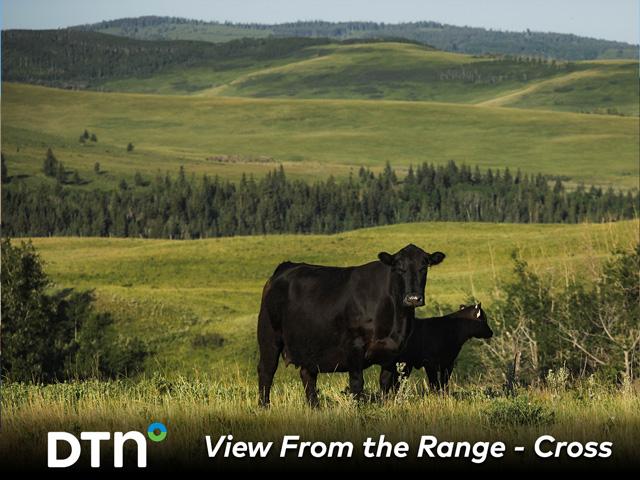
He said they look for a cow with a good amount of frame. She should be long, smooth-fronted and feminine. Being sound on their feet and legs is a must, as the cows must travel across hilly terrain and put some steps in to get to water.
"We want cows that will raise good calves. We feed our calves until they are yearlings, so we want them to have the same qualities we are looking for in the cows," he said. "We don't want any small, boxy cattle. They need to have a larger frame to carry the muscle we like to see."
Since cows are calved on grass, they don't want to have calving problems, thus they look for cattle with a sleek, smooth look and not coarse in their bone structure or muscling.
"We want the cows to take care of themselves and their calf. If they can do that and wean a nice big calf at weaning time, that is the kind of cow we want," he added.
P[L1] D[0x0] M[300x250] OOP[F] ADUNIT[] T[]
A good, clean udder with smaller teats that a calf can find and nurse quickly after birth without issues is ideal.
Docility is a must at Cross Cattle Company. They use mostly horses to move the cattle through the pastures and ride horseback through the cows daily. Austin said they notice if a cow is toward the back of the herd when they are moving them or if she is struggling due to a hoof problem. Those cows don't last long in their terrain.
BUILT FOR BIG COUNTRY
"The best cows when we are moving them are toward the front. They know where we are headed and lead the group," he said.
At their Alberta operation, the cows are on pasture all year. The weather conditions can get brutal at times in the winter, but the warm chinook winds on the eastern slopes of the Rocky Mountains help cause faster snow melts to allow year-round grazing.
Cows do get extra feed supplementation from October through just before calving starts in April. Austin said they aren't trying to put a lot of weight on the cows but want them to be in good condition going into calving.
"We want our cows to have some good insulation and be in good shape through the winter," he said. "It can get brutally cold up here, and we just want our cows to be able to thrive as they are gestating. We don't feed them so much as to add weight to the calf, but rather to maintain the cow."
Throughout the winter, feed is adjusted based on the weather or the prediction of a storm. He said they often will increase just before and through the storm to give the cows some extra energy, but not so much more as to have them waste any.
The Crosses work with their local nutritionist at the Cargill dealership to make the cow feed and use Cargill minerals while calves are on the cows from April through October. Austin said the loose mineral is cost effective, and they get good consumption; they believe it helps with their conception rates also.
FROM CREEP FEED TO WEANING
Later in the summer, they will provide calves with a creep feed to get them started on feed while still on the cow. He said while grain and commodities are cheap, it's a good investment to help save some grass and have the calves used to feed when they do wean.
At Cross Cattle Company, they believe in using new technologies to help improve health and genetics. This lets a cow stay around longer and helps them have a lower death loss. New technologies may include an addition to the mineral to help fight flies or a better vaccine to improve health. Since cows only go through the chute one time each year, they want to be sure the right vaccinations are given, and they use proper deworming and delousing products. Taking care of the cow means she will do her job and help them make more money.
**
Editor's Note: To see previous stories in this series, go to:
-- "Alberta's Cross Family Will Offer Canadian View From the Range for DTN," https://www.dtnpf.com/…
-- "From Calgary Stampede Co-Founder to Modern Ranch: Inside Cross Cattle Company's 140-Year Angus Legacy," https://www.dtnpf.com/…
Jennifer Carrico can be reached at jennifer.carrico@dtn.com
Follow her on social platform X @JennCattleGal
(c) Copyright 2026 DTN, LLC. All rights reserved.