


Producer Relies on Basic Principles When Choosing Bulls and Females
Set Priorities for Bull Selection
The next time you go to a bull sale, look at the potential buyers. More than likely, they're walking through the pens with marked catalogs or spreadsheets, checking out their picks based on expected progeny differences (EPDs) and indexes.
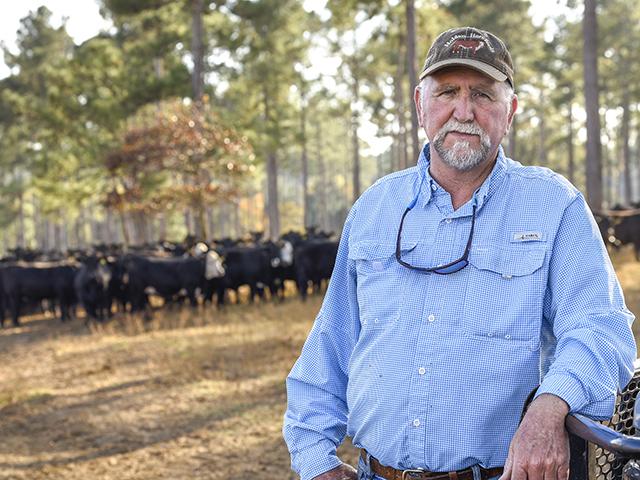
Not Matt Barnes. "I walk through and find what I consider my top 10 or 15 bulls. Good feet. Big tops and stout skulls, good bone. Good disposition. A bull needs to look like a bull. If he doesn't look the part, I'm not going to look at him twice. I think if we start giving up the basics on these bulls, we're creating more problems than we're going to help with the numbers."
Not that he ignores the data. "Once I pick out my top bulls, I start going through the indexes and try to put as many numbers on them as I can. But, no matter what those numbers tell me, if he doesn't pass my test of being a good bull, I don't have any use for him."
Fortunately, Barnes, farm manager for Simmons Farms, Sale City, Georgia, says the owners give him a healthy bull budget. That means he isn't shy about bidding on bulls in the upper percent of their breed for the economically important traits. "I like to be in the top 30% or above on weaning weights, yearling weights and on the carcass traits. If I can't do that, I at least want them to be above average."
A PLACE TO START
He starts his numbers search with weaning weight. The calves from Simmons Farms are preconditioned for around 60 days and hit 700 to 800 pounds before they sell in truckload lots through a video sale. "Then again, I also look at yearling weights, because I want the cattle to perform for whoever's buying them. I look at carcass traits, and in the last couple of years, I've really been pushing the marbling side on our cattle, so whoever buys them gets those real elite carcasses."
While he'd love to get feedlot and carcass data back, he says, "The only data I get is a check when they sell. We know our cattle go out and perform for whoever buys them, though, because we have the same people wanting to buy them every year."
Elk City, Kansas, feeder Flinton McCabe buys both commodity-type cattle as well as calves sired by his family's bull customers. He appreciates it when producers select for pounds and positive carcass traits. Specifically, he says, "Quality is a huge part of the grids, but in today's market, a lot of what drives grid profit is carcass weight."
P[L1] D[0x0] M[300x250] OOP[F] ADUNIT[] T[]
THINK ABOUT FEMALES
Back to Barnes and his bull shopping, he also pays close attention to the EPDs and indexes that affect longevity. "I think that is one of the most important traits in cattle today. We're getting the highest price we've ever had for cull cows, but there's still such a variance between selling a cull cow and buying a heifer or retaining a heifer. We need these cattle to stay here. If you've got a cow, and you have to cull her at 4 or 5 years old, and you have one that's 10 or 12 but still doing her job, how much more money have you made off the 10- or 12-year-old cow?"
Texas A&M AgriLife Extension beef cattle specialist Jason Cleere agrees. He says replacement heifers cost an estimated $3,500 to produce and $3,500 to $4,000 to buy, if not more. "We want to try to stretch those heifers out and make them productive as long as we can. So, longevity, or stayability within that herd, is extremely important." He adds, "It's the useful age or life of that cow. Is she going to have a calf every year, or are we going to have to cull her after five years because she missed a calf?"
Barnes says her ability to function on forage is part of that longevity. "She needs to raise a good calf every year. They can all look good when we have knee-deep grass, but just like right now, when we're in a major drought, and she's only eating hay, she still needs to stay in shape and breed back."
There is one trait the cattleman doesn't emphasize unless he is specifically looking for bulls to use on his heifers, and that's calving ease. "With my mature cows, I want a bull that's gonna throw a bigger calf. Any mature cow should be able to have an 80-pound calf. If she can't, she's not very much of a cow. Why would I want her to have a 60-pound calf? That's 20 pounds that I've got to pay for when it hits the ground."
Even with his commercial Angus, Red Angus and baldy heifers, he says, "I don't buy extreme heifer bulls. If I've got a bull with a birthweight of 70 pounds, and he has a decent calving ease direct (CED) on him, I'm fine."
Elk City, Kansas, purebred breeder Randy McCabe, Flinton McCabe's father, agrees. "A low-birthweight bull is a necessity when you're breeding heifers, but I try to steer our customers to the fact that if they're breeding cows, they need to have some birthweight. Just using a low-birthweight bull on all your cows is not an economically valid trait."
McCabe says he had a customer whose cows, mostly sired by McCabe bulls, started having calving problems. "For years, he would always buy the lowest calving weight bull in the sale. I went and looked at his cows, and they looked like black Jerseys. He had totally taken the internal dimension out of those cows."
LOOK AT THE BIG PICTURE
Cleere agrees there can be dangers to single-trait selection. "If we do that, we can get into wrecks," he says. However, he urges producers not to go to extremes either way, because genetic correlations can cause unintended consequences. "As we select for more growth, higher weaning weights, higher yearling weights, we can expect the potential for calf size or birthweight to increase, as well. There are curve benders, but in general, we have to be careful."
While there is no end to the data available, Cleere explains, "Economically important traits should always be a priority, especially in today's cattle market.
"We have high cattle prices, but we've got high input costs, and that's going to be more important as prices come down, because we know input costs are not going to come down," he adds. "Use genetic selection for these traits, and take advantage of heterosis."
Barnes is all about those traits, but he'll still look at the bulls before the numbers. "If that bull doesn't have good feet and legs, and can't get out there and get cows bred, nothing else matters, does it? It takes the basics to make the whole thing work. I think you can take any peg out of that, and you start getting really in trouble."
FERTILITY FIRST:
Researchers and producers agree when it comes to economically important traits that fertility is at the top of the list. No calf, no income. The challenge is that fertility is a lowly heritable trait, and it takes generations -- and patience -- to get very far with selection.
The good news is hybrid vigor. Texas A&M AgriLife Extension beef cattle specialist Jason Cleere explains that "the traits that really impact our bottom line, the fertility-type traits, as well as the survivability traits, are low in heritability, but we have to remember they also respond to crossbreeding."
He says research shows a bull of one breed bred to a cow of another will typically result in an increase of 8.5% in calf survival and calf growth. Breed him to a crossbred cow, and there is an average of a 23.3% increase not only in calf survival and calf growth, but in reproductive efficiency and hardiness.
In farm manager Matt Barnes' case, crossbreeding adds to the bottom line with marketing. He breeds Hereford bulls to part of his commercial Angus and Red Angus cows. The Sale City, Georgia, cattleman says, "That is the ultimate cow to me, a good baldy. I think they do so many things right. You can send the steers anywhere. And, if you ever want to sell the heifers for replacements, people are knocking on the door. They'll bring $50 to $100 a head more over a straight red or black."
[PF_0226]
(c) Copyright 2026 DTN, LLC. All rights reserved.