


Farm Groups React to FBA Payment Rates
Better Policies Needed to Boost Farmers' Bottom Lines Beyond Ad-Hoc Aid
OMAHA (DTN) -- Farm groups offered their gratitude after USDA announced the latest round of aid payment rates on Dec. 31, but commodity leaders said the Trump administration and Congress need to develop markets and pass policies to boost markets for crops as well.
USDA ended 2025 by releasing per-acre payment rates for $11 billion in the Farmer Bridge Assistance Program (FBA). As the program states, aid will be based on farmers' planted 2025 acres. Another $1 billion will be held back to provide aid for specialty crop producers.
The "bridge" is to get farmers to next fall when higher payments and reference prices under the Agricultural Risk Coverage/Price Loss Coverage (ARC and PLC) kick in.
The FBA payments come on the heels of the Emergency Commodity Assistance Program (ECAP), which paid producers $10 billion for losses from the 2024-25 crop.
No crop saw more impact from the Trump administration's tariff war than soybeans. Scott Metzger, an Ohio farmer, is now president of the American Soybean Association (ASA). Metzger credited the Trump administration and USDA for recognizing the economic losses, but said, "The payment rate for soybeans will likely not be enough for soybean farmers to keep their operations financially solvent as we move into the next planting season."
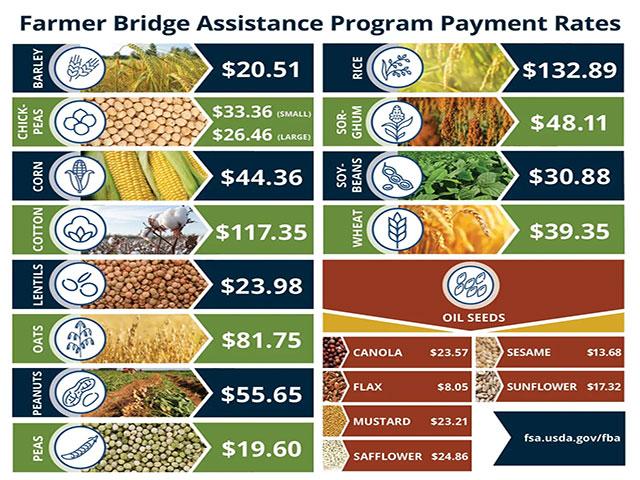
The payment rate for soybeans came in at $30.88 an acre though economic losses for soybean farmers were more than $100 an acre. At 81.1 million acres planted, soybean farmers will split $2.5 billion.
SOYBEAN FARMERS NEED RELIABLE MARKETS
Metzger said the aid will provide some relief, but "farmers need strong, reliable markets to guarantee the long-term success of the U.S. soybean industry."
Metzger called on the administration to focus on some domestic markets, which include finalizing policies that create a preference for soy-based biofuel feedstocks through the 2026-2027 Renewable Volume Obligations; boosting biomass-based diesel volumes; and finalizing the rules for the 45Z Clean Fuel Production Credit.
P[L1] D[0x0] M[300x250] OOP[F] ADUNIT[] T[]
"Reliable markets depend on policies that grow demand, strengthen rural economies, and provide certainty for the next generation," Metzger said.
DEVELOP MARKETS FOR CORN
Jed Bower, also an Ohio farmer, and president of the National Corn Growers Association (NCGA), had similar comments. With 98.7 million acres of corn planted, and an FBA payment rate of $44.36 a bushel, corn farmers will split nearly $4.38 billion in payments.
"While this financial assistance is helpful and welcomed, we urgently need the administration and Congress to develop markets in the United States and abroad that will provide growers with more long-term economic certainty," Bower said. "Corn growers have been sounding the alarm about the fact that farmers have been faced with multiple consecutive years of low corn prices and high input costs."
In its statement, NCGA didn't mention specific policies, but NCGA has been advocating for years that Congress pass year-round E15 as one way to boost domestic demand. Such a provision almost passed at the end of 2024, but was stripped out of a spending bill because Elon Musk used new-found influence with Congress and the incoming Trump administration to reduce the size of the legislation. E15 never went anywhere in Congress in 2025, though California passed E15 into law. The federal government and auto manufacturers also have let the E85 flex-fuel market fall by the wayside in recent years with no attempts to revise it.
LOOKING FOR ROBUST TRADE POLICIES FOR WHEAT
Wheat farmers ended with a payment rate of $39.35 an acre. With 45.3 million acres planted, that comes to $1.78 billion in payments. Pat Clements, a farmer from Kentucky and president of the National Association of Wheat Growers (NAWG), said wheat farmers are looking for regulatory certainty and "robust trade policies" to boost returns for 2026 and ideally help producers pay down some of the debt they have incurred the past few years.
"Wheat growers are closing the books on a difficult year marked by extremely high input costs and stubbornly low wheat prices," Clements said. "NAWG appreciates the Trump administration's response to the market challenges facing farm families and its efforts to deliver much-needed assistance. While the rates announced today do not come close to making wheat farmers whole for the per-acre losses experienced in 2025, the $39.35 per-acre payment for planted wheat will help lighten the blow of a challenging year."
NEED LONG-TERM SOLUTIONS FOR COTTON
Cotton farmers will see $117.35 an acre, or total payments of $1.09 billion based on 9.3 million planted acres. The National Cotton Council plugged the need for long-term solutions to increase domestic cotton demand such as passing the Buying American Cotton Act introduced by Sen. Cindy Hyde Smith, R-Miss.
"The FBA rate for cotton of $117.35 per planted acre offers critical support to growers as they navigate current market conditions and production costs," NCC said.
MORE AID NEEDED, RESTRICT RICE IMPORTS
USA Rice said the payment rate of $132.89 per acre encompasses long grain and medium grain, including temperate japonica, short grain, and sweet rice. With 2.8 million acres, rice farmers will share just under $374 million in payments.
Fred Zaunbrecher, Louisiana rice farmer and chair of the USA Rice Farmers Board, said the payments show Washington recognizes the challenges facing rice producers, but added rice farmers are facing significantly higher per-acre losses, averaging $364 an acre in 2025. He suggested more aid is needed for rice farmers to continue growing a crop.
"It is imperative that when lawmakers return in the new year, they work with USDA to provide an additional layer of economic support to ensure farmers can put a crop in the ground and realize the improvements made to ARC and PLC, which will come into effect in the fall of 2026," Zaunbrecher said.
During the announcement in early December that aid is coming, another Louisiana rice farmer, Meryl Kennedy, told President Donald Trump that other countries are dumping rice on the world market and the U.S. should be restricting imports of rice to help support the domestic growers.
Agriculture Secretary Brooke Rollins ended 2025 with a flurry of press releases, including statements advocating the administration is "putting farmers first." Among the statements were new research and development priorities that included at the top, "increasing profitability for farmers and ranchers." One suggestion was research into "reducing inputs or increasing mechanization and automation" to benefit farmers. Another priority included "expanding markets and creating new uses for these American-grown commodities."
See, "Farmer Bridge Assistance Payment Details for Major Commodities," https://www.dtnpf.com/….
Chris Clayton can be reached at Chris.Clayton@dtn.com
Follow him on X @ChrisClaytonDTN
(c) Copyright 2026 DTN, LLC. All rights reserved.