

Ag Weather Forum
Updated Nebraska Climate Outlook Shows Challenges to Corn and Soybean Yields
A new Nebraska climate change impact report published by the Nebraska State Climate Office points to more stress for the state's corn and soybean crops during the balance of the 21st century. This projection is one of many effects caused by greenhouse gas-enhanced persistent atmospheric warming around the globe.
The report, titled "Understanding and Assessing Climate Change: Preparing for Nebraska's Future", finds that growing seasons during the balance of this century will be erratic and challenging for crops. The 300-plus page report notes that "Nebraska's future climate will undergo substantial transformations through the 21st century. Statewide annual temperatures are expected to rise by 5 degrees F to 6 degrees F by 2050 and by 7 degrees F to 11.5 degrees F by the end of the century, relative to the 1950 to 2014 historical period." Temperature rises of such magnitude would put the Nebraska average annual temperature at around 60 deg F -- more than 7.0 deg F above the state average temperature during the 1930s Dust Bowl, and on par with the average temperature in Oklahoma.
Regarding crop-growing conditions, the report breaks down the potential for more exhausting heat. "Extremely hot days (greater than or equal to 90 degrees F) will multiply two to four times, while extremely warm nights (greater than or equal to 70 degrees F) could increase more than tenfold," the report said.
P[L1] D[0x0] M[300x250] OOP[F] ADUNIT[] T[]
The extreme heat prospects are focused on the summer and fall seasons and can threaten crops during pollination and filling stages.
When it comes to precipitation, the report calls for a big difference in seasonal precipitation along with heavy occurrences. Winter and spring amounts are projected to increase, but summer precipitation may decline by 10% to 20%. Meanwhile, "Extreme precipitation events, particularly the most intense ones, are expected to rise in frequency and magnitude," the report said. Extreme events suggest a flood risk.
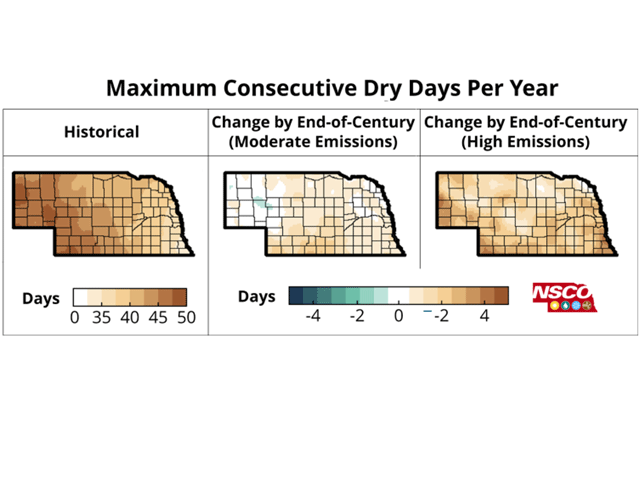
Meanwhile, summer dryness looms as a detriment to crops. "The maximum number of consecutive dry days per year (one indicator of drought) may increase by 5% to 10% by the end of the century, especially across the eastern part of the state," the report said. "The increase in extreme precipitation combined with longer dry spells has important implications for flash drought and flooding events."
The impact of these conditions could be significant to crop production. The Nebraska report cites research from 2023 which projects that "corn yields in the Midwest, including much of the geographic extent of Nebraska, could decline by 12% in the mid-21st century and up to 40% by the end of the century." The same research project found a mixed outlook for projected soybean yields; however, some forecast models point to soybean yield declines by the end of this century. These are not incidental impacts; Nebraska was 3rd in the nation in corn production and 5th in the nation in soybean production in 2024.
The Nebraska climate change impact report was produced by a multi-disciplinary team from the University of Nebraska-Lincoln, the University of Nebraska Medical Center, Creighton University, the Nebraska Indian Community College, the USGS Nebraska Cooperative Fish and Wildlife Research Unit, and consulting service Pale Blue Dot, LLC. Nebraska state climatologist Deborah Bathke and University of Nebraska-Lincoln extension meteorologist Eric Hunt spearheaded the project.
The full Nebraska state climate change impact report is available here: https://snr.unl.edu/….
Bryce Anderson can be reached at bryce.anderson@dtn.com
(c) Copyright 2025 DTN, LLC. All rights reserved.