

Replacement Heifer Dilemma: Buy or Raise Them Yourself?
Buy or DIY?
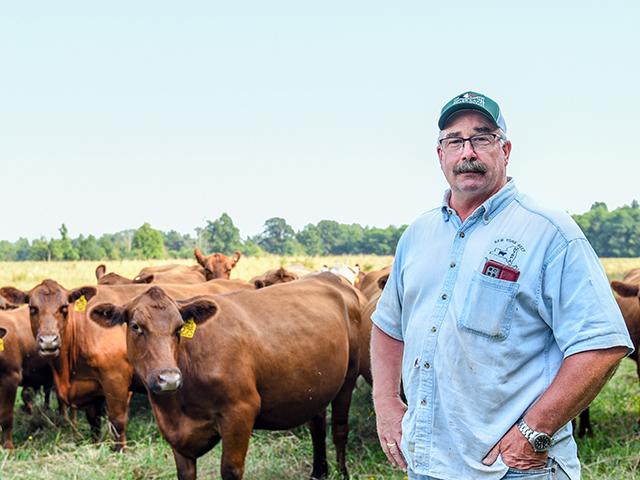
Last year, Terry Kirkland ended up with what could only be described as a gift. A doctor friend was getting out of the cattle business and specifically wanted Kirkland to have his replacement heifers. Kirkland quoted him a price under market value, but the 23 top-quality yearlings ended up in his pasture.
Even with that stroke of luck, ask the Batesville, South Carolina, cattleman whether he'd rather buy or grow his own heifers, and he doesn't hesitate.
"The main reason I want to raise my own is I can control their size and the genetics better that way. I run about 1,300-pound to 1,400-pound cows, and I don't like them any bigger."
He continues, "I make sure I have a good low-birthweight bull to put with them, so I know I won't have calving problems. When you buy heifers, a fella can say it was a low-birthweight bull, but you aren't sure sometimes. I know I'm able to tell more about the temperament, too, when I raise them myself. That's important for me when I have to tag the calves in the pasture. I don't need one that's gonna be running over me." The 71-year-old cattleman adds, "That's even with vaccinating and deworming them; you can't have crazy stuff when you get older.
"They are used to your environment," he continues. "I live in the sand land, and we have mostly bermudagrass and bahiagrass, and that's what they have to learn to live on. If you raise them on that, you can tell if they're gonna make it or not."
RAISED HEIFERS MINIMIZE EXPECTED PROBLEMS
Kirkland also says he can keep negative surprises to a minimum. "I'm not cutting buying replacement heifers, but you don't know about foot problems until they get about 3 years old." Since he has raised their dams and granddams, he's already culled problems out of his 120-cow Angus-based herd.
"I just like to watch the heifers grow into good mama cows," Kirkland explains.
In Branchport, New York, John Kriese has similar thoughts about his Red Angus, Angus and Hereford cattle. "We've been doing it for 50 years, so I've tried to keep all the gremlins out of the closet. I guess I could buy heifers. But, my question is, what did their grandmother do and their great-grandmothers, and what's going on in that pedigree versus my own?"
There is also the cost factor. Kirkland says that at this past February's Saluda County Cattlemen's Association heifer sale, both bred and open heifers averaged about $3,300. "I know I can raise them way cheaper than that," he adds.
P[L1] D[0x0] M[300x250] OOP[F] ADUNIT[] T[]
LOOK AT ALL OPTIONS
Curt Lacy, head of the Central Mississippi Research and Extension Center, needs to boost cow numbers at the station and is mulling over the buy versus raise-your-own decision. He agrees with Kirkland's and Kriese's reasoning. However, his background as an ag economist surfaces when he starts putting numbers on a spreadsheet. First, there is the cost of the potential replacement herself, or in economist-speak, opportunity cost. In late spring, actual auction numbers for 5-weight heifers were between $2.75 and $3 per pound.
Then there are the development costs. "What's it going to take to get her from weaning to the time we're ready to breed her?" he asks. "There is pasture, hay, supplemental feed, minerals, weaning vaccinations, anything that's going to be a part of that growing program." Lacy says it all counts, even minor costs such as ear tags. Then, there are interest costs, whether you borrow the money to develop her or not. Just to get her to breeding age and weight, he comes up with an average of $750.
The bull, or bulls, add a tidy little sum, especially if you only have a small number of heifers. By the time she's bred, Lacy comes up with a cost of $3,000 to $3,500 up to $4,000, and that's taking out the income from culling the open heifers.
It isn't all about the numbers, though. Lisa Kriese-Anderson, retired Auburn University animal scientist, as well as John Kriese's sister, says, "For the commercial guys who are interested in genetics and are going to take the time to buy good bulls and keep records, I suggest they keep their own. But, if that's not their thing, they just need to buy them."
Kirkland, the South Carolina producer, adds, "Unless you have the extra pasture for them and the right setup, it is better to buy them. You can't put them with your mama cows and expect them to grow."
Lacy says, "There's really no right or wrong answer. The right answer is the one that works best for you."
THE BEST OF BOTH WORLDS
John Kriese is passionate about raising quality heifers. However, the cattleman has a list of challenges that go along with developing replacements. "I am not a farmer; we do not grow our own feed. I don't have the land, the machinery or the interest, so I buy most of it."
Recently, he started getting a tube of corn silage custom-harvested. However, his supplemental forage and feed usually consist of round bales of hay (purchased and homegrown) as well as purchased protein pellets and corn.
The perfect compromise, at least for Kriese, is to send his heifers out to be developed. For the last eight years, his Angus heifers have gone to Pennsylvania State University's heifer development program. The rest of the time, they stay at the farm of his business partner, 80-year-old veterinarian Timothy J. Dennis. Sending them off to be developed and bred means one less group of cattle he has to feed and manage.
The Red Angus heifers go to Jason TenEyck, who also develops heifers for other members of the New York Red Angus Association. Kriese's weaned heifers go to the Waterloo, New York, facility around Nov. 1 when they weigh 550 to 600 pounds. He brings them home the end of April weighing 900 to 950 pounds. Currently, Kriese breeds them himself when he gets them home.
"I think Jason can develop those heifers cheaper than we can," for $2.90 per head per day, he says. "He has beautiful facilities, they are superclean, and he has really high-quality forages." If Kriese developed them himself, he estimates he would invest around $1,000 per head.
While many of the university-sponsored heifer development programs collect data on the heifers, including reproductive tract and disposition scores, the New York consignors stick with the basics, weighing the heifers every 28 days. The producers also go in together and have an ultrasound technician do carcass measurements. Kriese says this would be cost prohibitive for smaller producers to have the technician come to their individual operations.
Even better, farming his heifers out for development means he's been able to expand his cow herd to take advantage of the record-breaking cattle prices.
Kriese adds, "It also allows you the opportunity to reflect on your breeding program.
"Your heifers are in a pen with heifers from other breeders. How are they doing? How do they look? It gets us through mud season," he adds.
**
FOR MORE INFORMATION:
-- Replacement Beef Heifer Development, Brandi Karisch, Mississippi State University: https://extension.msstate.edu/…
-- UF Replacement Heifer Cost Estimation Tool, Hannah Baker, UF-IFAS: https://rcrec-ona.ifas.ufl.edu/…
-- Raising Versus Buying Heifers for Beef Cow Replacement: https://www.extension.iastate.edu/…
[PF_1225]
(c) Copyright 2025 DTN, LLC. All rights reserved.