

Kansas Family Thrives After Turning Off Irrigation
Going Dry
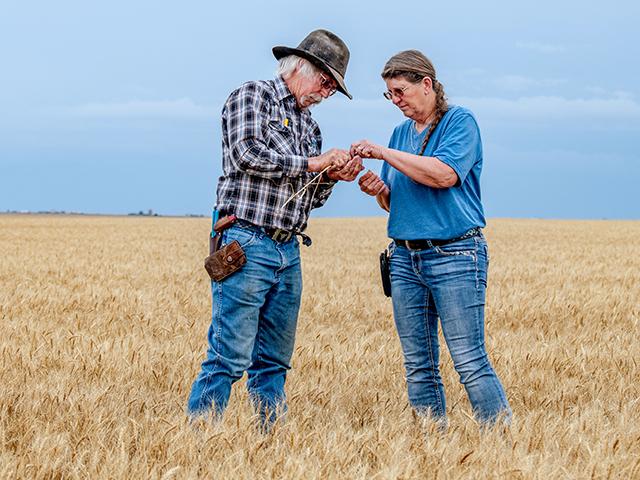
Monday, June 2, 2026, was a good day. Steve and Kathleen Arnold sat together on the porch behind their house, outside of Johnson City, Kansas.
It'd been so long, so rare, and now they couldn't help but grin widely.
For the first time in months, it was really raining.
And, for a family that's bet everything on rain in a corner of the world where it doesn't seem to come often enough -- the annual average is just 17.5 inches -- there's nothing sweeter.
Like most farm families in the far southwestern corner of Kansas, the Arnolds long relied on irrigation for a portion of their crops.
Unlike most farm families, however, they decided to turn the water off 18 years ago, even though the water still flowed and it meant changing everything.
Now, as they work to pass down the farm, they are convinced that even where it rarely rains, a prosperous farm and a fruitful life can grow.
"We're a lot happier, and, we have a lot less stress," Steve says before pausing midthought. "Well, except when it doesn't rain. That was a stress that irrigation could take away; but for us, the cost was still too high."
HIGH TECH, OLD SCHOOL
The Arnolds are old-fashioned and cutting edge, new age and deeply rooted. Dinner table conversation drifts from AI-powered sprayer technology to conservation practices to the inability to stream vintage TV shows and the National Finals Rodeo. A rehabilitating pigeon -- saved from an unfortunately placed nest in a grain bin hatch -- may sweep through the room at any moment.
Steve's a tinkerer, quick to invest in the latest technology or try a new idea. To him, turning off the water was like adopting a new gadget: another stab at improving life on and off the farm.
The couple ran 10 irrigation circles when they flipped the switch in 2008, but several of those were struggling to produce sufficient water. They'd already abandoned three others.
Only 20% of their roughly 9,000 acres were irrigated. While that ground grew the best crops -- netting a 204-bushel-per-acre corn yield in its final year -- it also demanded the hardest work and caused the biggest headaches.
P[L1] D[0x0] M[300x250] OOP[F] ADUNIT[] T[]
The inconsistent flows required constant monitoring and frequent repairs, interrupting sleep, track meets and even family weddings.
"I had a lot of sprinklers," Steve says, "but I didn't have many friends."
Even with five full-time farmhands, it took a toll.
"We're busy now," Kathleen says, "but not nearly as busy as before. Changing water, changing heads on irrigation engines, flat tires ... I'm grateful for no irrigation."
A NEW WAY
Aquifer levels vary widely across Kansas, but the decline of Stanton County's underwater reserve has been documented since the 1930s.
Arnold figured it would take 10 years of solid water flow to justify the expense of digging a new well, and in 2008, that prospect looked unlikely.
"We saw the writing on the wall," Steve says. So, they cut off the wells they had. Some were dismantled and taken off the property, others left as they were; but all were stopped. The hardest part was telling the landowners. The necessary operational changes were easier.
The Arnolds stopped replacing farmhands when they left and now run 8,000 acres with just family. They've changed from irrigated corn and milo to dryland wheat and milo.
"We slowed the pace down," Steve says. "That allowed us to focus more on the details. We had time to take better care of equipment. We were able to try new things and dig into research."
They bet heavily on regenerative agriculture, cover crops and rotations.
"Before, it was fixed in the same rotation. We didn't feel like we had any options," Steve says. "Now, we're learning there are better ways. I still feel like I'm just starting on the farm again."
They drive older equipment with less help, but they feel like better farmers.
"We don't handle nearly as much cash as we used to. But I do think we get to keep a little more of it," Steve adds.
Now, the looming challenge is passing those lessons on to family members who've never known any other way to farm.
A NEW GENERATION
Tess (Arnold) Heier, Steve and Kathleen's fifth and youngest child, was a toddler when the irrigation decision was made. Returning to the farm was always her goal, and after two years in an agronomy-focused college program, she did, with soon-to-be-husband, Ryan Heier.
The couple, in their early 20s, are just as passionate about showing that dryland farming can be sustainable in Stanton County, where the population has waned in recent decades.
They intend to ramp up soil health and drop some inputs. The farm has cut about one-third of its synthetic fertilizer in recent seasons without losing yield. As early adopters of Precision Planting's SymphonyVision sprayer system, they hope to slash herbicide use, as well.
"We are just extremely lucky to be in the position we're in, the way they have set us up," Ryan says.
Nearly two decades after turning the water off, the Arnolds have no regrets.
They've learned more about farming and being good stewards of the land. They've learned more about the needs of their crops and their family. And, they've learned there's little in life quite as sweet as sitting on the back porch listening to a good rain.
"I'm still figuring it out," Steve says. "I've always wanted to farm for God and do the right things for the soil, and not just be the greedy farmer using everything up."
**
-- Follow Joel on social platform X @JReichPF
[PF_1026]
(c) Copyright 2026 DTN, LLC. All rights reserved.