


Rotational Grazing Plan Restores Prairie Grass Pastures
Pasture Resurrection
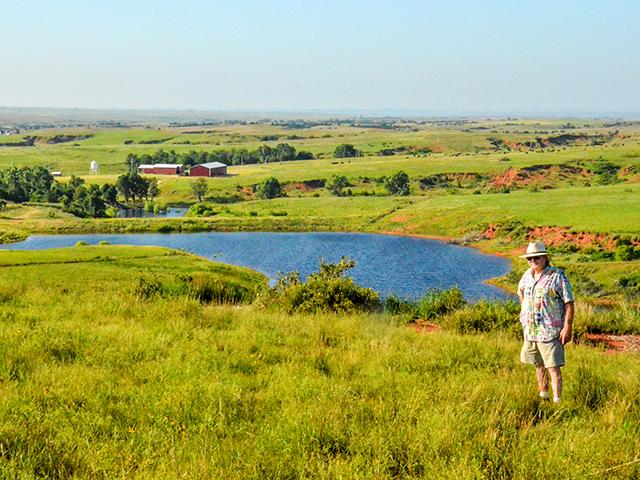
It's sunrise in mid-July, and Terry Hodgson stands outside his 1-ton Chevy truck blowing a siren to gather 500 stocker heifers scattered over 200 acres of lush warm-season native grasses. There's still plenty of forage on the rolling hills interspersed between rough canyons, but Hodgson's not greedy. He knows the grass must rest despite the herd only spending a couple of days here. It's time to move.
For Hodgson, a retired 26-year Natural Resources Conservation Service (NRCS) employee who began his career in Texas and then southern Kansas, the cattle are a harvest tool.
"For me, it's all about the management of the grass," he says of his northwest Oklahoma land that has been in his family for more than a century after his great-grandparents settled there. A sense of history runs deep on the Hodgson Ranch, with a limestone marker at the headquarters gate commemorating the four generations of the ranch's continuous cattle production.
The herd of 800-pound spayed heifers scrambles down a hillside road to the gate, collectively convinced of better rations in the next enclosure -- one of a dozen similar crossfenced paddocks on Hodgson's primary 2,100-acre operation north of the small town of Freedom, Oklahoma. The ranch also includes an additional 600 acres some distance apart.
FORAGE PAYBACK
This year, abundant and timely rains fueled extraordinary forage growth. Thick stands of big and little bluestem, switchgrass and a growing population of Indiangrass showcase more than 15 years of Hodgson's concerted effort to resurrect the ranchland from nearly a century of selective, continuous grazing by his family's cow/calf operation.
"We're just now seeing ample evidence of significant improvements in species diversification," Hodgson explains, noting the prairie grasses have come back naturally with no reseeding.
"Primarily, we see more tallgrass species, which tells me we're on the right track," he adds. The desirable natives began returning with Hodgson's ultrahigh-density intensive-grazing management as increased hoof action from the higher animal densities stirred the long-dormant natural prairie grass seed bank. Grazing today sees hundreds of thousands of pounds of animal density on the land for short periods in small paddocks compared with three to four animal units per acre grazing year-round over the entirety of the ranch during the cow/calf days.
P[L1] D[0x0] M[300x250] OOP[F] ADUNIT[] T[]
In addition to improving the rangeland, this year's custom-grazed heifer herd averaged 2.1-pound-per-acre gains per day over 120 days when they shipped July 31, a rate generally thought very productive for steers grazing lush, early-season forages.
Under Hodgson's management, the grass in each of his 150- to 200-acre paddocks gets roughly a month of rest before the herd returns to graze fresh growth. The stockers graze no more than three to four days on each paddock before rotating to fresh grass. By ending all grazing in late summer, the grasses have ample time to store carbohydrates before winter, he explains.
Hodgson's tools of choice to restore the grassland include intensive grazing along with timely occasional mowing to encourage pasture species diversification. While he's not against using controlled burns for brush control, primarily cedar, he chooses not to. Instead, he'd rather leave the carbon where it grows -- sequestered in and beneath the paddocks, a stored resource to be marketed under future carbon credit trading.
"Since I retired in 2014, custom-grazed stockers have taken the place of cows and calves my parents used, and grazing has been confined to mainly April through August," Hodgson says, noting he returned to the ranch that year at the request of his parents, who wanted to retire and knew his knowledge of new methods of resource management could ensure the operation's survival.
"In recent years, August has been challenging because of drought," Hodgson says. "This year, we decided on an April 1 to July 31 grazing season, giving the grass 30 more days of recovery before frost."
Citing a severe lack of qualified and motivated labor, Hodgson developed his business plan around his own labor and that of part-time help when it's available. He has successfully, and profitably, been leasing his pastures on a per-head per-day basis for 12 years. "After July 31 this year, I'm a free man until next spring, barring any improvements and upkeep that might be needed," he says with a laugh. "And, my dream of restoring these hills to their native state just keeps coming true. Plus, I don't have the risk of owning my own cattle."
Hodgson's agronomy degree and more than a quarter-century facilitating educational programs and field days with NRCS and the nine-county South Central Kansas Residue Alliance have equipped him well to manage his "guest" herds. The potential gains on Hodgson's pastures provide an attractive proposition for those seeking summer grazing, and almost daily close encounters with the herds at each rotation gives him a chance to catch and treat the sick ones. This year proved a busy one for treating foot rot problems caused by frequent wet conditions, he explains.
ENTER WHIP
Before Hodgson took over management of the property in 2014, he was instrumental in managing the land's upgrades for his parents with a USDA-NRCS Wildlife Habitat Improvement Program (WHIP) project that ultimately made his business plan viable.
"From 2009 to 2014, we mechanically removed roughly 300 acres of eastern red cedars from the property, which freed up many acres of grass production in all but the canyons," he explains. They installed more than 8 miles of underground plastic pipe and 14 rigid fiberglass stock tanks in pastures that lacked surface water ponds or solar-pump systems. And, they crossfenced the ranch into the 12 main pastures that are now being grazed.
The water system draws from a more-than-century-old spring-fed reservoir and supplies the water tanks in 12 pastures through 2-inch main lines. Pastures at the high end of the ranch, 200 feet above the spring, are automatically fed by a high-pressure booster pump controlled with a pressure-sensitive switch.
GROWTH AND MAINTENANCE
Although Hodgson doesn't practice controlled burning, he says because of the thoroughness of the original mechanical cedar eradication project, he's seen little re-encroachment of cedars.
"I do keep an eye on the pastures and try to keep lighter-grazed areas mowed to even up forage production," he says. "In one pasture, I had a dominant stand of little bluestem, and after mowing it, I've found an increasing number of additional tallgrass species emerging to provide cattle a much better grazing choice."
The many steep-sided canyons lacing their way through the ranch topography remain havens for hardwoods, cedars and brush species such as smooth sumac and sand plums.
"I've already contracted a spring-applied aerial application of a brush mix of chemicals for those brush-infested areas," Hodgson explains. "Like I said, I don't want to burn because I just don't see releasing all that carbon into the atmosphere. I figure my mowing and judicious aerial spraying at about $20 per acre compete well with the cost of burning."
While Hodgson's methods are different from his forebears on the land, looking out over the green-covered hills and working with slick, fast-gaining stockers every day, he says he's confident his grandparents would be proud.
And, looking back at the time he's been managing the ranch for the family, despite several years of very dry conditions in western Oklahoma, Hodgson says he's also fulfilled the wishes of his parents.
"They wanted me to come home and apply my knowledge and understanding of resource management so they could retire and watch the new stewardship further enhance the family ranch," he says.
[PF_1225]
(c) Copyright 2025 DTN, LLC. All rights reserved.