


Factor in Living Expenses When Developing a Compensation Plan
Hidden Benefits
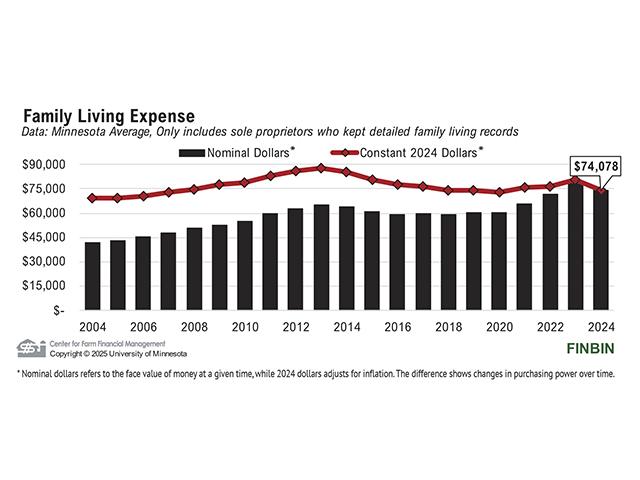
Farm families are having tough financial conversations this winter, but Lance Woodbury suspects one topic not being discussed is family living expenses.
"We tend to focus on where the big dollars are," says the Pinion Global family business consultant and columnist for DTN/Progressive Farmer. The expense of family living may pale in comparison to the price tag on a new combine, but when several families are living out of the business, that number becomes harder to ignore. It can also become more contentious, he says.
The University of Minnesota Center for Farm Financial Management says sole-proprietor farms spent $74,078 on family living expenses in 2024. While that's 5% lower than the previous year largely because of cutbacks in household repairs, recreation, gifts and "miscellaneous," it's still higher than the state's average net farm income of $67,890.
"A lot of our family expenses get buried in the business," Woodbury says. When the farm provides housing and transportation for key employees, which are also often owners, it can deduct those expenses from its taxes, but it "works against having an easy conversation about what we're living on."
DON'T ACT LIKE FAMILY BUSINESS
As farmers review their year-end financials and prepare for another year of narrow to negative profit margins, Woodbury encourages farmers to think about what they'd do if they weren't a family-run business.
"People don't really have a separate and distinct conversation in the management circle about what are we going to pay, and then it gets clouded up by discussions about what can the business afford," he says. "The reality of it is, if you were not in an ag family business, and the business can't afford it, you would lay people off."
Rather than firing family, most ag businesses elect to cut costs, reduce pay or put the remainder of what's needed on the operating note. Those strategies can lead to resentment and misunderstandings, Woodbury explains, especially when they're not communicated clearly.
Creating a formal compensation plan can not only help put the value of nontaxable benefits into perspective but can also help the business identify areas of additional savings. "Sometimes, to be a good family business, don't act like one," he says.
CREATE A COMPENSATION PLAN
P[L1] D[0x0] M[300x250] OOP[F] ADUNIT[] T[]
Dick Wittman, an Idaho farmer who has been consulting on farm finances for nearly 50 years, says most farms take advantage of tax-efficient compensation strategies but don't realize how "many of the hidden benefits that are furnished by the farm are truly compensation." One of the first tools he created in his consulting career was a compensation spreadsheet that quantifies the tax-deductible benefits as well as the hourly wage or salary of the employee.
"A lot of people think they're only taking $30,000 a year out of the business, but they're really drawing $60,000 or $70,000 compensation packages if they look at what they would have to make off-farm," he explains.
Wittman suggests starting with a market-based assessment of what a similar role would pay or what the farm would need to pay if it had to hire a nonfamily member to do the job. Once you've developed the total level of compensation, you can work backward through the benefits offered.
"Farmers have tremendous flexibility to do a cafeteria plan, because everyone coming to you has a different set of circumstances," he says. If the manager gets insurance through his spouse's off-farm job, or a manager has a horse that's boarded and fed by the farm, for example, that benefit could be offset somewhere else in the compensation package.
"Once people quantify where they are, then they can start looking at where the inequities are," he says, adding that it's a valuable tool to address concerns about fairness.
SEPARATE RETURNS
Wittman says most farm businesses he's worked with struggle to delineate between what counts as a return to labor and management, and what's a return to the ownership of the business.
"It's really important to have a policy that says we're going to pay a fair, competitive wage first, and then the money that is made in the business over and above compensation, it belongs to the owners and the shares of ownership they have," he says. That eliminates the temptation of giving large pay increases or bonuses in highly profitable years only to reverse course and pull back when the market changes.
Clear compensation plans can also help bring the next generation on board, especially for third-or fourth-generation operations that have cousins working together.
EXPENSE AND REIMBURSEMENT POLICY
Both Wittman and Woodbury agree on establishing a clear expense and reimbursement policy.
"It's not easy to get there because everybody's buried their stuff in different parts of the business," Woodbury says. "That Amazon purchase I made on the business's credit card -- was it really for the business? If it's personal, we tend to just throw it in the category of maintenance and repairs or office supplies."
One farm he works with has a weekly meeting to review expenses, and each person who submitted an invoice must defend the purchase. While that may not be a perfect option for all farms, "If you've got to defend it to other people, it makes you pay attention to what you're spending," Woodbury says.
Wittman says every farm needs a clear policy on what expenses go on the company charge card as well as a consistent, predictable reimbursement policy.
These conversations can be hard, Woodbury says. He suggests having a designated family meeting -- not on Christmas or part of the family's holiday plans -- to discuss what expenses are allotted to the business and what needs to be paid for out of individuals' pockets.
"Your accountant and lender can be wonderful resources in that conversation," he says. "They're usually financial wizards. Use them."
**
-- To download Dick Wittman's compensation worksheet, click this link https://wittmanconsulting.com/…
-- Follow Katie on social platform X @KatieD_DTN
[PF_1225]
(c) Copyright 2025 DTN, LLC. All rights reserved.